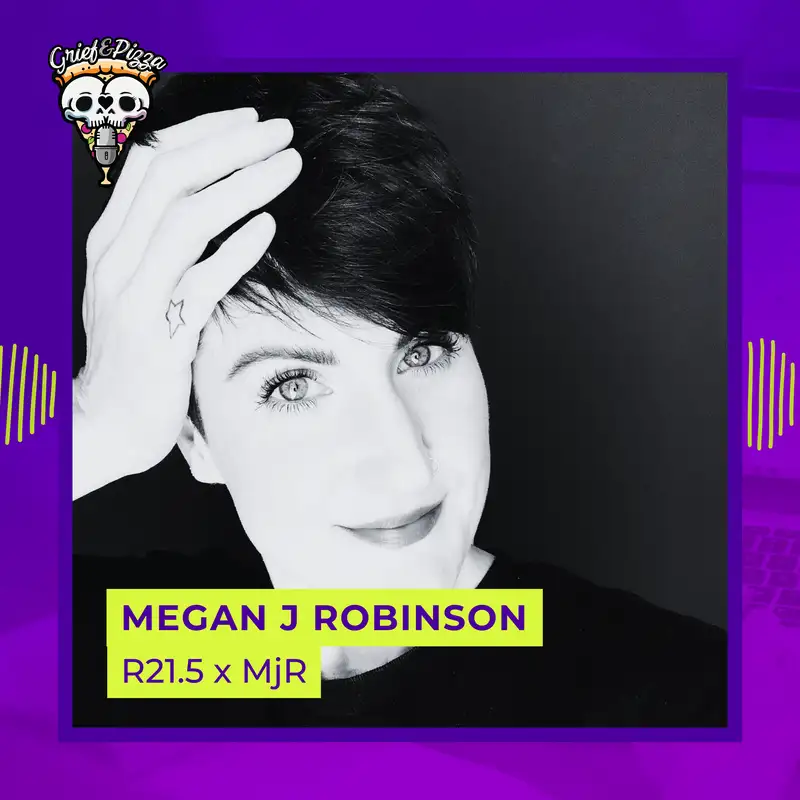
Reimagining Being Human with Megan J. Robinson
You're listening to Grief and Pizza, a podcast exploring the highs and lows at the intersection of business and emotional well-being. In this episode, we chat with Megan J. Robinson, a guide and leader who helps people and organizations rediscover how humans actually work so they can live and lead with purpose. We explore themes like the impact of AI on identity and purpose, the role model crisis, and the need for authenticity and vulnerability. We also dig into the significance of community, feedback, and sustainable systems in navigating life's complexities.
Marie:Megan also shares her perspectives on the evolving nature of work and creativity, advocating for a more fluid approach to goals and purpose. Purpose. I don't know. It's been like what, maybe seven or so months ago, Megan, that we were talking about our favorite tacos and talking about our businesses. And doesn't know you and didn't have the pleasure of having that conversation with you.
Marie:So I'm excited for both of you to get to know one another because there are so many themes in your work that I think feel super aligned with the kind of conversations that we want to be having. Like you're writing every time I like read one of your titles, I'm like, oh, that's it. I'm really excited to dig into some of these themes. It looks like you're also seeing these changes that are happening and the themes of alignment and purpose in your work. So I'm excited to dig into some of these things.
Marie:So I don't know, maybe you can give a little bit of high level overview of the work that you do today. And I want to dig into a little bit of some of these influences that have kind of brought you to today. So for, you know, anyone that doesn't know your work, how do you describe yourself today? What is your purpose?
Megan:Yeah, it's been a lifetime journey, really. Think, you know, kind of settling into who I am and what I think my unique space is in the world. And I think there's just been so much, especially with AI conversation that's come up in the last couple of years that just, just really provided a great foil, I think, to some of the conversations that I think people are wanting to have that I've been curious about having. Every story needs a good villain and, not that I want to make AI this villain per se, but it's a good, like I said, it's a good foil. And so it really brought home to me that the thing that I love talking most about is who are we becoming?
Megan:And that's why there's one little segment of my essays that's called Human Becoming and the COM is in parentheses because we're human beings. We're here, we're doing our thing right now and we're also along the way. We're also in this process of transformation and learning. And I think one of the things that I have especially been seeing a lot is people are just feeling really at a loss for vocabulary, for tools, for practices, for people with whom they can travel safely and wisely and to whom they can speak effectively. Know, there's, I think one of the things that's been interesting is just kind of this, I don't know if I want to say fracturing, but maybe multiplication of vocabularies in a lot of ways where, or multiplication of meanings.
Megan:And so, it's just kind of my effort at saying, okay, when I say these words, this is what I mean. When I bring these people in front of you, this is why they're connecting with these words. I think that they're really living it out. So that's a very high level overview. I'd love to hear how that strikes you, what you guys have been thinking as well.
Marie:Oh, yeah. Mean, AI piece, I think, is definitely a pretty interesting one that we're just really curious what other people in a similar space, people who are coaching other people, people who are desiring purpose in their work, what are the themes that we're all kind of noticing and how is the proliferation of AI shaping the way we're thinking about those things in those conversations. So it's something Ben and I over coffee many mornings are having these conversations about the sort of ups and downs of frustrations. Then like you said, investigating, is this a villain? Is this, what is this?
Marie:Is it an opportunity to go deeper and ask like, does it actually mean to be human? What is important in our lives? How do we not get distracted by these things? The sort of feeling like we need to keep up, we need to keep up and it's moving faster and faster. So I'm really curious about what are some of these things that you're noticing even in your own work?
Marie:I noticed at the bottom of some of your posts, you've sort of clarified even, Hey, you know, I've used AI to, to maybe edit this after I've done the writing, right? This is not a thing I'm using to generate my thoughts. And I think the depth of your work speaks to the fact that it's coming from your personal experience. And I think that's probably why I resonate with your work. Like I can see the human behind the work.
Marie:And so I'm curious if you're maybe noticing what feels like a lot of cookie cutter sort of copy paste that this could have been generated by anyone. You could change the author's name and it, there's a sort of generic feeling because it's coming from this big average of information. So I'm, yeah, I'm just really curious to dig more into your thoughts around it.
Megan:I'm glad to be having this conversation because I really swing between two thoughts. One is it's really not that big a deal. And the other is it's something. There is clearly something there. And the reason why I think it's not that big a deal is it's just a bundle of if then statements that, you know, but who, who was the sci fi author that said, you know, any, technology sufficiently advanced begins to look like magic.
Megan:So it's just such a complex bundle and snarl of algorithms that nobody can make heads or tails of it. So it feels very mysterious and it feels very magical right now. So on the one hand, I'm just like, that's at its core what we're looking at when we say generative artificial intelligence. And I love the word you pulled out, the average of what human beings have created. And on the other hand, there is this sense that it's doing something.
Megan:You had sent me, Marie, you had sent your 25 in review and some articles and media that you had really enjoyed. And there was one article that was the conversation or the question we're not asking in the AI. And the author had made the point, like, we're not talking about the good life. We're not asking what is the good life? And we're not asking what is human flourishing?
Megan:What's human life for To begin with, you know, what are we here for? And then what kind of life are we here to live? And I think that that's exactly the question I'm asking. That's the question that I'm exploring. And I think that's exactly the question that AI is almost forcing on us.
Megan:And I think it's one of those things. I was thinking about it too, in terms of, I think the pandemic really kind of ripped that veneer off of, in the sense that the kind of work that we're doing and the ways that we're spending our lives are, you know, there's just, there's always been this underlying sense like, what's it for? What's, what are we doing? And I think the pandemic and now the AI conversation is just really accelerating that sense of there's a lot that we're doing that may be kind of useless or maybe just kind of busy work or it's not really producing anything. So then what are we here for?
Megan:And so if there is work that AI can do that humans have been doing and what is the human being for? And I mean, I'm coming from the faith tradition I do, I'm like human beings are irreducibly wonderful and weird and, and working for quite a lot. So, yeah. So I think that that's the thing that I'm, I'm seeing is it's just forcing that question of what is a human being here for? What is a good life?
Megan:What does flourishing look like? And at the end of a period of time where we've been told, this is what you're here for. This is the kind of work you're here to do. This is the kind of thing you're here to produce. And now we're finding, that doesn't really fit as well as we thought it did.
Megan:So, I'm curious what you guys think.
Ben:One of my favorite sense makers, Daniel Schmachtenberger, he talks a lot about this concept of the difference between the technological progress versus technological betterment and one of the things that I've been exploring this year, like I have my word of the year is this idea of discernment and I think that a lot of folks don't really have the models or even building these languages to even discuss how they actually sit in this thing, it's basically everyone feels like they're being accelerated by technological progress but we don't have this moment where we can sit and anchor ourselves and understand what of this is actually beneficial to me as a human being versus just getting more work done and I'm really curious about your sort of anchoring your work in the faith based traditions and basically you had like a thing, I was looking at it about you know, your coaching is sort of targeted to exhausted Christians and one thing I'm noticing about this AI thing and I often refer to progress in the concept of an egregore, which is like a sort of god or like a force that becomes really prevalent in people's lives because a lot of people are, so to speak, worshiping it.
Ben:And I wonder how you see the conversation of religion and faith being sort of creating this weird reality distorting effect for a lot of people and I feel as though a lot of people are moving more towards machine orders and more of a worship of capitalism and progress over something that's embodied and sort of anchored in the body and in our communities and things like that. Is that something you're also seeing in your work? Like specifically, it's so different because I don't really have a really religious background so Sure. But it's so interesting to me seeing the parallels in all forms of faith right now.
Megan:Yeah, yeah, oh what a fantastic question. Oh my goodness. Where
Marie:do we begin?
Megan:Yeah. My specific faith background is American evangelicalism, which is something that I have a lifetime of very weird relationship in that it was both wonderful and life giving and also in fantastic relationships while also being in a system that was very dysfunctional and in sometimes actively harmful. And so part of my own experience in navigating and coming to this position has been like, what do I do with this tradition that has so formed me? And now that I'm kind of out of it in some respects, what does it say? Does it have anything to say to me, to the people that you described, Ben, who are kind of adrift, who may not have a religious vocabulary.
Megan:The author David Foster Wallace talked about everyone's gonna worship something. Question is, what is it? What is it that you are choosing to elevate to that status of defining your purpose, defining how you have opened the world? And one of the things that I'm seeing from the evangelical tradition is unfortunately, the majority of public thinkers, the speakers who are shaping a lot of ministry and talk are not grappling with the full implications of AI, of transhumanism. And I'm not trying to belittle this in any way but with IVF, like that's the prime conversation.
Megan:That's the prime technology conversation. And I think it's a necessary conversation that is not part of ours, but it's part of that technology and it's part of how do we interact with technology. And there are some thinkers. There's one, Jason Thacker is Christian theologian who's done a lot of work on technology and AI and just really trying to help Christians in that faith tradition or in the evangelical tradition think more intelligently, more coherently, more incisively. And it is something where a lot of people are like, oh cool.
Megan:This new tool that seems to know me better than I know myself. It really doesn't. It's just very, very good at mimicking and you know, it's almost like those astrology horoscopes. You can almost read into any of it, what you want because you're, you're bringing your own lens. Let me pause there.
Megan:Is there anything that I've said that worth tugging on?
Ben:No, think it feels really representative of, of a thing that I think happens with all large organized groups and I think you talk about this on your website a little bit around the institutional delusionment and I, not to speak out of term, but I think that that often happens in evangelical spaces and you kind of reference that in terms of saying, there's some really beautiful things in community here that can happen, but there's also the underlying organizational principles that can kind of bring with it a lot of harm. And I think that I feel personally that that's a lot of what we're seeing with AI where we're having a lot of folks that are absolutely finding real purpose with this stuff and being able to create from kind of a space of speaking something into the world and being able to create without having to you know navigate complex technical tooling, know. I see the things that I've been working and building for years now, people can just do that without any kind of specific technical knowledge and it feels like it's really difficult for me to feel this sense of excitement for those that can now create beautiful things that only were limited to the technical folks but also feel like my sense of being disillusioned with the way that it's being delivered to people and we talk a lot about where the value lies in the creative output.
Ben:Where is the value being captured? Is it actually being captured by people that are creating music and images or is it being captured at the institution level? Who is capitalizing from the tools existing is the thing that I'm talking about a lot and that's where I feel really disillusioned we're being told that you know, oh you individually can have these beautiful experiences with this technology but who is it actually benefiting at the end of the day and I think about that with all sorts of organized religions and things like that, where is the money going? Who is benefiting from your involvement and your building of this community? Yeah.
Ben:So yeah, a lot of parallels I think
Megan:Yeah.
Ben:In faith and technology, interesting stuff.
Megan:Yeah. I was thinking about that in terms of like prepping for this conversation and thinking about my own experience. So, as I said, I grew up in faith tradition. I have family who are in ministry. I have friends who are in ministry.
Megan:I worked for a large mega church on the East Coast. I went to seminary, so I was a student. I was a staff on seminary. I went to another seminary. I was staffed there, admissions, recruiting, executive leadership.
Megan:So I'm just establishing my bonafides and I know this world. I joke that there's a proverb, those who love the law and sausages should watch neither being made. And I joke that you should add like theology and ministry to that. You know, because if you really love something, maybe don't get in the mess of it. Like if you want to keep a pure and perfect love for a thing, maybe don't get involved in the messiness of it.
Megan:Like I said, you know, wonderful, beautiful relationships. So formative also in a system where there's such a potential for exploitation for manipulation. And I think that's not unique to the tradition that I was in. Unfortunately, we've seen, we've just seen that in so many arenas and people feel like there's a tension between spiritual, like working in spiritual, like ministry and earning money. And I've grappled with that.
Megan:And I think that's why you need accountability and transparency in how you're setting things up. And I've experienced what happens when money has become first deciding factor and who gets in to a degree program, how you get in. And I've seen what happens when money is the gift. It becomes the gift that lifts someone else up and helps someone else get through. I am a recipient of a gift.
Megan:I was very poor in grad school and to this day someone paid my rent one month and I have no idea who.
Marie:Wow.
Megan:Money is the gate and money is the gift. And so all of that to say, I don't know what I'm trying to say. You might want to cut this section out. You're good. You're good.
Megan:But I do understand why that disillusionment because faith traditions make a claim about reality, right? They say reality is a certain way. It does certain things. It creates certain parameters. And then faith traditions make claims about how you should live within that reality.
Megan:And I think one of the things, especially from my perspective, my faith tradition that's been so difficult is just to see all of these people who made those claims and said, you live a certain way and this is how we judge, or this is how we navigate everything. This is what shapes how we do business. This is what shapes who we choose to interact with and how we interact with them. And then just this wholesale 1 180 from those claims and from that rally. So I think that's one of the things like the exhausted Christians that I mentioned on my website is those people who maybe have not given up on the core of their faith or haven't given up on the person described at the center of their faith, but really are just like, well, now what do I do?
Megan:All of the structures, the language, the vocabulary, the practices, the people that you told me I was supposed to do and say and follow the script that you gave me, like that doesn't work for me anymore. Like that's not working because you're not following it. So now what do we do? And I think that that's also that exhaustion and that's part of that stew of finding something to fill the gap, of finding some way to navigate this gap between claims about reality and lived experience, yeah. Fantastic.
Ben:You talk a lot about on your website the importance of role models and helping navigate that and it feels like based on what you're saying that this might be sort of like a bridging gap from that discernment piece and how to operate and when I read that, I was really, I was like, oh, this is perfect timing because I had just finished watching this video from one of my favorite musicians, Adam Neely, he plays jazz bassist for this band called Sungazer, incredible musician, and he did this video recently on AI and generating music with AI and he did this survey on people that had been using this AI service for generating songs and asked, who are your role models? Who do you take inspiration from? And one of the things that he noted was that the people that were using the AI tools to create music had no role models. No one to look to for what is important to me about the music. Like, he also has this other beautiful video on how ethics are kind of encoded in genre in music and that's something that I've been really fascinated with lately, especially the role models thing, know, Adam was able to immediately list off all of these famous basis that he looks to for inspiration and for navigating the world, and it seems to me in sort of your work and in technology, in music, that people are really lacking some sort of spiritual guidance, whether it is a role model or how to act in a very rapidly changing world.
Ben:I'd love to hear like, how does that show up in your work? Like, do you bring people to the role models that they're looking for? Like, what kind of work do people that you're coaching how do they find the right role models in order to, you know, make sense of the world?
Megan:Yeah. Oh, it's such a good question. And I think it was a couple of years ago I was reading an article by Kyla Scanlon who writes a lot on financial. Yeah. And it was a kind of a throwaway comment in one of our essays.
Megan:And she's like, there's a role model crisis. And I just kind of went, boing. Yeah. Yeah, there is. And and that's really what started it for me.
Megan:And especially in the evangelical space, it's, oh, there has been such a shift to celebrity. Well, I mean, there's a general shift to celebrity and platform and exposure and fame, and that has also permeated a lot of evangelical culture. And I remember saying to a coworker of mine, she came in one day and she goes, oh, did you hear us latest about so and so pastor that he did blah, blah, blah? And I just kind of went, okay, great. And I just said, you know what?
Megan:I am so tired of not finding people that I can look at and admire. So I guess I'm just going to have to become the kind of person that I want to ignore. And wow, you know, I don't know if that sounds like hubris or what. So I really started digging into this and I've really started thinking about, well, who am I? Like, who are the people that have shaped me?
Megan:And, you know, start thinking about, well, what are the things that contribute to you finding those role models? And it's time, like the time you spent, you know, are you able to spend longevity with them? You know, whatever that looks like. It's also proximity. Are you actually able to be embodied?
Megan:I love Ben that you brought up embodied at the very beginning of this because I think that's such a key thing to keep in mind as we're talking about technology and this push to put everybody in a digital space and this reminder, like we are human beings in a body and we move through the world and we're on this spinning ball going through space. So what does it mean to give actual embodied presence to someone? What does it mean to look for harmony between what people say and what they do? And then also, what does it mean to take responsibility? Because we're always watching and being watched, right?
Megan:And there's this constant, Oh, you do you. Like, don't let me influence you or whatever. Meanwhile, is trying to make a living as an influencer. Nobody But that digital space, like being in a digital space and not having all of those other physical embodied factors is really keeping people like from remembering, you know, I actually have influence over this person. I actually have some measure of responsibility of what I'm saying and doing and how I am going into this person's life.
Megan:And so that's the thing that I really am looking at. I'm thinking about not just recommending this is what you look for. This is also a test for yourself. I'm in these people's lives. I go to work.
Megan:I have a team. I have family. I have friends. I have children. What kind of time am I spending with these people?
Megan:What kind of presence and proximity am I giving to each of these people? Am I saying and doing? Is this cohering together? And that, am I taking responsibility if I do something wrong? Am I owning that?
Megan:Or am I owning my, like one of my personal values? So I have it written down. I check as I own my responsibility and my opportunity to model something better and different in every interaction that I have. That means that I'm always thinking about not performing. There's a difference between how I'm presenting and performing, but I'm always conscious of, I might be the only person who doesn't treat this other person like crap today.
Megan:And that's my responsibility to remember that I can choose how I move through the world And I can choose whether I'm a crappy human being, or I can choose whether I'm a better human being. And I can show somebody else what it looks like making that choice in real time. Cause do you know how horrible it is to get to the self-service at grocery store and the machines don't work? Do you know how that sets me off?
Marie:Least the machine won't take it personally. Right?
Megan:So that's what I'm thinking about when I'm thinking about role models, I'm working with other people. And I think the pace of life these days is so hectic that we don't always stop and think about those factors. And so that's one of the things that I want to help encourage people to do is like, let's discern what your purpose is. It's not something that you have to create. It's something that you get to participate in.
Megan:It's something that you get to move toward. And then let's discern who are the people who are showing you what it looks like to participate in that purpose. And that's why I think you kind of need to have both of them. You need to have some sort of a destination. You need to understand what you're moving toward.
Megan:You need to understand what it invites, what it asks of us, and you need to understand how it helps you make choices. That's what I think purpose, it's not being driven. It's not being pushed. It's not brute forcing your way into something. It's a conversation.
Megan:It's a conversation with your life. It's a conversation with your community. And I think that that's what role models help you do. There's people who are further along on the way than you are. And there's people who are in history.
Megan:I mean, is a fantastic way to look at role models because you actually get to see the long term consequences of the choices that they made. Fiction. I mean, there's so many fictional characters where I'm just like, love to be like that person. And I think one of the things like Marie, when you were on people watching everyone that I talked with on people watching that really helped me understand, like you have different role models for different things. Like it's not just one person, it's the community of role models.
Megan:And you can be in conversation with that community and be in conversation with your life as well.
Marie:I just want to say I love that framing of the idea of having, you're having a conversation with your life, with yourself, with your community. It's growing. It's not a set like this is my value and it's how does that show up in different parts of your life. So I love the idea of framing it like a conversation, something to be curious about, something to explore. How does it show up?
Marie:I think it's a really helpful framing and a really beautiful way of looking at it. Do you have anything to add there, Ben, on the role model side of things? It's like, you know, we each have role models like music role models. We've got, you know, in our local community, there's going to be role models that we have. There's coaches that I've worked with over the years.
Marie:Are therapists. There's, you know, so many people in my life I think about. There's, if I'm thinking about health specifically, there's going to be different people that I'm wanting to sort of embody those qualities. It's not that you're needing to like find the words that match your purpose. It's sort of a tuning in, right?
Marie:Where we all have ways that I think we sort of instinctively show up, but maybe we haven't identified those qualities. And, you know, I think for me, working with Tanya Geisler was one of those experiences where she's like, here's what I see in every interaction with you consistently, or the way you show up, here's a couple of qualities like there's generosity. There's a value of intimacy, right? I need to go deep with people. I'm, I really value intimacy in my life, intimate conversations and, and sort of being a listening ear for people to go deeper.
Marie:Like that's something that shows up everywhere. And then innovation was one that she mentioned too. And I was like, what innovation? That feels like such a, it was almost like a scary word to associate And with so she's like, think you should investigate that. But even some of the products that you've put forward or ideas that you have and just taking it by the reins and exploring it and kind of being the first to market in certain places.
Marie:And it wasn't really something I'd thought for myself, but once she gave me some examples, was like, okay, yes. Sometimes you need those conversations with other people to reflect those qualities back to you, because you're too close to it to maybe see what your strengths and gifts are. I'm curious if you yourself, are there coaches, therapists, people that you've worked with that kind of helped shine that light where you're like, oh yeah, I maybe you weren't really clear on some of those things or have you always been really clear on kind of what your purpose and the way that you should?
Megan:I am the most opaque person to myself. No. A couple years ago, I helped, a guy. He is a founder of a discipleship program, and he was like, I'm doing this and I'm doing this and I'm doing this and I've got this and I've got this. And he's like, I can't keep track of my work.
Megan:Like, I can't keep track of everything. And I was like, well, have you thought about notion? Cause at the time I was just like notion notion was the answer for everything. Notion was king. And he actually was one of the few who was like, oh yeah, I'm familiar with it.
Megan:I don't mind working in it. I don't mind building it. And I went in and I was like, okay, let me tell you, this is what I'm seeing is going on. This is what needs to happen. And at the end of it, he recommended me to someone else and he was like, Megan is fantastic at understanding what's missing, broken, and confused in systems.
Megan:I was like, That's me? Actually it is. That's what I do.
Marie:You're like, thank you for that framing. That's very helpful.
Megan:But I could never, I would never have been able to articulate that. And so it was just that having someone go, not only did she help me, but this is why she helped me. This is why she was able to help me. And that I think was really a neat moment for me. I have friends and I have coworkers and they've all just been so generous in helping me understand who I am and what I bring to the world.
Megan:As a, if you're familiar with the Enneagram as an Enneagram four, like I will always notice what's missing or wrong before I will ever notice what's going well, which is why I notice it's missing or broken in systems. But that, you know, that missing or wrong is like applies to myself. Like I will always notice what I didn't do over what I did do. And so just having that mirrored back to me is just always such a gift and so very appreciated when I see that. I think that's one of the things where I'm just trying to lean into that more, just take responsibility, own that.
Megan:If this is what people are saying I bring, then let me own
Marie:Believe them. Yeah.
Ben:One of the things that right now our work has been moving towards a lot more, and I also see this in your own work where you talk about honoring capacity and we have a whole capacity planning workshop and Notion Mastery and that's like the thing that we get people to do before they even start getting into learning Notion because most people are overwhelmed with that to begin with. But one of the other things that we notice that a lot of people don't have and this is a word I use a lot that comes from programming and kind of software development but observability systems, that they don't actually have a lot of internal self reflective feedback mechanisms, so you often miss the, those kind of, what value did I provide to somebody? And so I think we've been doing our weekly office hours and weekly reviews for six years now and we have a feedback mechanism that comes past the workshops, know, you get what was helpful, what was, what could be improved, that kind of thing, and having that continuous cycle of feedback and then you can do your reflections at the end of the week on you know, how did I serve, that's one of the things that I ask myself every Who helped me today and who did I help today?
Ben:Those are the, that's basically my journaling every day and so having that ongoing feedback about how you're serving and then your reflections on that can be really helpful, at least that's something that I've reflected on and you know, that's how you discover those common patterns that are being projected at you about what you're actually good at and not the way that you see yourself necessarily.
Megan:Mhmm. Yeah. I think one of the things that's been interesting, and I don't know if every creative or entrepreneur has this. It's like, oh, I can't share that because it's so boring. It's just so like normal.
Megan:Everybody knows this. Then you share it and people give you feedback, I never thought about that before.
Ben:Yeah. We noticed that at the end of the year reviews this year that we had some people say, I couldn't possibly share that, that's too private, you know, about this question, and we had a lot of conversations with that about, you know, we get these feedback from our years and reviews, like, woah, like this is super vulnerable, like, how are you doing this, like, there is a question of like, how is it possible to be vulnerable in public in a way that is like, it really helps a lot of people see themselves in your work, so, but I found that fascinating this year especially that a lot of people were like, I don't understand, how do you do this? Like, what practice do I need to do to get to the point that I might share about like how I do parenting or my relationship and like the things that I struggle with and people don't even have, again, it's that going back to that not having the language to even speak to that need in their own lives.
Megan:Yeah, yeah. I remember when I worked in one of the seminaries, I worked with a wonderful woman. She ordained pastor, like pastor at heart. Everyone and everything was an opportunity to serve. And I remember her telling me one time, we think that we have to trust before we can be vulnerable.
Megan:And she said, you actually have to flip that. And she said, you actually have to be vulnerable in order to build trust. She told me that probably seven, eight, nine years ago, and clearly I still remember that because it's still very much a live question for me. It's still very much a live practice for me to get to the relationship, to get to the intimacy, to have the conversations that I want to have. You have to make that choice to bear a little bit of what matters.
Megan:And I think, you know, the more it matters, the harder it is to kind of risk it. And, I just regret this fantastic quote, something about desire and risk. If I think about it, I'll email it to you guys. But, it was very much that it resonated because there's just a lot where I think we perform vulnerability online. And so it's very hard to understand the difference between authentic And and I think that's something that I'm wrestling with and what I'm putting on my website and what I'm sharing with my newsletter and what I'm trying to bring to my coaching as well is, you know, at the end of the day, it's not about me.
Megan:It's about me helping other people on their journey, but others also need to know that you're on the same journey. It might just look different and you might be at a different stage. And I'm, I'm a private person. So it's very hard for me to just be like, oh, am I willing to let that be online?
Marie:Yeah. So you wrestle with that too. Find like when you're writing your newsletters, it's that like, okay, how far do I want to go? How detailed do I want to get? Like it's, I really struggle with that myself for sure.
Marie:Like how.
Megan:I mean, I know Maria on your 2025 review, you shared that there's just been a lot of changes in your family and just grief and everything. Like same thing like with my family the last couple of years, it's just been massive changes and roles and how family functions together. And it's like, this is very clearly shaping who I am and what I'm bringing to people, but I really don't want to talk about it online.
Marie:And I think we forget so many people are going through that too. Like everyone has different family systems and different things they're involved in and it's shaping people. And so it's a reminder to be compassionate because you have no idea what other people are dealing with, right? Whether it's like taking for an aging parent or whatever's happening. For some people that list is very, very long and so of course we're bringing that to our work, right?
Ben:Yeah, One yeah. Of the year end reviews that I read, they had a section on their work and they started the work section with, I bet you skipped right to this point, didn't you? But I went back to him after reading it and said, you know what section I to was the section on your music. Like I'm very interested in you as a person, I don't really actually care about like what you're doing work wise and some people really care about that, they wanna know what makes people successful and so they wanna read the work stuff. But I find that the internal struggles that people are going through tend to define the work.
Ben:I tend to start from the position, and this is, I've kind of inverted my therapies in the last year or so where I'm like entirely focused on somatic therapy now, rather than any kind of talk therapy because I feel like when my body and mind is healthy that the work just kind of comes. Like I trust my skill as a technical person now that I don't really think about like what am I doing work wise, it's just like I just need to take care of myself and focus on my emotional state so that I'm in a good enough position to support other people, great. And that's what I wanna know, like what are people doing internally, like what are they struggling with and how are they surmounting those odds versus the how did I make money this year? Like Yeah. This thing scaled, like not as interesting to me as what's it like to do that with three children?
Ben:How are you doing that? That's really interesting, know, or like the different types of therapies you've been investigating. This person seems a little bit like me, like, in terms of their vibe. How are they dealing with the fact that they're like me, you know, and so, like, what can I learn from their experience and their somatic experience, not necessarily like what is their work output? So that's the stuff that has been really interesting to me and so that's kinda like when I think about what interests me, I publish with the idea that there are other people like me that are interested in that side of me and they're not interested in stuff that I create, you know, because I'm sometimes not even interested in the stuff that I create, to be honest.
Megan:Fair, fair. Yeah, yeah. So here is an example where using an LLM was actually very helpful. I plugged in, I just threw in a year's worth of reflections that I captured and I was like, tell me what patterns are going on. These are my stated values, blah, blah, blah, blah.
Megan:And it was like, actually, you know, there's a huge gap between your value of self compassion and your unwillingness to sacrifice productivity and physical health. Like, and I was like, oh shit. Anytime you have a choice, I will sacrifice my physical well-being for something else. It's become very clear to me in the last couple of months, the consequences of that. And I'm like, I have a long lifetime history of chronic illness and poor health.
Megan:And so my body has just always been a battleground. And so one of my aspect of my journey is how do I in my body as this is my body. This is how I move through the world. This is the only home I got. Know, if you can't be at home in here, where can you?
Megan:And just recognizing like a level of control and restriction that I've been applying to so many areas of my life and hope for myself for this year because I'm really good at trying. Like I'm really good at being competent at a lot of things. And if I'm not successful at first, just try, try again. And you know, just keep, keep trying. And it's like, can't keep, there is no harder left.
Megan:There is nothing left to go harder with at this point. So what can I receive instead? And I think that that's something that I'm at the very beginning of right now is what does it look like to participate and receive instead of brute forcing and pushing and trying to manipulate and trying to control every resource, every process, try to control the outcome. I mean, it's a fool's errand to try to control the outcomes anyway. I know this.
Megan:Literally my faith tradition tells me that. You can't.
Marie:Ask me how I know. You had this quote on your site around, I spent years building elaborate productivity systems that eventually broke me. Talking about sustainability and sustainable systems and capacity. Like I know these are themes that you explore as well. I'm curious if even like, talking about the sort of quiet disability or, you know, dealing with health challenges, what are some of the changes maybe you've made over time in your own systems have you made to be more compassionate to yourself, knowing that you can't brute force things?
Marie:You know, what are some of the noticing of the patterns? What had to change? What are some ways that like systems support you today? And just observations that you've made to be able to be gentler on yourself.
Megan:Yeah. I've moved to a discbound planner, a paper planner, because I need a lot of flexibility and I still don't know if I'm neurodivergent or not, but I have a friend who was recently diagnosed with ADHD and he goes, do you have a lot of friends who are divergent? I was like, do you mean people who are weird in all the best ways? Yes. And he goes, then you are.
Megan:But I'm finding that this object permanence and out of sight out of mind is a real thing that I need to find a way to work with. Having kind of this open paper planner has been very helpful for me. I completely trashed 90% of my Notion workspace and, I use it purely as an archive and a reference now for things that I don't, that I know that I don't want to lose track of. I don't save everything that I encounter online. I am off the second brain wagon.
Megan:The only things that I save are resources that are specifically related to questions that I'm asking myself and projects like essays or work that I'm working on. Like it has to be related to that. If it's not, and it's just very much a thank you for enlightening my day, go forth into the world. Keep going. I also am just far less worried about capturing all of my ideas.
Megan:Are you familiar with Joan Rustenburg? Her work She and her has kind of come on, exploded onto the scene, you know, has been in tech for a long time, is just doing a lot of writing online, but rustenberg.com, I think. And she just talks about, you know, if the idea is good enough, if it's strong enough, if it matters, it'll come back. And so just learning to trust that, you know, if it's meant to be part of my life, maybe it's not right now and just kind of let it go and keep working on stuff. You know, if you're working and creating and staying curious about stuff, like you're going to eventually encounter the idea again, if you need it.
Megan:So I'm clawing my fingers from process and outcome and just kind of learning to trust that what I need in my life right now is what I, you know, I have what I need. So I'm just being far less automated. I'm being far less digital and I have a huge margin. And like I will pick maybe two big tasks a week and I'll give myself the week to work on them. And, you know, because one of the things that I'm really thinking about and exploring, you know, everyone's like, oh, here's how to knock out your projects.
Megan:I'm like, hey, what about the rest of life? You still have to do that too. And the rest of life, like the rhythms and the routines, that's where things get done. That's what tells you what matters to you. And that's what tells you where you're spending your time.
Megan:And so I'm really looking at these days, how can I literally make time? How can I remind myself to be creative? Like where is the creative container? Where does it make sense for me to do that? Where does it make sense for me to clean the house every week?
Megan:Where does it make, you know, that's where daily life happens and that's where I get some of my best ideas when I'm cleaning the bathroom. And then I really am looking at how am I maintaining both my everyday life and these special things that I want to get traction on. And so I have to leave myself a lot of margin for that and a lot of agency. I do not schedule specific days. I just am like, it needs to get done this week.
Megan:So when your energy, when your attention, when your interest, oh, interest is a big one. I have to be interested in the thing to do it. Oh
Marie:yeah. Oh yeah.
Megan:And so how can I kind of have that conversation with myself in order to do that? Yeah. So I'm just curious how that's resonating with you guys.
Marie:Yeah, fantastic. I can definitely relate to the thinking of things at, at a more of a weekly level than a daily level. And I think it's so easy for people to load up their list as sort of an ideal case scenario, eight hours packed. We forget about lunch. We forget about distress.
Marie:Like you just, when you look at what's really achievable in a single day, I think most people are putting way, way, way too much on their plate. They're not planning that margin in. I don't even know whose book it was that inspired me about that. I don't if it was Charlie Gilkey or someone else, but just like designing rest and recovery to be baked into the schedule. Some people that might be fifteen minutes every day.
Marie:For some people it might be two hours once a week. Like, it's going look different for all of us, but I think noticing how those rhythms and needs kind of show up for each of us such that we are leaving that margin in regardless of what day of the week it is or what it looks like. Right? So I can definitely relate to that. I love that you're-
Megan:I read recently this book by Dave Kadabi, I think it's called Mind Management, Not Time Management. And I think for me, the biggest value of reading that book was he talked about states of work and he talked about different prioritizing and designing like strategic is a different kind of focus than creative work or generative work. And administrative work is a different kind of focus than polishing. And so that was hugely helpful for me to understand like what state does this task require of me? Is there anything I can do to either get myself in that state or do I just need to acknowledge that I'm not going to be anywhere near that state and just pick something else and do that?
Megan:So that was really helpful because I think the idea of deep work has kind of really resonated for a lot of people. But deep work research is different from exploring. Exploring, you're just kind of, you know, hoovering information. You're just kind of looking at whatever research requires you to have specific questions in mind, look for specific, you know, do specific analysis and all that stuff. So that was super helpful for me and looking at that weekly level, as you said, and giving myself that margin of, you know, this might be what I get done this week.
Megan:This might not be what I get done this week. I also try to make as many pre decisions as possible. I think like Marie, you had had a video ages ago about theming your days. I try to do that as well. Like Mondays are just always an admin day.
Megan:Something comes up the rest of the week. I don't have to worry about when I'm going to get done. I'm like, oh, just scheduled for the next, next Monday, you know, it'll get done. And so that's just, that takes a load off for me. And I have had a client who's full time editor, parent, three kids, All of them are in soccer, husband, all this stuff.
Megan:So she's in the car all the time. And so she was like, when do I respond to voicemails? When do I respond to Marco Polo's? Do I use my time for that? And that was one of the suggestions I made.
Megan:Why don't you just pick a day? If it's Tuesday, you do it. If it's not Tuesday, you don't do it. That's it. That's your decision.
Marie:It's funny how much of it is like a permission thing too. Like we sort of forget that we often have more agency than we think that like, you don't have to do all of those things every day of the week. You can batch them, you can group them. You can do it in the evening if your mind state is better suited toward that after dinner and we forget to listen to what works Yeah. For
Megan:Morning pages have never worked for me. And so I'm just like, that's wonderful if you can do them. I don't want, I need like three hours. I just need to sit there for three hours, stare out the window, noodle around to write a few words. You know, I'm very much the, there's a writer.
Megan:The story is, we spent four hours in the morning and it came out for lunch and his wife goes, how did it go? Oh, I took a comma out. Okay, great. And then he goes back, works for another four hours, comes out for dinner. Well, how did it go?
Megan:Oh, I put the calmer back in. That's my writing. That's how
Marie:I love I
Ben:think the, like reflectivity and the elasticity is really important, like Marie designed this system that she sometimes uses this software called Morgan and if we categorize all of our task work as a certain type of frame we call them, you can actually get the software to say like, okay, this is a social frame today in this period and it will automatically kind of bring forward the stuff that makes sense for you and if you can design that elasticity where you're reflecting on the state that you're currently in, Normally, this is an admin day, but I can't do admin today. Give me something else to do, and you can switch those frames and it will automatically bring that stuff to the forefront, which is really nice. Think is one of the most powerful things about Notion is that ability to see the same data in a different way based on a filter or something like that. But yeah, one thing that we started noticing is whenever we have an office hour session where we're getting a lot of questions from the students and a lot of, you know, like, is this possible or like, tell me about this thing that you guys do.
Ben:Those were really amazing times after those meetings for Marie and I to sit down and collaborate on bigger picture thinking. So, it's about like, noticing when you're elevated or you're excited about something, oh weird, like following that workout, I was super kind of like ready to ideate or if I don't work out in the morning, I cannot focus at all, I need to have that energetic boost and so, you know, noticing when energy arises and documenting that as a sort of, you know, what's changed, why am I feeling tired this week, why am I so energized today, why am I so excited, like noticing those things can help you design better systems to like flow specifically with yourself, but also Marie and I have certain behaviors that we've changed together because if we don't do these certain activities prior to collaborating, it won't be as effective, so it's, and it becomes more complex, obviously, as you add more people. So, at the organization level, this is very, very difficult work to do and it's constant ongoing, you know, everyday kind of meetings and noticing, like, how did everybody feel about how that went kind of thing.
Ben:So, for yourself, not as hard, but it can be. Yeah. But yeah, it gets even more complicated as you scale up to more people.
Megan:Yeah. I remember coming across a while ago, someone, this article, and the author was making the point, like, we tend to think that as you add people, like communication scales linearly, and he goes, uh-uh, I need you to know. Communication scales exponentially. Know, you've had two people, you've had three people, now all of a sudden you've got nine different channels, not three, you know.
Marie:Yeah. It's not just this up and to
Megan:the right, it's this massive growing network of communication that you have to navigate. And my background, I have a studied in theology and I've also studied in human communication. So, you know, just the nuances of communication and like it's looking at the patterns and looking at the ways that we communicate is just always completely fascinating to me. And I'm just like, oh, they don't understand that their frames are completely different. No wonder they're not having the same conversation even though they think they are.
Marie:Bridging that gap is not easy when people have different influences, even how we've learned to communicate or, you know, family systems that have taught like passive aggressive communicate. Like there's all these different factors that when you're in an organization and people don't realize that they're not communicating as clearly as they think they are. That's interesting. Yeah.
Megan:One of the things that, I think Ben, brought up is the office hours and getting the feedback from students. So I have been in student services in one seminary and then I was in admissions and recruiting at another seminary. When I moved and I thought, oh, you know, I'm going to move up the ladder. This is what you do in a career. You move up the ladder, you get the executive leadership, you know, all of that.
Megan:I hated being in executive leadership. And one of the reasons I finally clicked for me was I'm no longer connected to the point of this organization. I'm no longer connected to the students. I'm no longer connected to the people for whom I am doing all of this work. And I wondered, does that reignite you guys for the work that you do when you have those office hours?
Ben:It's definitely my favorite part of the work because it's an opportunity to not only, you know, on the surface level, there's a problem solving thing, I definitely, I would call myself a problem finder, not necessarily a problem solver, but because of my experience with Notion, it's a joy to, I can direct people to solves very quickly, but it's also an opportunity to sort of go deeper on what some of the concerns might be, so I really like it as a place of asking, what's the concern, what are you trying to solve for here, and there's often an opportunity to, I can segment the conversation and the answer and say something like, okay, here's the technical solve and here's an idea of what some other things that you might try. So let's try doing this three different ways and you can decide for yourself what will be the most effective. But then we might also have the conversation of what if you didn't do this at all kind of conversation. You know, the need here is to for example, know, build a system for tracking X, Y and Z, tracking my workouts, reminding me to do the workouts, and speaking of deep work and atomic habits and these kind of thinking, what if there's a functional change in the way that you approach, you know, in real life systems that you don't actually need this?
Ben:So, I'll show you technical solve for Notion, here's how you do it, but what if you did this instead or tried this or here's some other ideas that might, you know,
Marie:take Putting the shoes by the door instead
Ben:of a technical, like these
Marie:little I'll things
Ben:give you an example, in my life, I had a checkbox in my daily journal for doing my skincare routine, which Marie helpfully set up for me, never did it, never did it ever once, and recently, I put the actual bottles on the sink and I put a label on the top that was t slash f, so Tuesday, Friday, I used this one, and now I do my routine every single day and I deleted the checkbox. I don't need the technical solution because I put a sort of waterfall habit in front of me that I see every day and I can't not do it, so it's a lot easier for me to accomplish that. So, that's why I really like the office hours thing because it's it's an opportunity to scratch a little bit underneath the surface, to pull back the onion, so to speak, to say like, what is the underlying need here, or in product thinking, the job to be done, so to speak, you know. Yeah. Job to be done is a really interesting framework if you've ever heard of it where basically it's figuring out what's the need that the person has.
Ben:So for you, for example, journaling can be served by Notion, it can also be served by a piece of paper. Can It also be served by the back of your hand. You don't need a software like Notion to do journaling, and so, in jobs to be done thinking, the paper notebook competes with Notion, even though you might think it doesn't, you know. You might think Asana, Notion, these are the competitors, but actually the notebook is the competitor.
Megan:Okay. Yeah.
Ben:The thing on the sync is the competitor for this, right? And sometimes, for some people, that reminder in real life is way more effective than a software and so that's why I really like office hours formats is because you can get more into the conversation of what are you trying to do here. Are you trying to check a checkbox? Are you trying to do your skincare routine? Yeah.
Ben:Because here's maybe a way that you might, you know, that I've tried that has been really effective for me, so, and I love the community aspect because then our other students will be in the chat going, I do this, I do this, I do this. It's basically free collaborative productivity experimentation within a community. And so, you know, in terms of influence, you have so much influence in getting people to look at problems from different perspectives. And I really love to have people reflect back to me the way that I see the world, and so that to me, I do actually like being an influencer in that way. Think currently influencing has a very negative connotation to it, but I would like to see that change and it's, and I think it's just about how you present it can that be really beneficial to people.
Megan:Yeah. Yeah. I don't think influence is a bad thing at all. I think it's just unfortunate that it's got tied to this monetary incentive. Yeah.
Megan:That's one of the things that I do enjoy about like the coaching and working with women is, is they're high performing. They're doing all kinds of stuff already and they know that there's a solution. It's just, you know, they might not have the vocabulary for it. They don't have the time to go look for it. They don't have the time to workshop what the process could look like.
Megan:And for as long as I can remember, I have just loved connecting people and ideas. Like idea, light bulb, that's the best thing ever. And so I just like seeing those moments when it's like, oh, this bottleneck in my life that has just been really frustrating the daylights out of me. I now have a way to break it. You know, there's something I can do.
Megan:And sometimes the changes are super simple. Know, I think Ben, as you were talking about, because we have technology, we think that the solutions are always technological and sometimes it's really not, you know, I'm trying to remember to take, I have to take pills with every meal and I have to take pills in between every meals and I'm just like, oh my gosh, so many pills. And I still have reminders on my phone because I'm still building that muscle memory and that, you know, this is how the day goes now when you because of these things that you have to do. So hopefully I will not need the digital reminder soon. Fingers crossed.
Marie:Well, I'm curious what is next for you in terms of either projects that you're working on or, and we've talked a little bit about the AI conversation that's kind of, you know, always ongoing, but what are some of the things maybe that you plan on writing about or that you want to explore deeper this year and that you're excited to be working on?
Megan:Yeah. I mean, do want to just keep working with women, with people. You know, when I was in seminary and on staff at seminary and getting to connect with potential students and incoming students, I love that. And I love that sense of meeting when working with people. So, I'm really excited and interested in the conversations yet to be had in helping women recover clear purpose and build sustainable systems.
Megan:And just in general, I'm very interested in personal formation. How do we become who we're designed to be? You know, how do we build that embodied practice with in conversation with our trusted guides? How do we build a specific kind of character? What is that character?
Megan:What does that look like? So I want to keep exploring that. And it's been a slow burn. It's still slow burning, but I am working on a project, on a book proposal about role models and, kind of really trying to explore. The crisis isn't that we don't have them, it's that we don't like the ones we have.
Megan:So what does it look like to get better role models? I used to be a makeup artist years ago as well. And let me tell you, working in cosmetics retail helps you, like you have to diagnose themselves fast. And so I learned how to do that, but that was pretty lured to say there was a makeup YouTuber, Bailey Sarian, and she does this mystery and makeup Monday or something like that. And she talks about how people are like, why are women so crazy about these serial killers?
Megan:She's like, get better idols. And that's kind of where I am. Get better role models, people.
Marie:Notice what you're paying attention
Megan:to. Yeah. Yeah. And so that's really it's a slow burn of a project. I've never worked on a writing project that big before and thinking about, you know, all the pieces.
Megan:And yes, you just write one word at a time, but it's like, you know, how does it all hang together and how do you approach this project? And so that's what I'm working on on the year ahead and wanting to have more conversations like this with people and just explore different aspects of being human, becoming human, becoming ourselves, and what is the good life and how do we live it and how can we help each other do that?
Marie:I love that. Yep. I've really loved this conversation. Where can people learn more about your work and your projects? What would be the best other than the people watching podcasts, which is awesome, but where else can people check out your work?
Megan:The best place, the central hub is r215coaching.com. That is my main site of thinking, of information and anything that I have elsewhere. I always put it on r215coaching.com and people can reach out to me there. I have just done scorched earth with all of my social media in the last few months. And so just really trying to double down on what I love, what I'm good at, who I want to be with other people.
Megan:And that's really the long form writing and the teaching and occasional YouTube videos when it makes sense.
Marie:Fantastic. Yeah. I'm really excited to read more of your writing, Megan. Like every time I read the pieces you put out, I'm like, yes. Like there's so much clarity.
Marie:There's so much purpose. I really resonate with a lot of your writing and, material. So I'm excited to see your book come out. If there's anything we can do to support on that front too, like say the word when you're ready to I don't know. Awesome.
Marie:What about
Megan:What you are you working on in the next year?
Ben:We're continuing to build and scale Notion Mastery, and our primary focus is transitioning to a model that we're calling productive by nature, which is kind of Marie and I's experience of permaculture and how we can bring some of the principles of permaculture to digital spaces. And so, we did a talk at Second Brain Summit, I think it was two years ago now about it. So, and I think Marie's got a thing on her YouTube channel called Productive by Nature and I kind of
Megan:outlined, yeah. I I that. Yes. Yeah. I am a low key Marie Poulin stalker.
Ben:Oh, me too. Too, I love everything that Marie makes, totally understand.
Megan:You guys.
Ben:Yeah, my, I don't really set too many goals, like yearly and Marie's kind of the same way, so we kind of have that like general direction that we're taking with our work that kind of is emergent from the things that our customers are asking us. So, recently we had a number of new students join and they all seem to be coming through this productive by nature video the idea of like we do have some permaculture thinkers in our community and so it seems to be something that is like really resonating with some of our students and that's the thing we're most excited about, so we're hoping to move towards that. And then Notion Mastery kinda becomes a sub brand of our larger of our larger, you know, work because you can execute any of this stuff in Notion, so, yeah, that's where we're at. How about you, Marie?
Marie:Yeah, mean, you know, we're working on this stuff together so it's like finding ways to express it, whether it's, workshops, whether it is a book, like, I'm not sure what the format of this work is gonna take yet and so, I've been really enjoying some consulting work that I've been doing that's sort of Notion Consulting, but it's also like change management and habit and problem solving. And so it's really sort of tickling my brain right now from, like, having a good challenge to work through and working with really interesting, vibrant people. And so, yeah, I'm just thinking about, like, what are some ways I can continue to work with amazing people regardless of whether it's with Notion specific or it's permaculture. I don't know what it is yet, but I'm sort of finding ways to kinda pull that. What's the thread that's kind of showing up in all of the different ways that I'm working and how do I get more of that?
Megan:Yeah. Love it. I love that you guys mentioned that neither of you really work with goals. I actually just finished and scheduled kind of my first, like exploring like purpose over goals. Like I hate goals, language and goals, culture.
Marie:And so objectives, it's very like technical, right? It's yeah.
Megan:I've done that. It was demoralizing. And so I'm trying to figure out how can I make progress on things that I wanna make without having to use this kind of language? And so just thinking about projects and experiments and again, like why purpose is kind of that North Star and why I keep having that conversation with purpose and letting things that I listed that I'm excited about and that I wanna work on. I will be working toward those things, but I'm also in conversation with maybe in six months, that's not the best way to do it.
Megan:So that's, I think what I find really ex- both nerve wracking and exciting is, you know, will the conversations look like in six months? Who knows? Check back.
Marie:I love that. I think conversation as a frame for thinking about our life's work, the projects we're working on, what purpose we have, seeing that as an ongoing conversation versus like these really rigid goals and objectives and theme, like it can sometimes feel very rigid. So the conversation is fluid. It's something that's always changing that can bring in new people. So I think that's a really helpful framing for people.
Megan:Awesome. Well, I have absolutely thoroughly enjoyed every minute of this conversation. Thank you guys so much for having me.
Marie:Thanks for Thank being you with so much, Megan. Yeah. I really appreciate you. And, yeah. We'll we'll see you on the Internet.
Creators and Guests