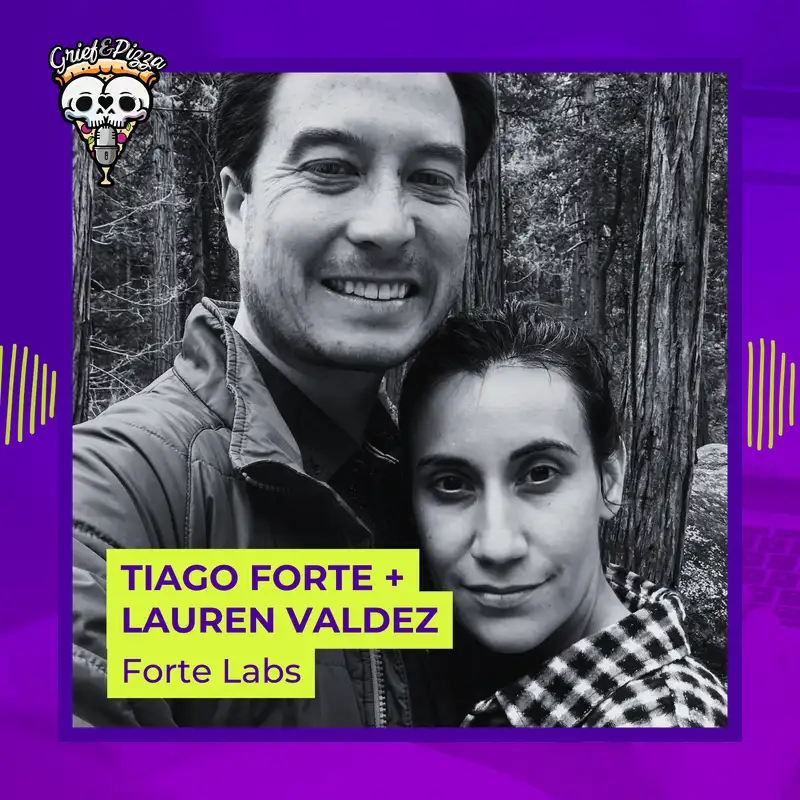
Living Well with Lauren Valdez and Tiago Forte
Marie: [00:00:00] You're listening to Grief and Pizza, a podcast exploring the highs and lows at the intersection of business and emotional wellbeing. In this episode, we're hanging out with Tiago Forte and Lauren Valdez for a candid conversation where we talk about their big move from the USA to Mexico and the impacts that change has meant for their family, business, and wellness.
We also dig into topics like working together as partners, some spicy perspectives around the future of AI, and the power of the annual review.
Thiago, Lauren, it is so good to see you. I think the last time we saw you guys might have been, like, two and a half, three years ago at the Second Brain Summit. I know a lot has changed since then, I think for, for all of us. Uh I think you guys were just in the midst of your move to Mexico, if I'm not mistaken, or you may have just moved there and were coming back for the conference. So how is living in Mexico? I wanna kinda start there, 'cause that's a huge change that you guys made that obviously there was a lot of intentionality behind that decision.
I'm sure a lot has changed in your business and your lives as a result. So, like, can we [00:01:00] start there with how has it been to be living in Mexico the last couple years?
Lauren: Yeah, I'll start 'cause Thiago's looking at me. Um, it's been a year and a half since we moved to Mexico, and it's been incredible. Like, probably one of the best decisions we've ever made that's impacted our family, our business, our mental, emotional health living here with little kids.
It's an adventure, but it also is, like, deeply healing living here. It's just a different culture and environment. Like, both of our families are Latino, and so we're-- we get to experience more of, like, that Latino side of ourselves, where we are so grounded in community and social support in comparison to how isolating America could feel, and in Western cultures generally, where it's very, like, individual driven, work really hard.
Here, it is way more about living well, and we live here [00:02:00] with, like, the most ultimate privilege as, like, being people who can move across borders freely in a time when that is not possible for many people. So we can maintain both our families across cultures, um, which is incredible, but we could also afford a really great life here.
It's been really amazing, and, you know, it comes with a lot of privilege, and we feel very honored to be accepted into the community here, to have our kids learning Spanish, and to feel so supported here, and also being able to just go home whenever we want to, you know, maintain our community ties back in the US as well.
So it's been a very awesome adventure.
Marie: And how often are you kind of going back and forth, and do you still have some family in the US that you're still making time to visit, or what does that look like?
Tiago: Yeah, I think that's one of the, one of the interesting things about, about Mexico in particular that, that continues to surprise me is, like, it's no further [00:03:00] than many parts of the US.
You know? It's a shorter flight than coming from the East Coast. No one is like, "Oh, I'm, I live on the East Coast, so I can never go to the West Coast." Like, no, it's just a quick flight. And the fact that it's a similar time zone means there's no, there's no real jet lag, maybe just one or two hours. And it's so odd to, like, be in LA, this, like, big megalopolis, and then to have a small subtropical rural Mexican town just a few hours away that you can just come and go.
It's like as if two worlds are, have a front- have a border that you don't expect or don't think about Uh, it's kinda unique. There's not really any other... I guess, I guess maybe you could go to Miami would be the closest within the US.
Marie: That's so amazing. So you're able to kinda, yeah, just jump on a plane.
There's still some family for you to visit in Los Angeles.
Tiago: Yeah, so much family, and we go home all the time. We go home sometimes just for a, a wedding or a birthday party or f- or a funeral or... Not only are [00:04:00] we just as much a part of our family's lives there, we've sometimes talked about that we almost, in a sense, feel closer to our family, even living further.
Um, I think that's a combination of, like, the time we do spend is, like, super intentional. You know, it's like we're flying internationally, staying multiple days there just to hang out with you. So you better hang out with us.
Marie: Make time for us. And how has it been traveling with the kids too? I'm sure the kids are getting used to traveling.
They're getting used to this cross-cultural experience, but what's that been like?
Lauren: Yeah. We're, like, I mean, anything with kids or anything you don't do often feels really hard, like a big challenge, and now it's like we're just pros on airplanes. Like, we, I, like, I have my packing, like, down. Like, my kids aren't kids with iPads on airplanes.
It's like I have a, my to-go bag that has, like, every color, activity, foam, puzzles, whatever. And then Tiago and I have a good system now for planes, where we used to split up having one kid next to us [00:05:00] each, and now we realize the better option is one person with both kids for an hour, and then the other person gets to relax and be by themselves, and then we trade every hour.
And we're like, "Oh, this is a great system." Like, we're on for an hour, off for an hour, and then we trade back and forth. Um, so we've really, like, kind of figured that out. You know, there are days where it's, it just doesn't work out. Things break down, um, especially if there's travel delays. Like, if our flight's delayed, like, hours, that, like, breaks down, like, my system.
I'm like, "I don't have enough snacks for the amount of time we're delayed," or whatever. But, you know, some of the trips are difficult, but m- I mean, we've kind of just, like, figured out a system. Like anything in life, if you just figure out your system and it becomes a routine, it's not challenging
Ben: Has there been any changes for the kids in terms of the way that they're sort of absorbing learning and culture across these, these moves?
Are they doing more homeschooling type stuff? Is there more community-oriented learning? Are they in a public school system? Like, what's changed for them in the, in this transition? [00:06:00]
Tiago: Yeah. There's been a lot of changes on all those fronts. They're in a private school, uh, here nearby in town, but it's like, it's kind of like a forest school.
Like it was originally a summer camp that they kind of once COVID hit and a bunch of people moved here from Mexico City, they turned into a school. So like we get pictures back from the teacher, and it's like, it seems like half the time they're like riding horses, milking cows, they're running in the forest, they're in the river.
I'm like, "They're having way more fun than me." Um, and then there is the cross-cultural and cross-linguistic thing, but it's almost like, it's like little kids are designed for that. Mm. Their entire being and biology is designed to absorb a new culture And it's almost like to them, whether it's their original, you know, culture, they have no concept of that.
It's just whatever is around them. And so it's so fascinating and meaningful to see them, I mean, first of all, picking up Spanish so naturally. Not just the vocab, but the, the little attitude, the, [00:07:00] the inflection- ... the accent, the slang, um, the way they deliver it. Like, especially my little daughter, when I see her as this, like, little Latina, you know, being formed, I'm like, "Oh my gosh, she's a little, a little emergent La- Latina."
Lauren: Yeah, they're starting to teach us vocabulary now, which is, which is interesting. And they say things, yeah, just, like, a lot more, like, natively than we would say them, um, in Spanish. So that's been really fun to watch. And I think here the, the culture is so extroverted. Like, it's extroverted by default. Like, you can't be in a restaurant without everyone who walks into the restaurant acknowledges you.
Like, the US, people just, like, ignore each other. Like, you just pretend other people aren't there. Here, it's like that doesn't exist. Like, you acknowledge every person who walks by you in any space. And when you walk into a space, even if you don't know every- like, everyone there, you walk up to every single person and say hi, and then you say bye to all of them.
And so seeing the kids like that and get used to that, where, like, [00:08:00] our son was very introverted, just naturally introverted, and it was a harder transition for him because he was three. He already spoke English when we got here, and then not being able to speak to the kids in his class and him being shier, he had some struggles with that, and we had to work through, like, the emotions of that and the emotions of, like, leaving his family and his cousins back in the US.
But now it's just so funny seeing him extroverted. Like, he will say hi to anyone who walks by, like, jump into conversations with people, where it's like he did not do that as a kid. Like, he avoided direct interaction with people. Like, he really needed a warm-up, and, like, now he doesn't need that at all. So I'm, like, glad he's, like...
He's kind of adjusted culturally to that
Ben: It seems like a really good cultural shift too for a shy kid. I moved around a ton when we were kids and I lived in Saudi Arabia and we grew up in England and then I moved to the States when I was five and so we were constantly moving and I feel like a lot of my adult [00:09:00] insecurities are around this idea that you're going to be uprooted at any sec- at any time.
And but look, coming to US culture and being a shy kid, like there, there wasn't that aspect of like super like excitable children and the exuberance of, you know, that you're talking about it being a very extroverted culture. Going from, you know, introvert to introvert, I feel like I never got that kind of thing growing up so that feels really, really meaningful for a, a shy kid, you know, as you've described.
Tiago: Yeah. You're not allowed to be introverted in Latin America. They just like won't accept it. They won't.
Marie: They don't let you. It's-
Tiago: They won't stand for it.
Marie: Wow. I'm curious how it's impacted... I mean, it must be so interesting as adults that have gone through this experience and you're watching your kids go through this experience and it's, you know, feels very meaningful and it's like shaping your perspectives.
I'm curious how those perspectives have maybe infiltrated your business perspectives, if at all. You know, I'm curious kind of what, what transitions have happened. I know you guys have a lot [00:10:00] of projects going on. I definitely wanna dig into them, but just curious if the cultural shift has kinda changed the way that you're thinking about the projects that you're working on and how you show up and kinda what's happening.
Tiago: Gosh, it's impacted so many ways. Where should we begin?
Lauren: Well, before Thiago gets into that, there's something too that's also very unique about the environment we're in. Like, this is an environment of, like, spiritual entrepreneurs, I'd say. It's a very unique town in that to live here, you need to be someone who has control of your time.
Um, and so there's a lot of people, and particularly it's the byproduct of the school we have chosen to send our kids to, where most of the parents are entrepreneurs, are people who have full, like, control of their time, because a lot of the people at this school came during the pandemic from Mexico City.
So they've been very successful in their careers, and they can work here remotely, and they may have to go back to Mexico City, but it's easy to do that from [00:11:00] here. And so, like, we used to feel very, not isolated, but where we were at in our community in, um, Long Beach, like, we didn't know a lot of people who had businesses like ours and had full control over their time and were working in this online way, um, which is why we found you all and, and people in different cities who do this kind of work and connected online, and we'd come together once a year and bond over our kind of unique lifestyles and businesses and marriage partnerships working together and all that stuff.
We're here, that is, like, the default of our friend group. It's really incredible to live in person in a place where everyone gets it, like, running your own business and side projects and, like, managing multiple things and also trying to raise a family and, like, live a good life. Like, it's people who've been s- successful but also really wanna, like, have a good life and not just make their life about work.
Tiago: Mm-hmm.
Lauren: So it, it's a very unique combination of [00:12:00] people here that I'd say has been very, very influential on us and our family and how we balance all of that.
Tiago: I would say, I would say too, like, it's entrepreneur sort of broadly defined. Like, we lived in, in the San Francisco Bay Area for, like, seven or eight years, so we have plenty of exposure to a certain kind of entrepreneur, you know?
The startup, venture-backed, tech-centric kind. But here it's like, it's, like, super diverse at the same time. There's, like, chefs, there's artists, painters, poets, writers, people making, like, organic permaculture experiments, you know, out here in the rural regions. It's like entrepreneur in the sense of, like, self-directed, self-chosen, something outside the normal career ladder type thing.
Marie: I'm curious, you guys were already kinda doing this, right? So what does it mean to you, I guess, now to have everyone else in your community is kind of by default already like that. So again, you guys were already living that kinda lifestyle, so is it just more that it [00:13:00] feels more natural to you? You're like, "Yes, okay, this is a normal way of life," you know?
Do you just feel more comfortable in your own skin as business owners being there around other people that are kinda like-minded?
Lauren: I'd say mostly it's, like, a scheduling thing. Like, it was hard to have friends in the US who all have 9:00 to 5:00s. And so it's like everyone... Like, by the time they get home from work, it's, like, 6:00 PM and, like, you know, then you have to put your kids to sleep.
And then on the weekends everyone's, like, meal prepping and, like, doing their laundry. And so here it's just like everyone has the same kind of freedom over their time as we have. And so weekday events and hangouts are, like, normal. Like, you can... At 9:30 in the morning, like, I met up with a group of moms last week and we did a ceramics class, like, at 9:30 in the morning, and they're all, like, creative artist moms.
And, um, and so we organized this ceramics class. And it was just like, we can do that, um, where I have a group of people to do that with. And Tiago has, like, paddleball [00:14:00] with a group, but they're all, like, exchanging business ideas and tips and starting projects together that they're brainstorming while they're playing paddleball.
So it's like that's probably the biggest thing of, like, having people here. Like, we don't have to, like, jump on a Zoom call to, like, organize a project or whatever. It's, like, in person and it's part of your daily active life, rather than something you have to, like, make time for. It's just, like, built... Like, friendship and business and, like, families are built in.
Like, um, here kids are invited everywhere. There's no such thing as, like, an adult party or a kid party. They're, like, interchangeable. You just, like, assume your kids can come to a party that's starting at, like, 9:00 PM for someone turning 50. Like, it's just like that's the default. Like, and same thing at restaurants and everything, it's just like your kids are there as part of it.
You're not at a kid restaurant. Your kids just come to the regular restaurant, and so do the other families, and you hang out. And so everything is a lot more, I'd say, like, integrated between family business and friendship. And health too. Like, even, like, your workouts, like, you have all your friends. That's [00:15:00] very, like, distinct about our lifestyle here compared to before.
All those things felt isolated and separate and really hard to combine. So if, like, you want to hang out with friends, you're like, "I gotta book my babysitter, and then I gotta do this, and then we have to clear everyone's schedules," and all these things. And, like, here it's like we don't have to do that.
You just show up with your whole family and it works out.
Marie: I imagine just the nervous system, the stress must just kinda feel so much more chill when you're not sort of worried about those things. There's sort of like a we're being held by this supportive network, right? And again, having friends and family and that feeling, I imagine, I'm, I'm just kinda guessing, it must just kind of add a level of ease to your, your lifestyle that-
Tiago: Oh my gosh, yeah.
I'd, I'd say that at a nervous system level, it's been a revolution. It's h- almost hard to, like, remember what it was like. Like in s- there's so many different dimensions to it. There's living in a rural place. We've, we've never really lived rurally. [00:16:00] We thought we were city people. Oh, no, we need the city.
There's the fact that, uh, everyone here has help. We should mention that. That's a s- just enormous aspect of it. For like a couple hundred bucks a week, we have full-time help who does all the cooking and all the cleaning.
Marie: Wow.
Tiago: Like that alone... And then of course, what do you do with that time? We spend it mostly, I feel like the, the number one thing that gets added in is self-care.
It's exercise, taking walks, hiking, playing with the kids, going to the pool, and so that's a big part of it too. It's a big part of it too.
Ben: Yeah. You've been doing a lot of, um- Yeah ... like personal training and getting into the fitness in the last year. How has that kind of changed your mindset around, you know, showing up for work and being energized?
Tiago: Oh my gosh, yeah. It has a tremendous im- impact on work. I feel like I'm working less than ever, than I ever have in my career. I rarely work past maybe 12 or 1, so like three to four hours a day. A lot of that is AI's help as well. [00:17:00] But, um, it's like each of those hours that I'm there are so intentional, and I'm in such a calm, balanced state that I just make better decisions.
And like decision-making is where it's at. Like one good decision can save so many hours of, you know, poor execution. And so I'm able to work less but have more impact with it, I think is, is m- one of the main impacts
Marie: I'd love to hear a little bit more about you guys as a couple also working together.
We're in the same boat, right? We, we just realized Ben and I have been working together for over 10 years now, which is kind of wild. I'd love to hear a little bit about the balance, right? Like you mentioned one parent taking the two kids so that the other can get their focus work done. I'm sure you guys have learned a ton and kind of figured out your jam, and that things are always changing and you're kind of adapting.
How do you balance the fact that you guys sort of run the same business, but you do have different projects that you work on? So kind of, um, what's the current makeup of, you know, the time that you're spending [00:18:00] working on these projects? Is, is one of you kind of taking a little bit more of the childcare?
Is it 50/50? How do you think about how you guys structure your lives to make sure that you can both be running your business together?
Lauren: Well, I think part of it is that Tiago says I work when I wanna work, and like I take on the projects I wanna take on, and I think that's something we learned very early in this is, like identifying when something is a good, unique fit for me.
And when we started the business, it was me helping Tiago before he had like staff and I was in grad school and, and then over time... There's this big truck going by. I don't know if you guys can hear it. But over time, um, we were able to hire people who were just very skilled and competent and could do things, uh, a lot better than me.
And so then it was like me kind of looking for my projects and input that is uniquely suited to me. And I think where I am most uniquely [00:19:00] suited is being able to be the counterbalance to Tiago. Um, and so the people we hire are all amazing and incredible, but Tiago is still like the boss who sometimes they're afraid to challenge and, um- When I can challenge him publicly, then, then they're like, "Oh, wait, yeah, Lauren, the-- we all think that, too.
We just weren't saying anything," or whatever. So it's like, it's like that's kinda like the unique role I play now. And so I'm really not hands-on with much of the business at all. It's more like strategic advising, big- looking big picture at things. Every once in a while, I take on small projects like leading workshops or doing some YouTube videos or things like that.
But I'd say mostly my role is, is counterbalancing Tiago's approach and way of thinking. Like, we really see each other as like the yin and yang of each other. Like, y- I'm just like a lot more embodied, intuitive, and like, uh-
Tiago: Spontaneous ...
Lauren: chaotic, I [00:20:00] guess. And Tiago's more the ordered, structured one and, um, like the systems one, and like you definitely need both of those things.
Since having kids, I've been extremely hands-off with the business and more focused on the kids. So the kids are my main priority and responsibility. And then, you know, I have my, my side projects, um, like writing a book last year and those things.
Marie: Side project, no big deal.
Ben : Just a side
Lauren: project. Yeah.
Marie: Just shipping a book.
Lauren: Yeah.
Ben : So it's been fun. Yeah, I wanted to ask about- Yeah ... I wanted to ask about the book, "Beyond Acceptance." It's about, you had mentioned you were in grad school kind of when you s- first started supporting Tiago, and the book is around helping people navigate that similar journey. So it seems like that, as a small project, side project, sounds kinda funny when it's probably been a 15, 20-year development.
Well, how did-- So l- in terms of balance, when you're writing that book and you need to devote more time to the focus, uh, where does your attention go and, and [00:21:00] who kinda supports you in that moment to finish that book and get it published?
Lauren: Yeah, it's been a long journey. If you guys remember from our first mastermind retreat we did, um, I was at that stage ready to close out this business.
I had, um, coaching people on applying to graduate school, and I was like, "Well, there's things I need to do to close it out," 'cause I wasn't ready to just, like, quit it. I was like, I have to have some things in place to feel like everything I've learned in this I can pass on. And so writing the book was really one of my ways of wanting to close this out from being a business to being like, "Here's everything I've ever learned helping people get into Harvard and MIT with, like, full scholarships.
It's all in this book, and you don't need me. It's in the book." And so yeah, that was a long journey to be able to write this book, and Tiago's always been super, super supportive of all these things I've done. Like this, I never paid myself doing this work. It was really a labor of love, coaching and supporting people.
Um, it was like [00:22:00] my, my nonprofit work, and I hired a book coach to help me with just getting organized and staying on top of the deadlines and all of that, and it was extremely hard with motherhood and moving to Mexico, and I'd never written this much in my life. Um, so it was, it was its own self-growth journey and having to restructure myself and how I work and how I approach work to be able to write a book and manage the family, and the deadlines were very...
I, I pretty much missed every single deadline from my book coach the entire, like, year and a half I worked with her. Um, just like sick kids and non-sleep and all kinds of things like that that get in the way, plus our very intense travel schedule made it very hard to do it, but I, I did it. I accomplished that.
Like, can close out that piece of work.
Tiago: Yeah, I think this is kind of riffing on that and the, the question of how we work together. I think there's been this constant recurring lesson that I have had to learn dozens and dozens and dozens of [00:23:00] times and probably dozens more, which is that in practically every way that we can imagine, Lauren is different than I am, and in many cases the opposite.
Like, it, it astounds me. Like, every time I think, "No, this is definitely a universal psychological trait,"
it's not the case. It's not the case. And every time, even with the, with the book project, a few of the, you know, the strategies that didn't work were ones that I thought that I kind of either recommended or maybe imposed a little bit. I was like, "Well, this really works for me, you know, having a strict deadline or having a very linear step-by-step process, so definitely it will work for you."
Marie: And that's been- I'm just nodding and being like, "Relatable." A little bit.
Tiago: And that's, that's so valuable. It's, it's a bit jarring at times, but it's so... That, that speaks also to the value I think that Lauren brings to my work and my business, which is it just constantly reminds me that I am one type. I am on one [00:24:00] end of a spectrum or of many spectrums, and the more that I just, just keep in mind and be open to there being other points of the spectrum and maybe entirely other spectrums, the better my work gets.
You know? It gets more open-minded. It gets more flexible. It gets more accessible rather than this is the right way
Marie: I love to hear that. I actually just signed up for a course that I'm super excited about, and I've got this book here called Neurodiversity Coaching.
Tiago: Ooh.
Marie: Um, so psychological approach to supporting neurodivergent talent and career potential, right?
So it's recognizing there are many different ways of brain activity, you know, neurobiology, and what does that mean for how we problem solve and approach things and communication style. So I, I really love the idea that you're moving more toward an openness and, and, like, how do we celebrate those, you know, weird quirks that our partner brings to us and say, "Wow, I never would have seen it that way, but I think there's, there's something really interesting here," and how can that, you know, you kind of move toward each other and, uh- Totally.
Tiago: You guys [00:25:00] are examples in this. I mean, you're such- ... cool. I feel like you were one of the early, both of you, early, early people to embrace neurodivergence, to speak to it, to elevate it instead of sort of just, like, s- you know, side mention. I think that I've learned, learned a lot from your model of that.
Marie: Hmm.
Tiago: So thank you.
Marie: Wow. Yeah. Thank you. I, I think I didn't know any other way. I was like, "Well, my brain seems to be on a different track, so how do I, how do I speak to what is working for me?" And hopefully it gives people a little bit more self-acceptance of, like, it's okay if this model of the strict deadline or the Pomodoro method or whatever it is doesn't work for me.
There's probably a different way I can motivate myself. And so, um, even acknowledging that, again, like, ADHD is a spectrum, and there's gonna be different people within that that, like, that doesn't work for me, but it works for someone else with ADHD. So I'm just really fascinated by that. Like, how do you get people to do their best work with whatever their, their sort of default mode is, you know?
Tiago: Yes. Yes.
Lauren: I think writing a book, that was like the [00:26:00] number one thing I learned in this past year. There's so much writing advice out there. It's like, get up and do your this many minutes or this many words and blah, blah, blah, and every day consistency and blah, blah, blah. None of that, like, worked for me at all.
It burned me out very quickly. I had to spend like one to two hours on like getting in touch with my intuition every morning. Like a tea ritual in the morning, no coffee. I, I like, I could even feel in my body what coffee did to my writing and I was like, I don't like that. Like if I drank coffee, I would very quickly start to doubt myself and go to AI and then I'd spend my whole writing time being like, okay, now everything I produce is crap.
Instead I'd have to spend the time like feeling into my body, my intuition and my sensations to then get me into flow. And so it, it required like so much self-care and being embodied and a lot of exercise and regularly keeping up my artist dates and that sort of thing, and processing my, my emotions and my fears and moving those [00:27:00] physically to be able to just write for like two hours.
Like to like, but that's like, that was my process. And I'm like, I must sound like I would have to get on my hands and knees and like as if I was like grieving something that needed to come out of my body to be able to write something, um, like on some days. And I was like, this is crazy. This can't be how anyone else writes books, but this is how I have to write a book.
Marie: Oh, and I'm sure there must be other people that can relate to that experience as well, right? Like what an What an interesting level of self-awareness and even, um, mindfulness and almost meditation that it takes to sort of even notice those tendencies in yourself to be like, there's like that experimentation needed where you're saying, "I've been trying this for a few weeks and this is not working, and so let me switch gears and try something different," which it kinda makes me think of the weekly reviews, the annual reviews, like noticing what is happening for yourself such that you can interject or kind of switch something up 'cause you're like, "This week felt really crummy.
I'm overwhelmed. Like, this is not working. What do I need to do to [00:28:00] kinda switch gears?" So I imagine there must have been like a, a bit of that, like, tension and experimentation and like, "Ah, this is not working." How do you get to the point where you were noticing even, hey, you know what? I actually need to just listen to what my body needs right now.
Were you reflecting on that experience doing reviews and, and noticing that stuff?
Lauren: Yeah. I think Tiago and I have gone on a big somatic journey over the last few years where, um, like in our self-care practices, in our personal development, our personal self-awareness things, like we've always been really into that, and I think it started very logical, and then we've moved into doing things that are a lot more like somatic and feeling.
Um, and so doing that I think has really helped me get in touch with even noticing, like, hey, coffee makes my work actually worse. Like, I think it makes me productive when actually, like, my body actually just needs a nap, and I ha- should allow that nap instead of the coffee. And, like, yeah, so it's a lot of just, like, being more [00:29:00] in touch physically with my body and caring for it, and even that has really pushed me away from, like, screens and, like, trying to do as little as on screens as possible.
Yeah, so I think it's... Most of us, we don't feel all the sensations that are there all the time, and it's because we have our screens and our coffee and our supplements to go to sleep or whatever, and it's... But it, it's like once you start to get in touch with that, it's like screaming at you. Like, it's funny that th- there's all these, like, um, habit tracker things now, like an Oura Ring or, like, people have their rules, like no blue light after 9:00 PM or whatever.
My body is constantly screaming at me. Like, if Tiago has the TV on at night and I walk by, I'm like, "Ah, oh, what's happening?" Like, I can't... Like, it physically hurts me to see a, a, like a blue light at night. Like, I'm like, "I need to get away," and I, like, run away immediately 'cause I can just feel the sensations of what that does to me.
Marie: Wow. Do you guys then have kinda your own r- [00:30:00] rules, rituals around this sort of stuff that you developed? Around technology, putting your phone away for the weekend. Like, do you have anything like
Ben : that that you're putting- We-- Yeah, we've been, we've been very intentionally detoxing completely from screens over the weekend.
Um, we've actually been doing a course locally lately called Plan Like a Farmer, and we go to these local farms and learn how to cultivate crops and seeding, you know, schedules and things like that. So we've been planning out our whole garden, and we kind of ritualized it to be like, okay, we're gonna be very in touch with nature on the weekends and only work with, you know, paper and our little planning guides and little diagrams that we can physically touch and move around.
So that's been kind of an intentional practice since the beginning of this year, which I find there's just so much space when you stop looking at a screen all the time. And I started really realizing how small the world is in the screen, even though it feels really expansive and connective, and they have all of this technology at your fingers now, [00:31:00] that that world is actually really, really reductive and narrow.
I really like... I've been really enjoying these detoxes to the point where I'm wanna do longer stretches, but, uh, it terrifies me to really disconnect that freely and that long, uh, for that sustained period.
Lauren: I love that. That sounds amazing.
Tiago: We've been on our own journey with that as well. Tried so many different things.
It's so ironic, but it's like a whole world. There's a whole discipline in non-screen activities. Like, you could study it. You could really, like... Because it, it really is amazing how the screen has come to dominate so many aspects of our lives. Like, I think, Ben, I think you were the one that asked me this question in the, in our mastermind that we both attended in 2023.
It stuck with me for years, which is like, "Do you have any non-screen hobbies?"
Ben : Oh, yeah.
Tiago: And I was like, "No."
Marie: It sounds like since moving to Mexico Yeah ... there's some, you know, [00:32:00] lots of- Oh,
Ben : it sounds like there's so many... It's, it's environmentally coded, right? Yeah. So the more that you experience this rural lifestyle in a culture that's a lot more expressive and, you know, the people are all in that mindset that these things just, like I said, it's, it's a very narrow world, and then as soon as you look outside that world, you notice all this other stuff happening on.
It's such a really rich and vast experience. And so I think those environmental changes are really key because I am a slave to the machine as the next person is, and Marie is constantly slapping my phone out of my hand, and I ask her to do that. You know, "Please, please protect me from myself," you know, those kind of things.
Lauren: Yeah. I, I think kids are, like, the number one environmental protector of that. Like, just since having kids, like, you, you become so aware of your own screen usage, and now our kids are at the point where, like, they are immediately angry if we are looking at a screen. Like, they are ... They will immediately start causing havoc because they [00:33:00] want attention.
And before they could express that with words, they do it with actions, and then now they're at the point where they can say, like, my, my son will be like, "Get off that stupid phone." Like, it's just
Tiago: like-
Lauren: Like, if I'm just trying to, like, set an alarm or something quickly, he's like, "Get it..." Like, the instant I, like, pick up a phone, he's, like, upset.
Tiago: Or they'll ... Or, or equally effective is they'll reflect it back at you. Like, our three-year-old daughter, just tiny, tiny little girl, she'll, like ... I'll come into her room and, like, want her to, like, get ready for school or something, and she'll get, like, a little picture book and open it as if it's a laptop, and she'll be like, "I'm working."
Marie: They're watching- Savage ... everything, right?
Tiago: Yeah. That's
Lauren: funny. Yeah. I love, like, um, when we... We go to a lot of birthday parties here, and birthday parties are, like, an all-day event. Like, the food just keeps coming out the whole time. There's plenty of activities for the kids. So we'll be at a birthday party for, like, six hours, and I love birthday party days when I'm like, "I didn't pick up my phone the whole time."
Maybe I took a pic- like, picked up my phone to take a picture, but I haven't... Like, I didn't even think [00:34:00] about my phone. And so I love when we just like, yeah, cultivate something going on where it's like it doesn't even occur to you to grab your phone to check it.
Marie: So it seems like that's been happening naturally for you guys.
It's just sort of like the lifestyle there is sort of lending itself to like, "Hey, I don't have to be on my screen," and it just feels natural to be present with people. So that's, it's kinda nice to not be in a position where you're, like, fighting yourself to get off your, your devices.
Tiago: Yeah, e- uh, I sometimes have this thought.
I observed this a number of times, that living here feels like living in the '90s. Like, it really reminds me so, so, so much of our lives in the '90s before, you know, most of the internet and definitely before smartphones. And it really makes me realize, like, stepping outside of, say, modern urban US culture or Western culture, how much our society has been completely transformed.
It's been utterly transformed. We just didn't notice 'cause we were the frogs boiling in the pot. But, like, it's the screens, it's seeing [00:35:00] most people out in public on their phones. It's, you know, having all these daily, like, transactions, buying something in a store, getting something from a DoorDash, where you have zero actual interaction with a human, and then to step outside of that and have a society...
Like, I think you can really understand Mexican society as a society that is completely built around human connection.
Marie: Mm.
Tiago: Like, every single aspect of the society prioritizes human connection.
Lauren: Mm.
Tiago: Which also leads to some of the parts that can be frustrating. Like, the reason no one is ever on time is if they run across anyone they know
Marie: Oh, that's so interesting
Tiago: So both the, the quote-unquote positive and quote-unquote negative side come from that same principle.
Mm-hmm. But I think overall it's a positive to live that way.
Marie: There's a little more understanding. You're like, "Oh, I get it. You ran into Mm-hmm. Yeah ... a family member or something," and it's fine.
Tiago: Mm-hmm.
Ben : I think about this all the time. I, I think I read somewhere it recently called the default mode network what your brain does when it, when you're bored.
And I think [00:36:00] about growing up and how, you know, we were-- did not have access to really anything, and my parents were quite restrictive on how much screen time we could have at all. Like, you know, you can play your video game for 30 minutes, and that's it for the day. And we would kind of sneak around and try to get around those limitations, but they were there for a reason, and so you'd have to find something else to occupy your time.
And I think that's probably the, one of the main causes of societal dysfunction, especially in the States and North America really, is that people are terrified to be bored, and they've gotta fill their time clicking some kind of button and getting that immediate response from some kind of interface at this point.
So, you know, I notice myself doing it as well. I've been reading a lot of kind of science-y books lately that are kind of well outside of my reading capabilities, shall we say, where I really need a thesaurus to come with it or like a, "Oh, explain that so that I can understand this in the right context."
And there's such a drive for me to [00:37:00] have Claude open while I'm doing that and be like, "What does this mean? What is this word?" And I notice what happened to my attention and my understanding of things when I put the phone away from when I'm reading, and I'll maybe just highlight a word a- to go look up later.
And then I do these, like, secondary passes of reading where I go through, uh, with my dictionary and I define that word. And then-- or I might try something like, "Okay, I know what the root of this part of the word is, so I'm gonna try to guess at what it means and try to, like, use my own intuition to figure out what's happening here," and then maybe go then do the research to figure out what's actually happening.
And I'm finding that I'm enjoying reading again so much more by not having the definition and the lookup stuff right there with me as I'm consuming, which has been a really interesting development. Wow. And,
Lauren: and that's like, I mean, I don't have any evidence on that, but I'm sure that's-- it's proven that that's how you learn best is, like, doing that, like, doing that extra labor and passes that you're doing versus, like, just, yeah, having the answer- Yeah
readily available. [00:38:00]
Ben : I think for me, what I'm, what I've noticed in the last especially two to three years is that people have become really, really, really uncomfortable with not knowing. Like, sitting in the discomfort of unknowing is a phrase that I hear a lot. Um- Mm. And that is, you know, it's fascinating because it's, it's sort of attacking My way of building knowledge in every aspect of my life, and it feels really confrontational to me to want to, like, always fill in my knowledge gaps all the time, where, like, people are now doing it for me on my behalf rather than it being a choice of mine.
I have people in my life that, like at the fire hall, we have ongoing, you know, conversations about how we do communication and the challenges of running a volunteer fire department when you have people of all different skill levels. And now we have people that are like, "Well, oh, w- there's no problem that can't be solved by AI.
We can throw AI at this problem, and we can figure this out." And, and so I'm usually like, "Okay, well, there's [00:39:00] considerations that we should probably talk about, such as the authority here, having power to make decisions and, like, the amount of budget that we have." You know, these kind of things. Policies, government
Marie: level stuff.
Ben : Yeah. Um, so it feels like I'm like, I like to really sit with a, a discomfort and a problem, technical problem for a really long time before I even start thinking about what are the technical solutions to this problem. And it feels more and more that the solution and the thinking and the knowledge work is becoming less...
It's becoming more, um, non-consensual. Like, I feel like I, I'm-- If I don't fix something or I don't address a knowledge gap, then I'm doing someone a, a disservice or, you know, that kind of thing, where people are getting upset that their pull requests from, that they've generated from Claude aren't getting merged because why would you reject knowledge?
Like, this is only good.
Tiago: I'd really never thought of it this way before, but I think you're totally right. It's like not acquiring the answer is now offensive. It's a moral wrong. It is a-
Ben : Mm-hmm. [00:40:00]
Tiago: Wow, I have never considered that point of view, but I totally see it
Ben : Yeah It's something I've been thinking about a lot.
I mean, I guess that's a good segue into the fact that I think you're-- the end of this week, you're opening the enrollment for the AI Second Brain, and you just published this article, I was reading it yesterday, the Introducing the AI Second Brain. And I think for a lot of people, me included, this idea of going from the, the containerization of PARA to the CODE acronym that you kind of defined in building a second brain was like a really incredible leap for second brains.
And I really love that you describe second brains as like a cognitive exoskeleton.
Tiago: Mm-hmm.
Ben : So I'm wondering if like how is a second brain different in this new age of AI, and like why should people, I guess, join this new program?
Tiago: Yeah. This is very much on my mind- Yeah ... as you can imagine. I mean, it's really been months, months [00:41:00] of work to get it ready, and really years in the making.
Like I don't know if you remember this, but that, that same mastermind in twenty twenty-three, that was now almost three years ago, the big question I had there, 'cause that was like six to eight months after ChatGPT came out, my question was: How do we change our business and our work in light of AI? And it's taken me three years to have an answer.
But I think the thing that allowed me to move forward on it with confidence is taking a set of positions. I feel like AI is now not just a one thing. It's not just like one type of tech. It's a whole world. It's a whole extended universe with so many different aspects to it and ways it's being used and forms that it takes, that to even approach it, you almost have to take certain stances.
Like one of the most fundamental is, am I in favor of this or against it? Like you have to decide for yourself, right? And I've loved our conversations, Ben, because it's, it's [00:42:00] now already kind of hard to find people that are not, at least in my world, that are not diving headfirst. But that's only one.
There's also the stance of like, is this for human replacement or human augmentation? That's now a... It's very controversial. Those are two different directions. Um, another one is I personally believe that the, the emphasis on agents is completely overblown. I think that people have completely lost touch with reality in terms of what an agent is, what it can do, what, what it should be trusted with.
And to get on X and say that now feels like, like you're shouted down. It's her-heresy, right?
Ben : Mm-hmm.
Tiago: Those are just a few of the stances I've taken, but it, it, it allows me to start sort of narrowing down things. What am I willing to pay attention to? What am I willing to spend time on? What am I willing to teach?
That's, that's another thing is like such a responsibility, as you guys know, to like advocate, to te- to like people look to us, you know. And to say, "This is something you should do. This is something you should try. This is something you should [00:43:00] adopt," I feel a tremendous responsibility when I say those things.
Ben : Yeah. One of the-- Just to Put your own words in your mouth, one of the last things that you said in that article was, I was really pleased to see was that you think we have plenty of time- Mm-hmm ... with this technology, and that the hype or the rush or the you're-gonna-get-left-behind narrative is, is pretty, uh, I would say foolish at this point.
I really appreciated that just because, you know, that I know that that's the kind of person that you are. But also that I've, I've had the same thinking, like, what is the rush here? If the goal is AGI or even ASI, what's the harm of it taking 10,000 years to develop a little bit more in an emergent sense, one that becomes more of-- Uh, it feels like the augmentative path is much longer and should be a little bit more careful, a little bit more progressive and, and iterative, and then you have this replacement path, which is the immediacy.
It has to be done now. We have to [00:44:00] mandate that it's used. We have to replace everything with AI. Yeah, one of the things I've been noticing a lot lately is people are taking systems that used to be very determinative, very simple, um, automations that work great every single time, and they're now replacing them with the agentic-driven workflow, which means that we can now sort of meter LLM use like a, a utility of some sort.
And so you're gonna be paying more to just get to the point where you're actually doing the automation, where previously we could just do the automation with code. So it's really interesting how a lot of the narratives are around... Like, I feel like a lot of times when I'm using Claude that I'm basically using a telecom.
You know, I'm being, I'm using like text messages and I'm just being billed for my usage meter and it feels really slimy at, at that point rather than solving a real specific need. Yeah, I don't know-
Tiago: So true ...
Ben : what my question is there, but I really appreciated that you [00:45:00] feel it's okay to wait, you know, to see how this goes.
Maybe waiting five years will actually put you in a better place where you've not sort of adopted everything that they're being told to adopt and sort of risking your businesses by sort of having a single point of failure on these things.
Tiago: Totally. Absolutely
Lauren: Uh, thinking about your question, Ben, that you posed earlier about, like, the morality of not knowing, this is something I think a lot about too in terms of second brains, is like, um, I read this article in The New Yorker, I can't remember what it was called now, but it was about a book about the value of forgetting.
That, like, your brain's supposed to forget. It's meant to forget things, and that's good for you. And thinking about, like, when you're trying to remember and preserve everything, like, that's actually damaging at some point. And so, like, you as the human are the one who decides what's worth remembering and forgetting.
I'm, I'm so grateful that I forget things all the time. Like, my task [00:46:00] management system is o- is, as, once I became a mom, I was like, if I forgot it, good. I wasn't supposed to do it. Like, um, I'm like, "I'm glad I didn't write that down. If someone didn't follow up with me to get it done, it was not supposed to be done."
That's actually, like, good for us. So I think about this with AI too. Like, there's a lot of people who just waste time being like, "That never needed to be done in the first place." Like the example you just gave. Like, no one needed that. You just... And I do this personally, and I've noticed this through my journaling and my reflective passe- uh, uh, work that I'm, I, I'll be like, "Wait a second, that was just a huge waste of time.
Like, did I need to do and create that?" Like, I could make a lead magnet really fast using AI, but like, did I need to? Like, when I didn't have time to make lead magnets, I used the same lead magnet on every single thing, and it was great. But now that I can make new lead magnets, I'm just gonna make a bunch of them.
And then I was like, "I never needed to do that." That has happened to me a lot with AI, and I think a lot of people don't realize, like, the toll that [00:47:00] takes on you. And this is something I've been feeling with AI, is just, like, feeling super fragmented very quickly because you can manage more projects, but that management takes its own mental load.
And so I've been coming back away from that being like, no, I, this requires so much more intentionality to decide when is it right and appropriate to do something with AI versus not. And I think that all comes back to the body and, like, being able to sense and feel things, which I think most people are so disconnected from their body all the time.
And so, like, you don't even know what you don't know. You can't feel that it's bothering you until, like, you're in burnout or whatever. And so that's what I think a lot, and that's kind of what I'm bringing to Tiago's AI course, is like how do we bring the body in and the intentionality and the, the work you have to do beforehand before you even touch AI, which is at the personal body level and self-awareness level.
And most people are just skipping that.
Ben : Yeah I was talking to our friend, uh, [00:48:00] mutual friend Kay the other day, and he is so excited by the things that he can do with cloud code, and he's building all these, like, really cool things, and it's really helping accelerate him. And yeah, like the-- There's something about the excitement, uh, that has given people so much access to the things that maybe traditionally software developers could only do.
So in terms of, like, the emotional side of it, that's the thing that I've been investigating the most is listening to the excitement that people are having about what they're able to do with it and trying to reflect back to people what it is I think that they're saying and that there may be some alternatives to doing this stuff with AI that would also give them that same feeling of excitement, such as, you know, maybe you should learn some code.
Like, I think that that would be kind of fun. It might be interesting to really get underneath it and do it, like, manually and to, to understand the value of where AI fits in. 'Cause I think I personally, having built apps for [00:49:00] like twenty years now, I don't get as excited about the idea of just being able to write a thing into a box and get what I need because I've been able to do that for many years.
And just the speed at which I can do things isn't really the thing that moves the meter for me. It's the decisions, it's the-- and I, I keep hearing this as judgment or discernment. That's the new skill. But I do find that a lot of times, like, there has to be underlying experiential phenomenological experience that drives the, your discernment and drives your ability to make decisions and not just push the button and get what I want.
You know, I'm both deeply uncomfortable because when somebody like my friends are reflecting to me, "I used to have to pay money for this, and now I can just get it by pushing a button," what I sometimes hear is, "You, the person who used to get paid to do this work, are no longer valuable to me." And that's deeply uncomfortable to, like, sit with this and sit [00:50:00] with.
And so that's the emotional part of the AI mechanization for me is both exciting 'cause I can see, oh, look at all these people get to do these beautiful things that only I could do before. Hmm. And also scary because it's like people are devaluing my skill set and my ability now.
Tiago: Yeah. It's so true. It's so true.
I kinda see this as one of the, the main values of AI actually is it's going to work on all the ways that our identities are wrapped up in just the way things have always been done.
Ben : Mm-hmm.
Tiago: Right? It's like, oh, it's so interesting. Like- Yeah, 'cause like if you build your identity on a, an activity, you know, a, a productive work stream, I suppose there is...
It's not bad, it's not wrong, but it's a bit risky. Because as that pillar gets knocked out from under you, and I, and I sense this happening in the world, just this wide-ranging search for what is the source of value? What is the source of, of meaning, of purpose, of significance, of [00:51:00] fulfillment? It's all being destabilized as those identities get kind of unmoored
Marie: Yeah.
It's like what will be the ripple impact of that? We don't know yet. We're kind of in the middle of it, and everyone's-- we're all uncomfortable being like, "You uncomfortable too? Are you in this as well?"
Ben : Bit of a segue, but I noticed that in-- on the website for your new book, Life in Perspective, which is about the power of annual reviews, you actually called annual reviews a technology, and I know that you're very careful with your words, so I'm curious about why you chose to refer to it as a technology in this case.
Tiago: Yeah, good catch. Good catch. So this is something I, I realized... I think I was telling-- I was sharing this with my team just last week. We kind of have an MO in the work we do that I had never really realized, which is we present a thing, a system. We sell a system. But then when you get that, you know, an object, an artifact, uh, this [00:52:00] discrete entity, but then-- And people, you know, take it, they accept it, or they buy it, but then when they open it up, what's inside is a process
Right? Like you want a second brain. Well, really, it's CODE. It's this four-step creative process. They want PARA. Oh, an organizational hierarchy. Well, really, even PARA is a process. Things start as projects, they become areas, et cetera. And I think that's kinda how I see technology now more broadly is systems or things disguised or processes disguised as artifacts.
And that's what the annual review is. It's just a slower moving process than we're used to. It's kinda interesting, actually. Like almost every year-long process has been ripped out of society and eradicated. There's almost none left. And the ones that remain, like Christmas, have been so commercialized that they've lost their original meaning.
And so it's this, this step-by-step process, just three parts: looking at the past, looking at the present, looking at the future, like not that original, and repeating that [00:53:00] every year. That to me is the essence of technology. And now it does also involve technology, like to look back at your notes helps to have those digitized in some way.
To look back at your content consumption helps to have your YouTube viewing history. Like technology has a way of keeping records in such a way that you can look back at them and reflect on them
Ben : Yeah, I've always loved your yearly reviews are some of my favorites to read. And Lauren, your, your yearly review this year, past year was a video review, which I found just amazing.
Like, I was really excited to watch that, and it felt so rich and, you know, that I could actually experience some of those moments with you and not just your recollection of those moments was kind of a really nice touch. Something I've been thinking I might try to do next year. At least, you know, we do this with photography, but the video and then your narrative over it was really engaging.
I thought that would be a really cool way to do things going forwards. I'm curious for both of you, do you [00:54:00] do any different reviews at different timescales? And what would you see as the importance of each of those timescales in terms of, uh, fitting into a larger annual review?
Lauren: I do so many reviews. I have my morning pages that I write most days, and then I have a weekly review scrapbook where it's like I print pictures and I journal about the week.
And then I have a moon ritual review. So every new moon and every full moon, I have a check-in, and that's kinda like my monthly review. And then I have my annual review. But I also do a review on my birthday or, like, if any big thing happens, like, um... And I do reviews with my kids. So, like- Mm ... before, on their birthdays, like generally, like the night before they go to sleep on a birthday, we review the last year, and I ask them questions, and they answer, like, about the highs and lows.
So I, I love reviews, and I used to, like in the GTD sense of reviews many years ago, I could [00:55:00] never get my reviews a habit. Like, my weekly review, my monthly review, like they just broke down super quickly. It-- I never got the habit until I started doing it through, like journaling and, like, by hand, and it being like a, something that felt more spiritual m- and more of a ritual.
Um, and same thing with my annual review. I, I spend like two months on my annual review. I love it. Like I like, I like revie- I like rereading my, all my journal entries from like the whole year to do my annual review, and then I, yeah, I, I put it into a video form as like my creative project artifact. So yeah, I, I love doing reviews.
I think they're super important to just check in, 'cause I think on the day-to-day, I feel like we have the negative narratives running. Like, ah, I didn't get enough done, like, this part of my life sucks, like da-da-da-da-da, and then I read my reviews and I'm like, "Oh my gosh, look at how far I've come." Even this week, like I like sit down to do my weekly scrapbook and I'm like, "What happened this week?"
Like nothing really got done, and then I like look back at the week, I'm like, "Look, I did all these things. What an incredible [00:56:00] week I had," and my narrative has now shifted. And so I, yeah, I find that all like super important.
Ben : Hmm. Where did that excitement for reviewing and journaling come from? Was that given to you from like a family member?
Was that a practice that, or a ritual that is somewhere in your history? Or, you know, was there something that, you know, you were really curious about?
Lauren: I think it was like when I had really big needs. Like, I, I never really was like a regular journaler, and then I have a cousin who's very, like, witchy, and she would lead these new moon circles for women.
And she did them-- This was, like, before Zoom calls. She would do them in person, and then she would do them on, like, a, a voice call, where it's like you would just call in a conference line, and she would lead them. And, um, she had a series of check-in questions for the new moon and the full moon, where you were reflecting on your life, and the new moon was like a new beginning, and then the full moon was like you reflect on your intention and [00:57:00] what you wanna change or whatever.
And I was in grad school at the time, and that saved me in grad school. Like, it really helped me just, like, get oriented and really... Like, grad school can be a very heavy space, and that just kind of kept me clear on, like, the bigger picture of my life and where I was moving towards, and not getting sucked into, like, the drama of grad school and, like, being able to, like, let things go.
And so it became so important for me in grad school that, like, it became a habit. It's like if I didn't do it, I felt, like, destabilized. And then similarly with morning pages, once I became a mom, it was like that space to just, like, clear my head every day became, like, critical. Like, I was a crazy person before I started doing morning pages every day as a mom.
And so it's, it's just kinda like I built over time, like, doing things because I, like, I just, like, needed it, and then it, it, and then it stuck. And same thing with my weekly review scrapbook. I tried to make a scrapbook one year as part of my annual review, and I never finished it 'cause I just never had [00:58:00] time.
So then the next year, I was like, "Let me try to do once a week." It would feel, like, lighter than doing a whole year scrapbook, and then it finally stuck. Um, so I think it's just kind of like adapting to what I needed in the moment and seeing what failed and maybe why it failed, and then looking for, like, experimenting with something else.
Ben : We've been doing, um, weekly reviews with our students for about three years now. So we actually do a, a session that is basically just co-working and just to hold space for them. It gets to the point now where sometimes we go for three hours and- Wow. ... our students hang out with us the whole time because we end up doing-- It kind of bleeds from review and into co-working, and it's a really good place for a lot of, uh, students that are also neurodiverse find the body doubling really helpful for them.
And so we've expanded it now, and we actually have our first, uh, quarterly review session. We always do an annual review session, but now we're also doing quarterly reviews. And we give everybody a starting [00:59:00] kind of format for their reviews and then encourage them to sort of make it their own. I'm actually curious how you present annual reviews, Tiago, in your book, and how does one make an annual review their own after following a sort of standardized framework, this ARC framework that you're presenting?
You know, what kind of tips are you giving people to do the type of work that maybe Lauren has intuitively done her entire life to find their way to a review practice that makes sense for them?
Tiago: Oh my gosh, this has been my white whale the past year. It's been such a challenge because what I've found in talking to people is most existing associations with any form of annual review are so negative.
Marie: Uh.
Tiago: It's incredible.
Marie: They think- Is that from like the work world? You're sort of thinking- Yeah ... like, oh, I'm up for review-
Tiago: Yep ...
Marie: performance check-in- Interesting ... kind of thing.
Tiago: Exactly. It's their performance review, which is among the most negative experiences in their whole career, uh, has b- has been shown in the [01:00:00] research to be highly demotivating and disempowering for most people.
Or it's even other things like, um, your yearly physical at the doctor, not exactly something you're excited about, right? Yeah. At be- or taxes, right? Most things that happen that m- that, you know, happen at a, at a yearly scale are sort of like undesirable but necessary, kind of in that category. And I think I'm trying to sort of...
I always try to meet people where they're at, uh, and that's why I, I kept the term annual review. You know, I could have rebranded it as like the intentional yearly check-in or something more on the right brain somatic intuitive end, but I was like, no, your... it's your annual review. I kinda wanna provoke people a little bit, just poke that little raw nerve.
But actually, my answer to the question you asked Lauren, where it came from for me, I'd never really thought of this exactly in these terms, but I think it was really my dad, who's an artist, and he never had any, has, has never had any interest [01:01:00] in organizing anything, has zero interest in productivity.
He's not really even interested in any kind of achievement, and yet he captured like crazy. He was constantly taking notes, constantly making little sketches in his journal, taking photos, taking videos, saving things. He'd like go down the street in our neighbor's trash and like rummage through their trash 'cause if he found like a cool object, he could like incorporate that in his art.
That's what, how I want people to think of it. You're just capturing little bits of insight or meaning, little artifacts, little evidence of the life that you've lived, and then once in a while on some frequency, you're looking at it. Uh, I love the etymology of review. It just means re-view. Look again. Look at it again through a new lens from a new perspective.
That's kind of what I hope people take away from it, I guess.
Marie: It's a really beautiful way of putting it. Yeah. You've been a huge influence of mine on the weekly review being a habit, and again, [01:02:00] just seeing how generous you've been in sharing your yearly reviews, I think is, um, gift, I think, that you put those out publicly, share them with people, show them what's possible.
To show the highs, to show the lows, I think it's beautiful, and I'm grateful that you're willing to share so much of, of what you work on and what you're experiencing behind the scenes.
Ben : Me too. I think it's incredibly important. I think after our last review, because I usually spend two to three weeks writing my annual review as well.
We basically take December off, and I'm just, you know, looking, going back, remixing things. Like, I've been actually going back and making different mixes of my songs and things like that during the review to kind of like go back and actually re-experience what I was actually creating at the beginning of the year or something like that.
And when we published them, we had some people reach out to us privately and say that they wished that they could be so vulnerable about what they were struggling with in their annual reviews, and it was to a degree that I was-- This is a thing here, [01:03:00] that people are deeply, "I can't do this. I could not possibly share anything about my mental health in my yearly review."
And there was one that really jumped out to me, very well-known creator, and I was reading his review, and at the work section, he started the beginning of the section and it said, "You probably jumped right to this section, didn't you?" Question mark. And I sent him a, a message and said, "I actually jumped right to the section on your music," 'cause that was what I was interested in learning about.
I actually don't care what you're working on, to be quite honest. You know, it, it was some AI framework and I was like, "This is boring. Tell me about your songs." You know, that kind of thing. Mm-hmm. So yeah, like, I deeply respect people who are willing to put out... You've shared so many personal experiences, from psychedelics to parenting to, um, you know, your relationships, and that's such a moving thing.
So I'm really looking forward to reading your book.
Tiago: Thank you so much. [01:04:00] Thank you so much. Yeah, I feel like it's so important. It's so important as... Also as leaders, as content creators, as public figures. Like, there's this weird way where if you only ever talk about the highlights Even with good intentions, you really are painting a picture that is not complete, like you are.
Marie: Yeah.
Tiago: And people look to us as role models, and they are un- unconsciously at some level, I think, thinking, "Oh, this is, this is the full picture. This is what it looks like. I guess they just never struggle, and therefore, if I buy their, you know, course, I will not struggle." And I'm like, "Oh, couldn't be further from the truth."
Marie: You're like, "Come struggle with me. Let us struggle together. This is life."
Ben : I love that, I love that note about role models, and we've talked about it a little bit on our, some previous podcasts, is that there's [01:05:00] just a really, a crisis of role models right now. And I think, you know, the, the idea of masterminds and accessibility to like-minded people is such a, a, you know, the way that you two have been able to be enriched so much by being, like, you know, in this pure environment with other role models.
And the ones that you've created for yourself as well are a testament to the quality of creativity and output that can come from a communal environment of, you know, deep m- support. That deep support layer is so fundamental, I think, especially in this AI-based future, is gonna be really a critical component, I think, for people to be able to express themselves in a human, connected way and not through a sole corporation.
So yeah, that's
Tiago: my perspective. That's the true frontier. That's the true frontier now.
Ben : Yeah.
Marie: Awesome. Well, I think that might be a good place to leave it. I know we're past the hour. I could [01:06:00] talk to you guys for hours. I love hearing what you're working on. But yeah, what, what's the best place for people to kind of follow up with what you're working on with your different projects right now?
Lauren: I'm on Substack, laurenvaldez.substack.com.
Tiago: Hmm, for me, it's buildingasecondbrain.com is the, the hub of everything we're up to these days.
Marie: Awesome. Awesome. Thank you both so much- You too, Rock ... for making the time today. It's, yeah, you're awesome. I wish you guys nothing but success in your upcoming projects, and hopefully it won't be, you know, three years-
before we see you guys again.
Tiago: What a pleasure, guys. Thank you.
Lauren: Yeah.
Marie: Amazing. Thank
Lauren: you.
Marie: Have a good one.
Creators and Guests