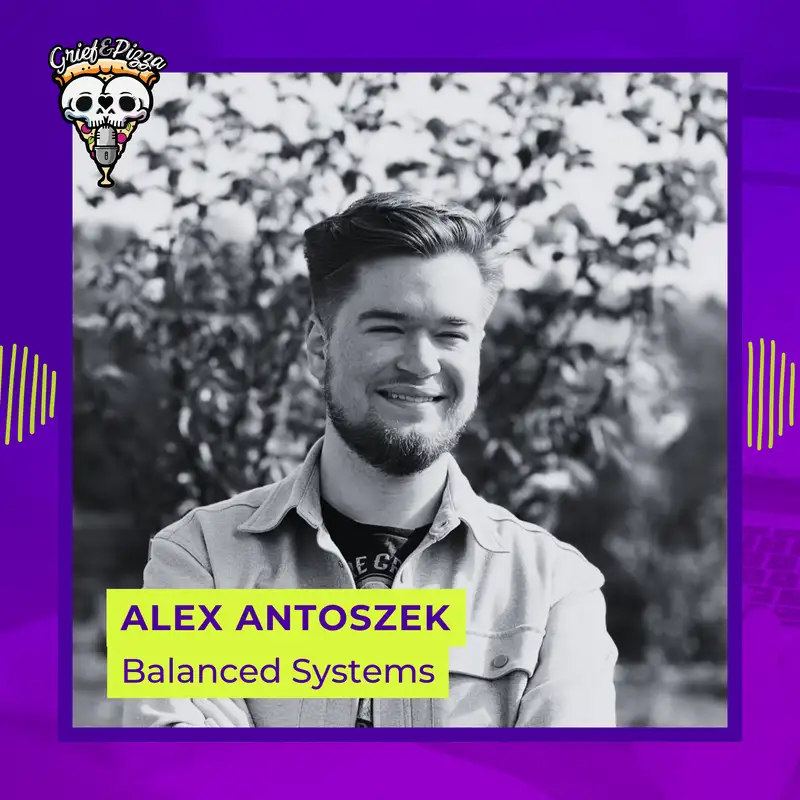
Finding Balance with Alex Antoszek
Ben: [00:00:00] This is Grief and Pizza, a podcast exploring the highs and lows at the intersection of business and emotional wellbeing. In today's episode, we're talking with Alex Antoszek, a Notion consultant and self-described ops artist. Like us, Alex started as a creative before finding his way into tech through Notion.
We get into why the best ops work is really about listening and how growing up in Poland shaped his views on growth and business. We also discussed his honest take on
Alex: AI from inside the Notion ecosystem and why he's stepping into a new chapter to build something of his own
Ben: Recently, we were talking about work, and you had noted that we almost have a parallel journey to Notion in that we started as an artist/musician and then sort of transitioned into technology as sort of a way of, I think, earning income.
And I found recently that you had kind of also made your way back to making music, and as I can see in your background, you have turntables and a keyboard and some guitars, and also behind [00:01:00] me, Technics turntables, keyboards, and guitars. So we have this parallel thing going on. And you had asked me how did I get to this point as a Notion educator and technologist, and I'd love to start off by just asking you what your journey was like from childhood to education to this Notion journey that we're both on.
Alex: So I'm way earlier in my career than both of you, but you are right, uh, the trajectory has been a little bit im- uh, similar. I grew up in a pretty interesting household where my mom was a language teacher, an aspiring ar- artist, poetry writer, so kind of, you know, a lot of books, a lot of artistic, fragile, and kind of very human-focused things, whereas my dad was one of the first IT system as- administrators in the country.
So I literally grew up while piles of books about ancient cultures and Slavic gods were piling up next to me, but I was also playing with early [00:02:00] RAM sticks laying around in our flat as I was growing up. So my kind of worldview and my entire life experience was always a mix of both tech and culture, and kind of I literally grew up on the edge of both.
And so from there, as I kind of started shaping up what I wanna do in life, it was very much focused on art. I was always aware of tech, and I was always inspired by tech pioneers and by tech solutions, and I understood computers very, very well 'cause they were pretty much native to my upbringing. I grew up with cell phones already being a thing.
I saw smartphones and Wi-Fi become a thing here in Poland, but I don't remember a life before computers were ubiquitous. So from there, I went into art a lot. Art resonated with me way more with technology just because it f- it felt more human. It felt more [00:03:00] real. Felt more real. It felt more real because there was a lot of emotion, a lot of...
It-- There was always a journey related to whatever art I was consuming or trying to create. And so for a long time, I dreamed up my adult life to be very much centered around art, and I went to photography and film school for a while. Then I tried to start my own photography kind of business/become a published artist.
I even had my own exhibition once. That turned out to be a pretty big uphill battle. But kind of on the side, in a bit of a similar timeline as when-- to when you guys, uh, discovered Notion, I discovered this app called Notion, which I'm sure many of the viewers, listeners of this podcast will be familiar with.
And for me, Notion was actually firstly a tool to manage my photography. It was a tool to manage my art. I was not obsessed with the tool itself in the very [00:04:00] beginning, but because I was generally very familiar with computers, I did became very much fascinated by the flexibility and the kind of very novel way of thinking about data that Notion presented at the time.
So eventually, I started getting really deep into the Notion community. I started leading pretty much the default place for the Notion community, uh, back then, which was the Reddit, which all of us have spent a lot of, a lot of hours in, for sure. And from there, that kind of grew, uh, pretty much just as a hobby.
Again, art still being my number one focus and kind of planning to develop my professional life to making art that resonates with people. However, as Notion grew, surprisingly, from my point of view back then, it also became a very popular tool, not just for individuals, but also for businesses. And, uh, when I first saw people like y'all becoming Notion consultants, Notion, [00:05:00] uh, educators, building a business around this tool, I was very surprised.
It seemed like a very, very novel idea. And back then, when I was still a struggling art student, I was asking this very, uh, lofty, "Who would pay for this? Who would pay for this?" In no way I could have predicted that then, that that would become my career path. And so over the past five or six years, Notion has eventually become my full-time career.
I am right now working within tech, within Notion in a bunch of different ways, which I'm sure we'll talk about. I work for Thomas Frank, who is the largest Notion creator on YouTube right now. I, and I also run my own consulting agency, Balance Systems. And so I am very much a tech bro, kind of probably so.
But art is still pretty much what I love the most, and I wanna lead or I wanna steer my tech career in a way where [00:06:00] it can elevate art and kind of be considerate about art instead of just kind of rolling over it. Long answer, but hopefully it covered most of it.
Marie: Fantastic answer. Great answer.
Ben: Yeah. Yeah, we have a very similar journey, and I think to say that we expected Notion to be this incredible tool for business is the funny way of thinking about it too, because, you know, the entire Notion Mastery business was based on really just Marie organizing her life and her projects and finding a better way to organize work visually, I think is, is really the important part of Notion, is it's re- it's a lot easier to visualize data in the way that makes sense to you.
So I can take a punch list of tasks, and Marie can see that visually as a gallery view, and it's-- and it helps her do her work. But we're basically focused on the same thing. And so I think our, our surprise was there as well when people started throwing money at Marie and when she was doing her [00:07:00] initial videos and being very surprised by that.
"Teach me how to use this 'cause this is incredible what you're showing here." And so it was very much born out of a curiosity and discovery with the tool that people were seeing something really special there. I'm curious about your business is called Balanced Systems. Tell me a little bit about that, because you've got this kind of, I would imagine, a quite busy job as the head of education for Thomas Frank because that he runs an education business.
And then you also have this side business. Well, I don't know if you would call it your side. Which one's the side business in this case? I know that Balance Systems is... Is it three members?
Alex: Right. There's two. Two.
Ben: Two? Two founders. What's awesome about this intersection between the Thomas Frank template business and your own system, and how do you actually strike the balance there between the two right now?
Alex: All my friends make jokes about the name of my company, and whenever the word balance comes up in all of our private conversations, there's always a, there's always a [00:08:00] joke around. But I, I maybe should explain where the name comes from, 'cause before I started this business, and before I even started working for Thomas, 'cause, uh, when I started working for Thomas, I had to finally incorporate an LLC because of jurisdictions, because him, him being based in the US, I wouldn't-- wasn't able to work on a normal contract, of course.
I used to write a blog when I was still very much in the art world called In Search for Balance, which was kind of a, just a personal exploration. It's something I, I don't really review back these days, but it was definitely a very pandemic, isolation, public journal of just exploring life and a lot of different topics.
And so this concept of balance as a driving value was definitely very much in my life for a long time. Other than that balance between culture and tech that I had in my house growing up, I also grew up in a bit of a kind of cultural balance context because I went to a Catholic school while not being really [00:09:00] Catholic, nor my parents being very Catholic, nor very practicing.
There was also a lot of other great reasons about that school. But before I even stepped into adulthood, this kind of concept of balancing between different worldviews, different points, different lifestyles, and, and just balance as a value, as a value through which we would-- one would perceive the world, kind of external actions, internal values, was always very near and dear to my heart.
And so when it came to naming my company, Balance Systems was pretty much the obvious choice. I think I literally spent, like, five minutes thinking about it And balance these days is very much about, yes, balancing these two jobs. Working with Thomas is, has been pretty demanding at times. Thomas runs a creator lifestyle business, which often means a lot of ups and downs in terms of demand, in terms of tension, because that often shifts as certain videos become [00:10:00] more popular, certain products suddenly become hits.
And especially since Thomas' business is very much aligned, as all of our businesses are, but Thomas' especially, is aligned with the Notion release/hype cycle, there's definitely been a lot of tough moments to balance there. But I will say I've built a bit, a pretty good routine blending the two. What I like about working with Thomas is, because we're a creator business, we have many customers, but we of course, can give a little bit less of attention to each and every one.
Whereas Balance Systems is, was pretty much born as an extension of that, where I can actually help and dive in and help people. I will admit, Thomas was pretty much the person to convince me to go into consulting. I was terrified of the concept of working for someone from abroad. I used to do consulting before, but it was all here locally with people I could meet in person, people I could shake a hand with.
Whereas, uh, the Notion consulting stuff was definitely very much [00:11:00] international and remote-based. But I will say that these days, the concept of balance is definitely, again, way more about balancing life and work, uh, because these two jobs very much are intertwined. And honestly, I haven't found a big challenge navigating between the two.
It's just a matter of some very good time blocking and setting priorities. But balancing creativity and work has definitely been a bigger challenge, and something that I've pretty much, uh, devoted a lot of last year to, uh, kind of giving myself more space for that. But that's a different topic
Marie: Different, but equally relevant.
A phrase that I like to think of, and I'm curious if this resonates with you, is strategic imbalance. You're sort of using an imbalance, but in a very intentional way, and you're saying, "You know what? Because I've maybe neglected this creative side of myself, and I know I need to kinda fill that cup," it's sort of saying, like, balance isn't about everything getting 50/50, an equal [00:12:00] amount necessarily, right?
But it's like paying attention to what each part needs. So I'm kinda curious, when you think about balance, like, what it actually means to you for something to feel balanced.
Alex: I, I really like that. I haven't c- uh, come across this term, strategic imbalance. I really like that. I will say, I mean, first of all, of course, this is up for everyone's interpretation.
I was very much deep into the productivity pre-pandemic, kind of minimalist, Cal Newport, Thomas Frank, Ali Abdaal sphere. That was definitely a very important part of my life. But as different external challenges came and destroyed any semblance of balance that I built for myself, I redefined this term.
And for me, it's way more about just being very open-minded about listening to yourself, listening to your, uh, body signals, and to listening to your external signals, listening to your close ones way more openly. And as someone who definitely has a bit of a, [00:13:00] kind of sometimes a type A/ambitious/I'm-gonna-do-it-all-myself attitude, that was actually the toughest part.
Tuning in. Tuning into the stuff that's not loud, like, you know, health signals or mental health signals or close ones. Just things that are really easy to kind of drown out when you're so focused on building something or doing something, when you're focused on a mission. That, for me, these days, balance is way more about that than necessarily balancing responsibilities.
Because the truth is, if you really care about something, you can just do it. It's, it's as simple as that. That's pretty much all of the productivity, hundreds of productivity books I've read. For me, they come down to this: If you care about something, you'll do it. You just need to care about it. You need to be careful about what you care about.
So balance is very much about listening to the world and yourself.
Marie: I'm curious what some of those signals are for you, 'cause I do think everybody's signals are different, right? The, the [00:14:00] little signs that like, "Ooh, something's amiss." Like, I've been skipping my journal for however many days in a row, or I notice myself, like, skipping breakf- Those little things that kinda show up for us that are those indicators, and that stuff takes time to kinda notice and, and recalibrate.
So I'm curious for you, are there some really strong signs that kinda tell you, "Hey, I'm kind of maybe moving in the wrong direction"? What are they for you?
Alex: So the biggest one is decreasing curiosity. Like, I'm someone definitely in a neurodivergent space. I haven't delved into it clinically too much personally, but it's definitely one of my lists for, for this year to discover more about how my brain works.
But a part of my nature was always intense curiosity. Wikipedia was always the number one app on my phone, and it's-- When I take breaks, I don't scroll Instagram, I read Wikipedia about everything and anything. That's also why I'm not the biggest fan of AI models, but we can talk about that later. And so the first thing that was always lack of curiosity.
If I'm overloaded enough that when I [00:15:00] have time, I am unable to be curious about everything and anything that I usually am up curious about, that means I'm definitely overloaded in some way. That means that definitely things are not in sync, that the little internal tree is not getting enough resources to grow.
And the second one, honestly, something that I've only discovered recently, but really being way more listening in to signals from close ones. Because your family, your friends, your close ones, your significant other are usually the best person to tell you that something's up. And this is a whole other topic, how to talk to others and how to listen, and it's so hard.
But just working on my own capacity to listen to things that may not be comfortable from others, and then not taking that face value, really going [00:16:00] deeper into that, that's been another, another signal. So being in tune with Personal curiosity and seeing and b-being very aware of when it starts to die down as a symptom of things not working, and then being on the lookout for any kind of tensions, any sort of, kind of unloaded tension in personal relationships.
'Cause a lot of that often results from, of course, either myself or the other person, but oftentimes myself not having enough capacity, not having enough space to work on those.
Ben: I have a feeling that you kind of just answered this question that I had for you here. You described yourself as an ops artist, and when I read that, I thought, "Hmm, I think a lot of people think of operations as highly technical."
And my question was, how is it artistic? And I think you kind of just answered that question for me. [00:17:00] But I would love to hear more about what you see as, you know, the artistry in technical work, how those two interplay. Um, 'cause I think that really sets apart a really solid, reliable operations from just doing autonomous work that kind of you're not listening to the signals that the autonomous operations are giving you.
Why ops artist?
Alex: That was pretty much just, uh, uh, uh, w-why it's in my title, why it's in my bio. It's just, I wanted to feel like an artist again, so I told myself, "Okay, I'm gonna call myself an artist from now on," 'cause people call themselves all sorts of stuff that are often not true online. But I have a bit of an explanation, yes.
Well, ops these days is pretty much just, uh, kind of on a basic level is just designing how computers talk to one another 'cause everything is digital. Most businesses that make money in Western [00:18:00] economies are, to a large degree, digitized, even if what they make, even if how they operate is still very physical.
So there is that layer of just pure technicality and pure physicality. But what people really miss is this extra layer of how we interact with computers, how we view them, how we feel them, how we personify them, which is... AI has just opened a Pandora's box related to that. So in my ops work and when I work with my clients, I try to focus way more on the human emotional aspects of it, because computers are easy to figure out.
Computers are or have been, until recently, very deterministic, very rules-based, very predictable People are not. And so I've come to believe that any good digital system has to be built with the emotions, with the habits, with the worldviews, with the [00:19:00] thoughts of people using it. So I consider my job way more to be like, um, like a therapist for business owners or for managers than, than a true tech consultant 'Cause what's the value in that?
You can just ask Claude to build it for you now. And so I'm very m- well, I'm way more interested in how people feel about computers and how people feel about work than about how they actually do that work or what tools they use to do that work. Tools are ubiquitous, whereas people are not. So that's how I view it.
Marie: Yeah, and I think with all this, we can get into a little bit of the AI conversation and whatnot, but it's sort of like if AI could solve the human side, we would have people not needing Notion consultants. But I feel like in the last year, like I'm doing far more Notion consulting than I've ever done at a much higher rate.
The stakes are higher. There's more people involved. There's change management. It's [00:20:00] organizations trying to figure out very complex challenges of how people collaborate, how they cooperate, how all these different pieces are talking to one another. And it's not a thing you can just plug into a system because, as you know, you talk to people and you're like, well, you have different people on, uh, different ways of processing information, right?
Some people get really overwhelmed by the way a page looks. Someone else wants to see all the data. Like, how do you make these different ways of operating work together? So to me, the, the human side of it really is, I think, if you have a skill in that area, that will set you apart as, certainly as a Notion consultant and as an ops consultant.
So I totally agree with you there. And I'm curious if you have, I won't say rigid processes, but sort of approaches that you take because, you know, often when someone is coming to you for this kind of work, they're feeling a lot of ways about it. They're feeling like things are a shit show behind the scenes.
They're self-conscious about it. Maybe they're self-conscious about their own productivity or that things feel really messy organizationally speaking. So sometimes I feel [00:21:00] like when people are coming to me, they're already kind of in a state of heightened stress or heightened tension, and they're wanting things to work well.
And so when people come to you in this state, I'm curious kinda how you introduce the fact that there is gonna be a lot of discovery and curiosity and, and it's this problem-solving thing that you're doing together. Do people get that when they come to you, or are they thinking that it's a very technical thing?
It's that like Trojan horse where you, you know, sell them what they want, give them what they need, which is actually that therapy hand-holding process. So I'm just curious about your relationship with that as people come to you and maybe don't know what they're signing up for right off the bat.
Alex: This is the toughest thing about my business.
It, it, it's, it's the toughest thing about my business. Being very clear about this up front, I've put in, in, in over the past few years as I've co-hosted the Notion Monetization Mastermind with Ben, which you started with Ben, right? It was you two that started the mastermind. Okay. Yes. Yes. I, uh... So a- as we work through that, I've tried to build processes so many times, and this is perhaps the true artist part that comes in all this, [00:22:00] that it's very hard for me to put myself into a process, and that's always been the biggest challenge.
What is most important for me, and it's, th- this is a very kind of high level answer or, like a very simple answer, but it's just listening It's just listening, and this comes down to the therapist part that I talked about. It's just listening. It's just very, very-- being very... W- when I get a new lead, and I always just start with, with a very open-ended call, no strings attached, no payments yet, I just listen, and it's like a first session with a therapist pretty much.
I try to listen, and I try to pick up on signals that they may not even be aware of yet. And a lot of people come to me with, "Yes, I want the technical stuff done." But I'm always very upfront that technical stuff is easy. The technical stuff will not get you that far. I can do just the technical stuff for you, but I can pretty much guarantee that then you will spend a lot of wasted productivity and time internally because the technical stuff needs to be, you know, [00:23:00] slowly eased into this organism that is your company.
And that slow process that is-- that I will charge extra for if going beyond just the technical stuff is really worth it, 'cause that will then help you save time and lost productivity on adapting the system. I've been very, very deliberate about what clients I work for. Last year, I did a talk for Notion where I talked about how I-- kind of my consulting journey, how I helped a bunch of small businesses.
I have rejected a huge percentage of the leads that come from-- to me, not from revenue reasons. I would love, uh, all the revenue coming from those clients. But just for personal reasons and feeling a sense of alignment And so kind of this pre-screening phase of, of, of picking-- and this is something that y'all have taught me very, very much through the mastermind or through your resources.
It's okay to fire your clients. It's o- it's okay to not sign on a client, and that has definitely helped with [00:24:00] this process. The toughest part is, or what I'm kind of-- what I propose with my clients is always a very deep discovery process, which is upfront, similar to how you guys used to approach this at least a few years ago.
Very much upfront payment, very much, "Okay, we're taking a bet on each other," and I'm just going on the listening tour, and I listen to complaints, and I listen to hopes, dreams, and I try to make sense of all of it. Other than that, there is no process, and that's probably the artist part shining through.
Ben: Yeah. For the listeners, our, the mastermind that Alex is referring to is, um, in the Notion Ambassador space. We have started a, a mastermind for specifically around monetizing Notion services, because, mm, three years ago, it was quite new, and a lot of people were discovering that there was this opportunity to sell Notion as a consulting offering beyond doing templates and things like that.
[00:25:00] Because I think as the marketplace expanded, it kinda had this effect on templates that reduced their value quite a bit. And now we have this situation where, you know, you can ask AI to build you kind of any template you want. So you can give it a, a set of instructions or maybe even a mock-up or a, a screenshot of someone else's template, and it can build it for you.
So I think more and more the value of these things is going the way of something like mobile apps, where the marketplace kinda went to 99 cents for even the most incredible applications were really, really cheap or free. And so we had to figure out different ways to monetize the services around Notion, and a lot of that is in education and setup and, you know, the fact-finding missions with all these people.
So yeah, we went into that scenario with, um, a new lens in those first years and tried to figure out what it was that people were struggling with with Notion. And sometimes it was the technical stuff, but a lot of times it is mostly change management. [00:26:00] And I think the one question that I introduced to that group that I always use is who's going to resist this change the most?
Because a lot of times, I have numerous clients that I've worked with that have basically said, "This is awesome. We want Notion right now. Let's build it." And we've gone and we've done the builds and things like that, and then right as you're deploying it to the entire company, somebody comes in and says, "Why are we doing this?
We already have this set up on monday.com, and now you're asking me to totally redo all of my systems, and I have to learn this new tool that is sort of always editable, so that means I can accidentally backspace and delete our entire operations, you know, if it's not set up correctly." So, you know, it's usually this kind of change management stuff and the emotional friction to change that a lot of companies n- still need help with.
And there's not really a lot about AI that kind of assists with that type of work. It assists with the [00:27:00] manual labor and the individual work that people might be doing, but as a collaborative change management system, it doesn't really help, and that's where people are still quite valuable in this space, at least for now.
Is that what you're seeing as well?
Alex: Yes. Yes, I am probably the least AI, hyped on AI Notion consultant, maybe somewhere, uh, on the bottom of the list along with you guys. AI is great at solving some problems, but it's also really good at making a lot more problems. And I am excited about what it can bring, and I'm excited about the technology.
I'm still a tech nerd, but I do agree with you on this point that the value of, of all work, pretty much, all work that can be done on computer, of course, 'cause there's stuff that thankfully, hopefully, AI will not be able to touch for a while. But all work that interacts through a digital machine is, is being redefined now, and the value that you can actually bring is listening, truly listening.
And what AI will never be [00:28:00] able to do, I think, will be to truly listen to someone's emotions, to someone's objections and put itself in someone's place. So I hope that this, what is very much a core selling point of my services and the things that I plan to do in the future with Notion, will be I can actually properly step into someone's shoes and give them advice and give them directions that AI would maybe only be able to replicate part of.
Marie: How do you feel about, you know, given that Notion is really heavy AI first, right? In the last couple years, they've, they've really gone all in on AI, and so we know that they're moving in that direction. We know that, uh, as an educator, it gets more and more challenging that the interface is changing so often, the way it works is changing so often.
You have everyday users are using AI to kind of build parts of the databases and things like that. So it's, it's happening so fast and, you know, we, we've sensed that tension as well, right? Where we're [00:29:00] like, I get that this tool can do some powerful things. It takes a lot of some busy work out, and it's introducing new challenges.
So given that your business is r- you know, tied to, I don't know if it's only tied to Notion or if you have any plans to kind of, you know, deal with other ops as well, but sort of how do you find balance in that relationship of being excited about this technology, but still having some criticisms or reservations about kinda how it's being used or who owns the tech and all of that stuff?
How do you find that balance? And, and do you worry at all that as Notion continues to kinda double down on AI, will this impact the way you feel about your work and the clients that you take on, or do you feel like there's always still kind of a space there for you?
Alex: Wow, that's, that's a very good question, and there's a lot to unpack.
To kind of start from the begi- uh, from the end, I do hope that there will be space for me because I love Notion. It is just an app, but it's also a company, and it's also a community. A lot of my Notion-related work has been very much community-driven, not [00:30:00] necessarily being business-driven, 'cause there's still a lot that I feel can be done within this community.
I will frankly admit that I am excited for Notion, but also I've be- I've grown more skeptical of Notion, especially... Before all this AI stuff, I always thought that Notion was unique in the sense that, yes, it was a VC-funded SF company. Yes, it was partaking in the same hypergrowth and hyper-scaling cycles that a lot of these businesses participate.
But I got to interact with a lot of the core team very early on with, with Ivan Zhao, the CEO, with Akshay, the co-founder. When I started kind of collaborating with Notion on a bunch of different things, they were a team of seven or eight people, so there was a lot more space to learn about who the people behind the tool are and what their values and what their visions are.
And I will admit there's definitely been a lot of challenging parts as the company has scaled and as the, uh, tech ecosystem is, is [00:31:00] frankly getting m- more excited about itself. A, a lot of the driving force is, yes, doing change for the world, but making sure that we're better off from that change first and everybody else comes last.
And I will say that personally I am feeling less connected to Notion's mission this- these days because their emphasis on taking away work from people in terms of AI agents, automations, is one that I can get behind, but I cannot get fully behind because the end game for that promise is replacing people with AI.
And I know that Notion themselves are definitely not doing that. Notion still is a very human-centric platform, and to, for Notion to work well at all, you do need human input. For AI to work at all, you do need human input. AI is still, in the end, just a lot of human-produced stuff being recycled, [00:32:00] reworded into new things And so there are concerns, but I will say that I am pretty happy with how Notion is treating this.
I also understand that, well, they kind of have to do this. They're playing a game where AI is, it's the lane that they're swimming in. And I know a lot of people on Notion's team are kind of more careful about implementing an A- AI and are kind of quite aware of the good and bad implications it brings with itself.
And so I'm still pretty confident that Notion is going to, or right now is kind of balancing the scales pretty well. And I also know that because Notion is such a big organization now, what the product team is feeling and envisioning versus what the sales team is feeling and envisioning versus what the revenue team is feeling and finances and revenue team is feeling and envisioning are different.
And what we are seeing is kind of, you know, r- result of a bit of a [00:33:00] ideological/kind of priority tug of war happening internally. That's how all big companies work. They make bets, and they hope they pay off. And so I will say that my kind of, I wanna say love, but my love, yes, my love for Notion has not necessarily decreased, but been redefined with this new AI age.
Personally, I'm not using AI pretty much at all, just because I kind of, on the utilitarian side of AI, where we build workflows, where we help automate things, I do use it for a few things, but they are very small because in the end, my conclusion is, if I want to use AI for this, maybe I shouldn't be doing this at all because it might be a redundant process.
It might be a thing I don't need to do at all. On the creative side of things, I am very much against using AI for creativity. I am very much against, uh, mus- AI-generated music, pictures, videos, different conversation. On a team, uh, [00:34:00] work/business system side of things, I am a little bit more open to using AI because I do agree it's, it's pretty damn good at doing things that before were much, much slower and clunker at doing.
So this is a very long answer. I hope that Notion will do the right things. I feel like I know that they'll do the right things, but also I know that the incentives, the financial incentives mostly that they have are a little bit different than how I view things. So I'm aware that eventually there might come a day where I will not agree with Notion anymore, and I will not be basing my entire business on selling their software.
Ben: I'm curious how Some of your cultural values are kind of encode your ethics around AI. You've been speaking quite frequently about venture capital and the Silicon Valley-led technology, but also this new resurgence in Europe in having maybe even a European-led [00:35:00] technology sector. How do you see Europe taking a lead into the more sustainable and ethical side of this tech?
Maybe even specifically in Poland, which I think over the last decade or two has seen immense growth in the tech sector, and the country is quite different from what it was in the '80s and '90s. How has some of the cultural impact of growing up in a country like Poland impacted the way that you see technology?
This is very much intertwined with
Alex: just thinking about the future in general because, yes, Poland is a country that has just recently undergone a true open market capitalist, uh, driven growth. It's a country that until very recently was one of the poorest in Europe for a lot of reasons, but mainly because it was part of the, uh, Soviet satellite system, of course.
It was, uh, it was a communist country with a centralized system. And Yes, this is a country that has grown rapidly [00:36:00] fast. It is-- Even five years ago, this was a totally different place bo-both in terms of standard of living, both in terms of opportunities available. Everything is changing. And so I have firsthand witnessed how great, not too controlled capitalist societies or, uh, uh, reforms can truly be something, uh, of a, of a wave that lifts all boats.
And pretty much all economists and all economic data pro- uh, points to that. Poland has played this transition very well, one of the best. We have avoided creating a, an oligarch class that has risen in many of the other post-Soviet countries, where a few fortunate and smart people bought up a lot of the previously state-owned infrastructure, thus monopolizing a lot of their power.
We have still one of the lowest Gini [00:37:00] coefficients in the EU, so there's definitely a lot going for us. But also in the past few years, as this growth is increasing evermore and businesses report even more profits and we play this game that the West has played for, for hundreds of years, we are seeing the downsides of it.
We are seeing that homelessness is on the rise, that the inequalities between the richest and the poorest are quickly rising, that the cost of living for the middle class is rising very heavily. So I kind of see this trajectory of my own country as a very kind of telltale story of what can happen with business and with VC and with, with growth.
Growth is a good thing. Growth is essential to life, to society, to human flourishment, but there is something called too much growth or growing too fast. And to kind of use a, a very [00:38:00] kind of physical analogy, I definitely do, do agree that there is a point where if a thing grows too fast, it cannot walk on its own.
It starts to trip up. So I'm definitely viewing business and, and Notion and VC and Europe as a whole and, uh, uh, in comparison to the US, which is very much All about growth, and this comes back to balance. There is a balance between growth and everything else. And so I do definitely wish that Europe could become, together with a bunch of other countries around the world who share the same vision, a place where business, yes, can flourish, where there is little friction to start something new, but there's also enough of a system that doesn't put enough pressure to grow at all costs.
I don't think that Europe is achieving this too well right now. I think that Europe is very much stuck. Europe is very much, uh... And, and by the way, Europe, like this is a term that North Americans [00:39:00] like to use, Europe, which is very fair 'cause-- But it's a whole continent. It's a very, very, very, very dense continent with a lot of history.
And as much as I love the European Union and believe it's the future of this continent, I also do wanna say that it's, it's very divided, and there are very-- a lot of very different perspectives on it. I do hope that Europe will become the best place to start a business because to take bets, which is literally what starting a business is, you do need to have a bit of a net when that bet doesn't work, and that's something that in the US has been very rapidly deteriorating and here in Europe still holds, but it's also being questioned more and more.
So my hope is that Poland, in the context of Europe and the US and the larger world puzzle, can be a leader in showing that growth is good and that we must ensure that growth remains, but also that there are other things that we have to care about other than growth. And this balance between pursuing a vision but also [00:40:00] taking care of the essentials is something that I do wish my country could show the world how to do, and it's something that I'm very much interested in, into how we steward this country in the next 10 or so years, 'cause I believe that a lot of the Western world, a lot of the industrialized world will be facing the same issues.
Ben: Yes. Great answer. I'm curious how, 'cause you work with obviously both local customers and Notion is very US-centric, I think, in the way that they deploy products, and so we have a lot of... Well, most of the, of the larger companies doing Notion stuff, they do have some large customers in, say, Japan and Korea and things like that.
But what's the difference from working with customers from, say, the US and somebody from Poland? How do, how do those customers show up differently in the work?
Alex: So I always say, and this is something that my fellow Poles might disagree with, but I always said Poland is the most Americanized country in Europe. Because of our history [00:41:00] and because of us being very much in opposition to the Russian world, to the Russian sphere of influence, we have always looked towards the US as a bit of a savior, and this is a very big word to use, but I will definitely stand by it.
I think previous generations definitely viewed the US in their way of living, their way of, of working, their way of believing to be the end goal and to be the way to live and the way to exist. And so Poland itself is a very interesting place in that context because it is also still a very European country.
There's a lot of culture, there's a lot of tradition. Because let's be honest, Americans are unique because America is a nation of immigrants. W- It's one of the fewer nations, there are many like that across both Americas, of course, but it's the, the biggest country that is made of strangers. It's a country of strangers, and it's both a [00:42:00] beautiful thing because it's pretty much the largest social experiment of that scale that we've ever seen, and so far they've made it work for hundreds of years, and they've made some great stuff, but there's also a lot of stuff that's not working.
So in terms of kind of how I approach working with US customers and European customers and the differences I see, Americans, first of all, are very kind of instantaneous. Americans are kind of very, very snappy, which actually in business, it's, it's fantastic. Working with US customers, I'll admit, is usually much easier and much friendlier.
It's much better to feel real progress when working with US customers. 'Cause Europe, on the other hand, it's all about processes. It's all about this kind of dance, and because of the culture, because of the all of the fluff around it, there's a lot of It's just a dance, and it's a very choreographed- It's time
Marie: for my siesta.
I'll, I'll call you- Exactly ... after my siesta.
Alex: [00:43:00] Exactly. Exactly. I, I love, I love the Italians, but working with them is often a challenge just because of the speed. So what I wanna say is I think both have a lot to learn from each other, and what I actually hope to do with my business and with my future impact is helping both cultures.
Yes, I'm European, I'm Polish, but I'm also very aware and very embedded in the US sphere and US mind, so I do very much hope to help bridge the gap, 'cause both have a lot of good stuff. The US, the speed, and the attention, and the care. They really care about all this stuff. They really care about building things.
But in Europe really cares about everything else. And so my goal is, first of all, to make my business draw on both cultural values, but also hopefully help my country, Poland, draw inspiration from both.
Marie: Seems like that's a pretty cool differentiator, and, uh, I'm curious how much you amplify that maybe on your, whether it's your LinkedIn profile, your website, you know, how much you talk about [00:44:00] that as a, a strategic advantage for you, being able to kind of lean on things you see across different organizations and different cultures being, like, a way to kinda bridge that gap.
I could just see that being, like, a, a huge advantage for you in business.
Ben: Back to the strategic advantage.
Marie: Yeah. The
Ben: strategic ba- imbalance, right? You can balance it. Yeah.
Alex: I don't. I don't, but I should. That's a very good suggestion. I don't, but I should, and it's, it has been a very tough process because pretty much every client I talk to, you know, they come up, you know, casual question, "Oh, where are you based?"
You know?
Marie: Yeah.
Alex: I'm like, "Oh, yeah, I'm Pol- I'm based in Poland." They're like, "Oh, are you an expat?" "No, I'm Polish." "Oh, okay." So it's always a very fun conversation and, uh, yeah, I should make more, more of a point of it. Uh, I will also say that this is tough because in one way, becoming American, becoming Americanized, or becoming aware of the American culture, you lose a little bit of yours And for me, the more important part in this is how do we, how do we keep both?[00:45:00]
How do we keep both? Yeah. That's a very good suggestion. I'll definitely... I should definitely emphasize that more. Yeah.
Ben: I don't necessarily have the same extreme of this, having immigrated from the US to Canada and now becoming a Canadian citizen. But I was born in the UK and then, you know, through my father became American, and I grew up as a US citizen, so I feel very American.
But in Canada, I blend in. You know, I don't have that same-- Maybe some people will pick up on certain accent cues or things that I talk about that might identify me, but I don't really have that sense of being, being sort of really, really polarized in, in between two cultures. But I... The more that I stay in Canada and the more that I experience things like socialized medicine and things like that, I feel a lot less American as the days go on, and I, and, you know, I don't have any real desire to maintain that culture anymore.
I, [00:46:00] I, I want to be Canadian. I wanna be in that, you know, maybe even become part of the EU at some point. We don't know. But yeah, I feel that as well, the, the imbalance and that, you know, I am losing a little bit of my original culture, having been in Canada now for 14 years or so, and I'm kind of okay with it.
So I think the inverse is true. You know, once you become maybe more Americanized, that you lament the loss of, of your culture. But the inverse for me is definitely also really apparent for me right now.
Alex: Would does Canada do better?
Ben: Yeah
Alex: What does
Ben: Canada
Alex: do better, Ben?
Ben: But what is compared to the United States?
Two
Alex: things. Two things. Yeah Not, not necessarily system-based- Mm ... 'cause healthcare we know, guns we know, but like culture, culture-wise, what do you like better about Canada? I'm really curious.
Ben: The, the thing that is, that is misunderstood about Canadians is, is that Canadians are nice. Canadians can be very u- not nice.
In fact, I li- [00:47:00] where we live in a rural area, there's a lot of un-nice people. But the one thing that is true about Canadians is that they are very kind, and I think kindness isn't niceness necessarily. But I do think that Canadians are incredibly tough, and they have a, a, a sense of determinism that is kind of...
I think people underestimate Canadians and their toughness, and I think a lot of it goes to the-- goes down to the point of there is a social safety net, and when it comes to founding businesses and things like that, we don't need to worry about, "I need to secure employment to cover my healthcare." So there's a lot more feeling of self-determinacy here, and that it's possible to start a business and carry it, and maybe we don't actually need as much to run and sustain a business.
Um, you know, that kind of thing is, I think, culturally is kind of encoded here. [00:48:00] And I think a lot of times I've had qui- conversations with folks here about that they would prefer to be American. They want the, those cultural values as well. And, you know, explaining to them what that looks like, "Here's my experience with healthcare in the States.
You would pay for this, you would pay for that. If you have an emergency, you know, here's what it's gonna cost you. This is kinda what healthcare costs." And they're often surprised. They don't actually They don't actually understand how much Americans are constantly thinking about those kind of social safety things.
So there's a lot of fear, I think, in around that stuff from my American side, and I still retain a lot of that and worry about money and things like that. But as I have lived in Canada for longer, that kind of anxiety, that social anxiety that's sort of a baseline in the United States is lessened. So I think your top is higher.
You can make more, you can be more successful, and you can... But your baseline is not covered. So there's a [00:49:00] more risk, but more reward, I think. And I think that not having that, it kind of softens those edges a little bit, and it feels a little bit more calm culturally.
Marie: Would you agree, Ben, too, that I sort of feel like there's a little bit more of that we have energy to care a little bit about our fellow human because we're all like, we're all kinda covered.
We're, our baselines are covered, right? Yeah. So in the States, you're like, "I'm just trying to put food on my plate and just trying to, you know, pay my bills, and I can't think about you. I'm thinking about me right now." Mm-hmm. Yeah. So I, I feel like it kind of incentivizes people to think just about themselves versus- Yeah
as a collective.
Ben: I think the, the incentive is key and the intention. You know, there are a lot of criticisms about Canadian healthcare, especially per province. Certain provinces do better than others, as that's the, a provincial responsibility is the providing of, of medical coverage. So I think there's lots to criticize about it, but it, it's the feeling that I can have a critical emergency, it's not going to [00:50:00] bankrupt me, uh, that creates that sense of wellness.
You know, in the States, I was 30, and I got really badly assaulted, and my medical bills were about $30,000. And the only way I could afford that was because of a, a statewide coverage for, uh, victims of crimes. But I was thinking about, let's say I got into an accident, and it was $30,000. Based on the insurance that I was ab-able to afford when I lived in the States, that would have not been something that was paid for me, you know, so I would have ended up paying at least, you know, $20,000 or something like that for that medical coverage.
So yeah, that baseline is really helpful, I think, for entrepreneurs and for people doing creative works. One thing I've been seeing a lot lately is some of the Nordic countries talking about how there are sort of government-sanctioned or paid-for artists to write books and things like that, and they're like, "I'm being paid to write a book right now."
That's pretty confrontational to an American 'cause I think a lot of people would be very [00:51:00] sort of jealous about that and think, "Well, if our government did that, then it would just collapse because everybody, everybody would become an artist and everybody would be creative if, if they got paid to write books."
And it's kinda like, yeah Yeah, they would maybe. Like a lot of people would transition to doing arts and creativity and human connection, and what would be amazing about that if we were to do that? I think it would be a golden age of creativity, you know, that kind of stuff. So it's a fascinating... I've enjoyed going, even though they're all sort of commonwealth colonial countries, growing up in the UK and then the States and then Canada was really kind of interesting.
It's really changed my perspective of how culture informs the way that we see these things, you know. Americans see AI very differently than Canadians, and every European country is going to have a general idea of those things that are very different as well.
Alex: Uh, th-this is a very interesting topic, and I think we can leave most of it for, for a different conversation.
But I just do want to touch on that point, because [00:52:00] that balance between, like, I know people from Nordic countries who, who on one hand, they have the best social safety nets in the world. They have peace of mind and, and a lack of this anxiety that, for example, a lot of Americans and a lot of people in other parts of the world have.
There's also the flip side of that. People are feeling less motivated to do stuff. Like, I have-- One of my best friend's girlfriend is Finnish, and I, I visit Finland at least once a year. Finland, one of the best safety nets in the world, a very good, equitable society, a good feeling of belonging. Also a fairly individualistic society, comes both from the climate and the culture.
But there is a pretty large sense of a lack of purpose amongst young people and lack of direction, and those programs that you mentioned are fantastic, and I believe every country should invest in its people by, uh, taking care of that baseline way more than, for example, the US does. I also can definitely see that there is a limit to that [00:53:00] and this balance between, yes, make sure everybody has a great baseline.
Let's make sure nobody is, you know, dying on the streets from diseases or homelessness, which is happening more and more in, in the US. But also, how do we make sure that people wanna do stuff? Because I believe that it is in human nature to do things, and it's okay to kind of, you know, step out of that race.
You don't have to build a million dollars business. You can just, you know, build a farm and take care of nature and animals around yourself. But I do believe there are good parts about what the US does, just the parts. But I also feel like what has made us such a better place to live is that drive. And I feel, especially amongst the younger generation, that there still needs to be a lot of very carefully managed, but space to be a little hungry.
You know? Not to be hungry literally, of course, but to be a little hungry to, to do things. 'Cause I can see, and that's how my parents and my grandparents grew up. No one [00:54:00] wanted to do anything, 'cause you knew there was-- the top was so low, right? 'Cause then, of course, if you have no bottom, terrible. The bottom was there.
It was a very terrible bottom, but it was there. But the top was, the ceiling was so low you couldn't even jump up. So I know there's the flip side of that, and that's why I think Poland and the old post-Soviet states have a very interesting story to tell That yes, that was bad. This is better, but it also has bad stuff.
But also those guys that were even worse had some things right. And all I hope for personally is that we all as society can, can get to learn from each other and build a better future. Mm.
Ben: Yeah. Yeah, I like that. It's a good way of putting it. I think elasticity is really important in societies, and I think that the fact that I grew up in the US and then moved to Canada, having that sense of what it's like to exist in a culture that is very [00:55:00] growth driven and then maybe switch to a rural area, I don't live in a city anymore, and so my values have certainly changed based on my environment over the years.
You know, working as a volunteer firefighter, I see the world very differently now because I work in a rural area, and we see what it's like for rural people, uh, as opposed to, say, in Vancouver, a larger city, or Seattle, where I grew up and, uh, lived in the States for a long time. So I think that elasticity is what helps me, like, flex into the hard work when I need to or understand, you know, when it's time to rest and maybe pull the foot off the gas because I'm just progressing for progress's sake rather than the betterment of my life and my community.
So I think, um, it might, might be good for more people to experience other cultures, you know, over time. You know, move around every five to seven years. Try a different culture out, see how it fits you, see what you can adapt from that and learn from that, and then [00:56:00] move on. Yeah.
Marie: I think that's also a big part of why when you work in a community online where you can sort of have access to people all over the world, like that to me is one of my favorite parts of working with Notion in a community environment is like we have people that are showing up from New Zealand and Australia and then Germany and India all in the same call, and some people are waking up at 3:00 in the morning.
Ben: Yeah.
Marie: Um, but the idea that we're getting exposed to different ideas, different ways of thinking about work, and so every time we have an office hours, we're kind of-- we're having to sort of think bigger and adapt and not think that just these productivity books that we grew up reading is how it is, because it's very different in different places in the world, and I love that.
So I love the idea of being exposed to different cultures all the time so that we're not kind of limited in our thinking. Yeah. Right? That's the beauty of the work that we do.
Ben: I really enjoy that, where you have AI haters from Spain to Brazil to Argentina, English [00:57:00] haters, German haters, and then all of those Countries also have zealots that are just absolutely obsessed with the growth and, and the access that it gives them globally to new forms of revenue and streams and things like that.
And there isn't a super obvious through line to why people are super excited about it or super intimidated and scared about it. And I love those types of communities where we can sit in the discomfort of these conversations and maybe even, you know, there's a huge advantage as ambassadors in that we get to chat sometimes with some of the Notion engineers and designers and product thinkers and kind of see what their thinking is as well, and maybe even where they're a little bit uncomfortable with some of the technologies and their own reliance on some of the larger AI companies such as Anthropic.
You know, how much of their work is now dictated and delivered through a single source of one corporation. [00:58:00] So, you know, I think it's super advantageous to be able to sit in these places where you get so much different type of signal that you can, you know, make more sense of a global transition to machine order, in a sense.
Alex: This just applies to both our jobs and as well as society in general. We should just talk more to people who are a little bit different. And, uh, that's also what I enjoy about my job a lot. I get to talk. Last week I had calls from people from pretty much all five or six continents, so that was very, very, very fun.
And, uh, I always take away from this pretty much what has driven me with-- in the Notion world is, yes, I get to talk about tech, but more importantly, I get to talk to people, and I get to listen to people who are very different than me.
Marie: Yeah.
Alex: And, um, this is something I wish the tech world did a lot more in general.
The tech world is very much a bubble, and it always had trouble. People very embedded in that world often have trouble kind of stepping down from the pedestal [00:59:00] and talking to people from, from different backgrounds, from different places, from different cultures. So yeah, definitely a very important takeaway- Yeah
for, for all of us on that point.
Ben: One of my favorite things I get to say a couple times a week is good time zone indiscriminate greeting to you. Because we have morning, evening, night, middle of the night. Some of our students get up at two AM to do reviews with us. I'm always incredibly appreciative of how people show up globally when, you know, we're all limited by time zones and things like that.
Marie: What's next for you, Alex? You know, your business is-- we're all kind of, you know, growing and going through different transitions in our businesses. But, um, you know, to wrap up this conversation, I'd love to know what are you most excited about? What's coming down the pipeline, and kind of what are your hopes for maybe for 2026?
Alex: Yeah, so that's a very good question. Honestly, at this very point, I don't truly know. Uh, I'm wrapping things up actually with Thomas in a few weeks. We're kind of [01:00:00] going our own ways for a lot of different reasons. I was always very excited about building a community and bringing people together. So right now I know that building maybe something related to Notion in, in the Notion world or maybe something beyond that, building a community is, is what I wanna do.
I wanna bring people together. I wanna facilitate great conversations and great knowledge learning. And for the kind of, you know, very short term and for the sake of getting my bills paid, I'm definitely kind of stepping more into balanced systems and helping f- companies do things. But my longer dream is to, to build a place for those conversations that we just talked about.
Whether that'll be about tech, maybe, but that's the dream. So right now, a lot of things are up in the air, but we'll see what comes next.
Marie: That's fantastic.
Ben: I'm excited to see where it goes.
Marie: Yeah, me too. Hopefully I'll be
Ben: part
Alex: of that community too.
Ben: Yeah.
Marie: Yeah.
Alex: [01:01:00] Yeah.
Creators and Guests