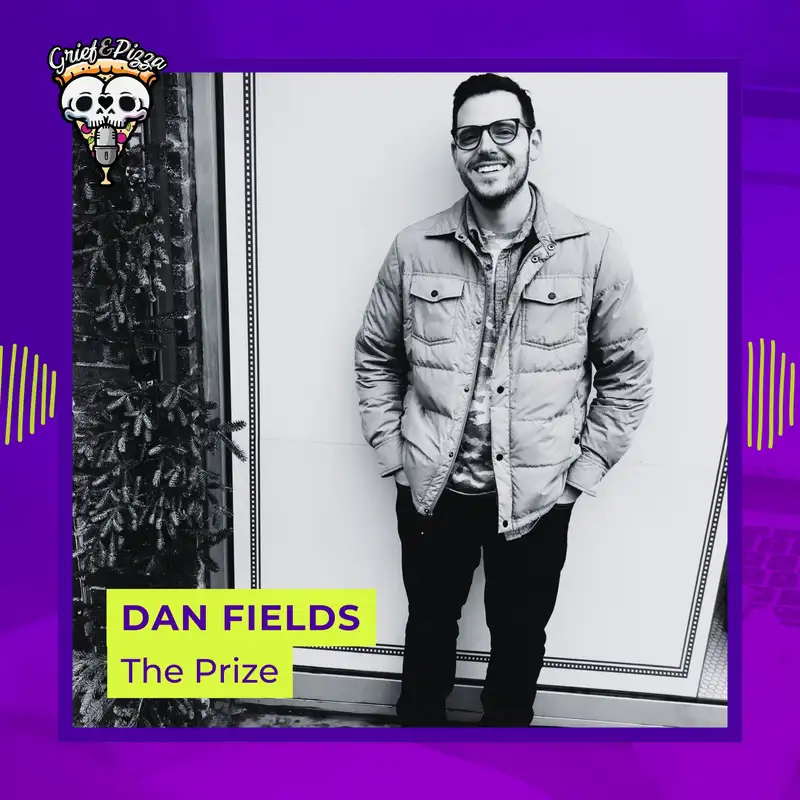
Eyes On The Prize with Dan Fields
Ben: [00:00:00] You're listening to Grief and Pizza, a podcast exploring the highs and lows at the intersection of business and emotional wellbeing. In today's episode, Marie and I spoke with Dan Fields, an old friend of mine from my agency days. Dan runs a digital production agency called The Prize, and we spoke about the trends in the ad agency world and the impact of AI on digital projects.
How important is adaptability and creativity in this ever-changing landscape? Let's find out
So Dan Fields, welcome to Grief and Pizza. Uh, you're an old friend of mine, and as we were going through some of the old stuff yesterday, we realized that I was the first, uh, guest on your podcast back in 2012, was it? So- Yes ... a long time ago. Um, and yeah, I was, like, the first guest, plus then I came back on the show, and I was laughing about this because the very first episode of your podcast, you were asking me about what's going on in my life, and I was go- going through a divorce at the time.
Dan: Mm.
Ben: And then the second time I was on your [00:01:00] podcast, you were talking to me about my girlfriend, and that girlfriend is the lady that we also have here on the podcast, now my wife, Marie Poulin. Wow. So it's like, it feels like you and I have had this podcasting relationship for almost, over a decade in some way, and your podcast, Save It For The Show, was one of the first podcasts that I actually genuinely enjoyed listening to.
Like, I, I really wasn't a podcast person, but SIFTS was a thing that got me to really enjoy podcasts. You and Eddie are-- have some of my favorite memories, and I have so many- Aw ... so many little riffs that, um, that you s- you've said on your podcast or on your Instagrams that Marie and I repeat to each other a lot of times.
And I've always thought of you as a very funny guy.
Dan: Aw.
Ben: And I've loved your podcast in the past. You had some really interesting guests, like Albie Sure! was on your podcast at one point. Yeah. And, like, you had, like, some really interesting guests over the years.
Dan: Thanks.
Ben: Um, so I'd love for you to, you to introduce yourself, what your journey's been like as a digital producer and, uh, you know, a creative person and, and we can kinda riff [00:02:00] off of that.
Dan: Yeah. No, I, I was ahead of the curve, and I guess I should have stuck with podcasting, but it was like the Wild West. I, I used to post it to SoundCloud. Uh, Spotify never, didn't do podcasting, so it was a pain. And yeah, you were always such a good friend, Ben, that you would come on and, and we would talk, and I'm so equally proud that, of all this thing that you guys have built.
It's incredible to see. Um, yeah, it was fun to do. I feel like as a lot of people do, you need an outlet and, you know, I had a day job. I've got three kids and a wife, and I don't know how to whittle or paint, and maybe I'm a, I'm a frustrated person who had, needed some way to do that. And you mentioned Albie Sure!.
I used to use his song as my intro, and so I tried to have ironic guests like that. Like, I, I used Dan the Beast for most of my stupid internet stuff, and I, I had-- I interviewed Dan the Beast, who was a UFC fighter, [00:03:00] and he had this funny thing where he was like, "Well, don't, don't go to danthebeast.com 'cause some other guy owns that."
And I said, "I own that." Like, "I should give this to you, Dan." And he was so, like, taken aback, like, "What? Uh, y- you own that?" So yeah, so it was fun to do, and it kinda ran its course. I don't know, after eight years and 300 episodes, I mean, you guys are content creators. I think you always hope you have that moment where something blows up.
And even though it was getting a few hundred listens a, a week, it never really took off to that level, and we just kinda shelved it and, and moved on. And it's been five years since we did the show, and people still kinda listen to it, which is pretty cool. So yeah, can't complain about that.
Marie: How did you make that decision?
I know we talk a lot about, you know, grief and goodbyes and things like that. Like, how did you know it was the right time for you to say goodbye to that?
Dan: It was tough. I, I feel like every week I would make a show, and I had a co-host, Eddie, like Ben said, but I pretty much shouldered the majority of it. And it just kinda got to a point [00:04:00] where, I don't know, I think if, if Eddie had been like, "Let's keep doing it, let's keep doing it," but when I told him, like, "Hey, I think we should stop the show," he said, "Okay."
And I was like, "Oh, okay. Well-
Marie: Guess we're doing this.
Dan: I guess we're done. Uh, and so we, uh ... It quickly w- wound down, but we did like a farewell tour where we knew we were quitting, and the last four or five shows we, you know, we, we told people we were quitting. But I struggle with it. I, I started doing other dumb things on the internet, like my stupid wrap videos.
What's in Dan's Wrap, which was a TikTok thing that I did for a minute. Wrap, like-
Marie: Still my favorite thing.
Dan: Yeah. Aw, thank you. Like a tortilla wrap. I, I eat odd things for lunch and wrap them up. So I feel like it's important to have that internet weird haven. I still ... I'm looking for my next one, 'cause I haven't done one in a while.
Maybe this will be it, this podcast.
Ben: Let's talk about your background a little bit because I feel like, like when we first worked together, uh, about 15 years ago, we were working at an ad agency called Buckwild, which is still around. And you were kind of [00:05:00] the head of digital production there, and I was the director of development, and we worked together a lot.
But you had a background in like really ... Like, you- you're a creative person. You've always been a creative person, so you do seem to have always like some kind of creative outlet. But now when I think of the professional work that you do, you're, you're like a producer of digital products, digital ... You know, that kind of thing.
But you've always got some kind of like side creative thing, and your background was in ... I remember you built Flash websites just like me, and so we had that in common. But you took more of the route to managing digital product, projects and, you know, I went more towards the building of the things. Tell me about your journey from doing digital product management to what you're doing now with your company, The Prize.
Dan: I think I would never in a million years lump me in the same development category as you, Ben. I was a hack. I was ... What it was is, I, I'm 43, and so I feel like guys our age, when you come up learning about the computer, the only way we could learn about it was by dissecting it, [00:06:00] taking it apart, figuring things out, hacking our MySpaces and, you know, things like that.
So inherently you all become a little nerdy and, and technical, and now it's not that way at all. Even with my, my son. I have a 17-year-old son. We built a gaming PC together, and he still really doesn't understand how Windows works, you know, how the computer works. Whereas I think like, uh, people like, you know, our, our age, you know, when we started using the internet we had to figure it out.
So I sort of fell into being a developer only because I liked video games and I liked figuring problem-solving, and it was the only path that I could take until I realized I wasn't good at it I'm not like an engineer. I'm not very good at math, and I appreciate you saying I'm creative, but I'm not traditionally creative.
I'm a terrible designer. Uh, my wife picked out my outfit before the call in here. I had her in here, and I was like, "Honey, like, is, is the light okay? Is my hair okay?" Like, I gotta know my strengths, and it's not that kind of stuff. I'm a traditional [00:07:00] creative. So it was... I just fell into it. And so once I realized I'm much better at talking to people and writing proposals and sticking to schedules, I, I quickly...
I, I quit that job Ben and I did together, and I, I went to be a designer, um, at a new shop, and I was sitting in my office designing a website for horse vitamins, and it was so bad. The design was so terrible. And my wife came in, who's incredible, and she's like, "Honey, you made a big mistake. You are not a designer, and you need to go back to Buckwild and be a producer."
And I said, "You're right." And I did. And then from then on, I was more of a manager and a producer, and I haven't designed a website since, thank God. So there's hope for people who aren't creative. I think once you realize what you're good at, uh, push into that. And for me, it was working with people and talking to people and, and helping them out.
Ben: Yeah. I think this has been going around a lot lately, and I think it's likely due to Rick Rubin's book, The [00:08:00] Creative Act. I don't know if you've seen this one. But his, his general premise is that everyone is creative, and maybe, maybe not everyone is a, an artist, but everyone is creative in their own way.
And I think you have an extremely creative angle on the way that you run projects and the way that you work with people, and I think there's, there's such inherent crea-creativity in all human communication. So I wouldn't... I mean, I personally wouldn't discount your creat- your level of creativity because I feel like with, you know, your podcast and all the things that I see you do and create, even, like, your wall behind you as I'm looking at, it's got, like, these really colorful...
You know, you're, you are a creative person. I, I can say that with certainty.
Marie: Just embrace it, Dan. Just own it. I,
Dan: I should.
Ben: So I'm curious, like, if you could think about how, how what you're doing now... So right now you're working with The Prize, and I think of you as almost like a, an orchestrator of projects.
Like, you bring together these super teams to create these really big projects that maybe an individual creator couldn't do themselves. Like, how does, how does that factor in? How does [00:09:00] creativity factor into the way that you work with these different teams? 'Cause you're, you're really-- You've gotta select the right people for, uh, a large agency's, uh, ad, ad campaigns and digital products.
So, like, that to me sounds like a really creative exercise. So what's that work like for you?
Dan: Yeah. No, you're right. It can be. And, and to back up a tiny bit to explain a little bit more about that, because of my background, because I was a developer and then a producer, because I've built and made so much stuff, I've turned myself into, like, a consultant where, like Ben said, if- If, if someone needs a website, if they need a commercial and they're not sure who to hire, you could go on Google, I guess, or, you know...
But odds are you're gonna ask a friend, like, like any of us would. "Hey, I need an app built. Um, I need an animation for my podcast." And so I've just surrounded myself with really great people where folks know, "All right, if I reach out to Dan, he's gonna connect me with someone who's really great. They're gonna do a [00:10:00] really good job.
They're not gonna screw me over." Because there's so much in this industry of awful people who will take your money and run. And so I've-- Yeah, that, that's, that's my job. And you're right, it is a bit like an orchestra where I can say, "Cool." I've do- I've done it with Ben. I was like, "All right, Ben, you're gonna develop this.
You're gonna design this. Here's the person who's gonna, uh, do the, the UX for it," or whatever it might be. And, you know, I-- The way I'm compensated is, you know, I get a, a tiny little piece from each little part that I do, and it's a lot of fun. And I-- It, it can be hard to know who's right for it. If I put the wrong person up for the job, you know, there's, there's personalities I have to think about.
There's, um, have they not had a j- a project in a long time? Maybe they just need work. Like, I need to consider that. It's, it's great, and I work from home. Like, that's the other thing. Five, six years ago, working from home, I used to hide it. I, I-- People used to think it was weird or, like, not professional.
Like, "How could you work from home?" Like, that's [00:11:00] bullshit. No, you have to work in an office. Um, and so I, I, I, I have three kids, like I said, so I missed out on a lot of their little life, um, when I worked at an office. So it was nice to be able to work from home, kind of be my own boss as, like, a reluctant entrepreneur and Yeah, so far so good.
Marie: I'm curious how you manage the, those relationships. Like, is that intuitive? Do you have some amazing CRM system? Like, how do you track that information behind the scenes, and even, like, what status or where people are working? What kind of tools are you using to manage that?
Dan: I am a hardcore diehard Superhuman user for, for my email.
Marie: Oh.
Dan: That changed my life. Like, I know that sounds crazy, and I remember when I took the tutorial and they're like, "It's $30 a month." I- in my mind, if something's more than Netflix, I'm like, "What are you ta- $30
Marie: a month?" That's outrageous for email. Yeah.
Dan: For email. Emails should be free, and I would pay a, a, $1,000 a month for it.
Like, it's just changed... Like, to me, my inbox is my to-do list, and that's [00:12:00] the, the premise behind Superhuman. And so every day when I come to work, and it resends you emails that you might have reminded yourself, like, "Remind me in two weeks to reach out to Marie," and then fwoop, that email comes back. It has 1,000 features, but really that's become my CRM.
I, I do use Pipedrive, which is another CRM, which I'm kinda lukewarm on, and for me that's just more of, like, projects. And as I'm rambling here, I'm kinda realizing, like, I probably could benefit from having a better way of tracking people. Like, I don't really have, like... I don't use HubSpot. I don't use, um, Salesforce.
Um, so much of what I do I feel like is just repetition and luck, that if I had these, like, automated systems where I'm like, "Send an email here, do this, follow up here," and it felt too robotic. I, I think what sets me apart is I'm not a sales guy traditionally. I'm more of a person, like a human being, that when I talk to you on the phone, maybe halfway through our call we'll start [00:13:00] talking about work, but the first part is not too dissimilar from this, just bullshitting and enjoying each other's company.
But yeah, Superhuman all the way. I can't say enough good things about Superhuman. In fact, I was talking about them so much they're sending me a hat, which Ben can attest to. Nobody loves free swag more than me. And when Ben and I would work together, everybody in our office would play it cool, 'cause we had really cool clients like Burton and all these video game clients, and everybody always wanted the product.
And I was always the guy that would be like, "Hey, client, send us free shit." And then I would be like Santa Claus, like going around the office handing out Xbox games and tennis shoes.
Ben: Oh, man.
Dan: It was good,
Ben: good times. Yeah, we had such... We, uh, we were working with a lot of... We worked with a lot of outdoor brands, so you were getting Dragon sunglasses, Gregory backpacks, and then we w- and then, uh, Eddie, our VP, was also in the music industry, so we were working a lot with music artists as well.
So, you know, I- we have these wild stories of developing websites [00:14:00] for To- uh, Talia and Backstreet Boys, New Kids on the Block. We did all kinds of different stuff where we actually were doing production on those and meeting those people in real life. So it's a, it's, it's, yeah, a lot of fun, a lot of fun history there with that kind of work.
Dan: Dude, Ben, that's how we met. You... Ben did a website for Ice-T. And this was in the Flash days- Mm-hmm ... where, like, a website was almost like a little mini video game, and I miss that. The, the internet has lost so much charm and weirdness. But Ben was the king of this effect, that it was like this like zoom and move effect that Flash websites used to have.
And you were living, I think, in Ohio at the time. You didn't even live in, in Seattle. And we... I don't even know how we got connected with you, but you were so good, and you immediately, like, joined the crew and elevated us. And you mentioned Talia, which I don't know if a lot of people know, but that is like your Sistine Chapel.
I feel like that website you made for Talia Is unbelievable. There's nothing else like [00:15:00] it
Ben: It was-- You know, that's, that, that was, I think, the, the heyday and the height of Flash design, and we had a creative director, Jeff Toll, who made the most beautiful, beautiful, like, painterly, uh, layouts of-- for these musicians, like, just incredible art.
Um, and it was such a delight to work with because it was one of those things where the team is working at its, like, height. Uh, everybody's at the highest level of the production. We had our CTO, Robert, design these Photoshop actions, and this is, like, well before any kind of, like, design systems and stuff.
But he had these Photoshop actions that you could just run an action, and it would take whatever you had selected and turn it into an exportable graphic that was just, like, Flash ready. And then Jeff is just designing these beautiful painterly things. We had a guy that was doing coding the animation packages, and I was kind of or- putting it all together in, in Flash and, and it was just, like, music and, like, every little bit of it was just like we had this really awesome super team.
And yeah, I [00:16:00] definitely miss those days sometimes 'cause it feels like nowadays that you have more of a, just a standard, more of, like, a templated website that you're plugging images into rather than, like, creating actual works of art.
Dan: Mm-hmm.
Ben: Um, and there, there's, there's quite a few companies, I think. I'm sure you work with some companies that are doing some really high-end, like, art-artsy stu- type stuff with, with JavaScript and with, you know, more modern web technologies that run also on the phones and things like that.
Dan: For sure.
Ben: Um, but yeah, I do, I do think. I, I often lament those days, the, the loss of those days. You know, Steve Jobs in famously in, you know, 2008 saying that they're not gonna allow Flash to run on iPhones was kind of like-
Dan: Mm-hmm ...
Ben: the death of an industry in some ways. Um, and I remember, I remember writing a post on my original website saying that creatives need to, need to extend their, their reach outside of individual platforms 'cause so many guys that were doing Flash stuff with us, they lost their entire business immediately because the, there was no [00:17:00] Flash.
And, you know, we had to, had to switch gears to doing, you know, HTML websites all of a sudden and figure out all this new technology. And so, like, you know, that was, that was a really fun- foundational learning in my business, was not to go too deep on one specific thing that you're, you know, is getting traction because it can be just technology just changes so rapidly.
And, and I think now it's like- Those kind of cycles that were maybe five to 10 years are now five to 10 weeks
Dan: Yeah
Ben: Um, with, with AI and things like that. So I'm curious if... What, what are you seeing trend-wise in the ad agency industry and with these digital products and apps that you're doing? How's that being, how's that being impacted by AI and, like, individual creators that you might have pulled in to do something?
Are they being, are they being thought about as maybe, like, we could replace this with AI kind of thing now?
Dan: Yeah. AI is wild. There's so many different facets to it where you, you... Just saying AI [00:18:00] as this, like, catch-all is, is become so complicated, and the first thing when you started saying that, Ben, you made me think We, Ben and I probably made, I wanna say 50 websites together, like from all stripes, and one of my favorites we did was for the USA Network.
Do you remember Characters Unite? And there was a hot moment where doing Facebook Connect, because it was sort of novel to see your face on the internet, you know, 10 years ago, and so a lot of the websites Ben and I did were these user-generated content, UGC websites, and this was one of the first where you uploaded your face, you were part of this, like, tapestry, and that's-- nothing's changed.
Like, I still get briefs where it's still upload your face, except now it's AI. So, you know, you're in a different pose, and it's me on a whale or in space, and it's still the notion of putting the onus back on users to sort of like do the creative. And, you know, the brands will say like, "No, no, [00:19:00] no, we're giving them tools."
It's like no one likes doing that. They wanna play PlayStation or watch TV or hang out with their friends, like not engage with a brand online, creating content to then share on your story. But there's this, like, industry that I think almost like banner ads that just relies on perpetuating that and hoping people create content.
But then there's also just AI for AI's sake where there's, like, automating, like, I think even, uh, shows like this where, you know, there's, like, cool AI that's gonna try to pull out interesting chunks from our conversation. To me, that's such a great use of AI, eliminating the busy work from a lot of the things- Mm-hmm
that none of us wanna do. So yeah. So I'm definitely seeing a lot of user-generated content AI websites and-- but I think it's-- You can tell, like it has that, like, uncanny valley energy to it, and I think there's gonna be a pushback on it where AI will almost become like its own genre of content and then bespoke.
It-- We made it from [00:20:00] hand. Like, that's gonna continue being seen as like a craft and have so much more value for people.
Ben: Tell me a little bit about what kind of projects do you work on now with The Prize, and what's, what's the thing that has been sticking, you know, in your business? What's the hardest thing that you've had to overcome in the last couple years?
Dan: It-- Last year was weird. Like, I think anyone who works in the digital ecosphere in terms of, like, making websites, making products, you know, Squarespace is incredible and Wix and Webflow and all these things, but- W- when we made that Talia website, you know, we probably got paid 30 grand to do it, and now that website would be, like, a million dollars.
Like, the amount of time and energy that went into that. And so now people would say, "No, no, no, I'll just use Squarespace," and, and, and that's okay, and it, this does such a great job. So I think one thing, kinda like you said, Ben, about having to switch from Flash to HTML, is people just having to realize how important it is to have a site [00:21:00] and spend money on it, and d- do something unique and bespoke.
And, and, and so that, that's been difficult to overcome, is getting people to do that. Uh, COVID certainly hurt, like, events. Like, a lot of what I do is really cool activations, and I'm at South by Southwest, and there's... The new Fallout TV show is coming out, so there's a, you know, a cockroach that I get to ride or you know, whatever.
Uh, COVID killed most of that, and frankly, I don't even know how effective a lot of that stuff is. Like, you know, as a brand you spend a million bucks to build something for, you know, 200 dorks to walk through and hope that they share it on their social media.
Ben: Right.
Dan: I can't believe I'm saying that out loud.
Like, I'm... I love thes- these projects. It's my livelihood, but I, I really wonder how effective they are truly, because then what it's, ends up happening is all you make is, like, a legacy video or a case study. It's like all these, like, digital out-of-home, like these 3D out-of-home billboards you see. Those are cool, but in real life if you're at the wrong angle, they don't even look [00:22:00] that great.
Mm. And so it's, it's funny how it just all becomes about the case film that you then share, um, to try to win an award and stuff like that. So it's been tough though, but I think fighting to try to stay relevant, make these cool websites, and then events. Yeah, so I've been doing a lot of fun events, which is great to see.
I think people really wanna be back out there, um, experiencing things again, which is nice, uh, 'cause it... Yeah, we missed that for sure.
Marie: So you're starting to see more of an uptick now of, like, things going back to being more in person?
Dan: Yeah, yeah, thankfully, um, which I feel like I'm talking out of both sides of my mouth.
I hate traveling now. Like, I used to have to travel so much. And I've become such a homebody, but it's tough too, because I think we spent all these years perfecting our homes to live in, assuming we wouldn't have to leave, and now we're like, "Yeah, I-" I, we got a pretty good setup here. Like, I don't wanna leave anymore.
Like, I have to think about [00:23:00] my son, who's now going to college, and he's gonna leave. Like, it's gonna be a pretty big change- Yeah ... you know, for, for somebody entering that world, where I think kids often wanna leave home to get away, and it's... Most of these kids have it pretty good at home, so.
Ben: Is he going far for college, or is he staying nearby?
Dan: He's staying near, just a couple hours away, thankfully, um, which I'm really torn about. He's such a good kid, and I, I love having him around. Um, but it's, it's good for him. It's time to leave the nest and spread his wings.
Marie: What's he studying?
Dan: Engineering so far, which I'm like, great. You know what? I, I hate to be that dad who's like, "Be a doctor, be a lawyer," but, uh, what's a kid gonna do in 10 years from now?
Who knows what these jobs are gonna be? So somebody's always gonna need a civil engineer or an electrical engineer or a computer engineer and... But also, who knows what they wanna do when they're 18? Oh, I know. Like, that is an insane thing- Yeah ... to put on a kid when they're that young. So we'll see.
Marie: Yeah, we...
I feel like we've been [00:24:00] having those conversations 'cause of my nieces and nephews, too, are kinda at that age and thinking about going to school. And it's just like, oh man, thinking about the, the student loans and just the fragility of some of these industries, and you're like, "Ugh, what's the best move?"
Like, I don't even know. Things are so different than when we were going to school, and like jo- jobs that, uh, you know, didn't exist when we were in school that existed, and now, you know, things that are just kind of evaporating so quickly. You're like, "Oh, well, that no longer is a thing." So just feels really unstable.
Dan: Mm-hmm. And if at all. Li- like you said, I, uh, Ben and I, our, our old, old boss, you know, we would... He didn't go to school, and he's an incredible entrepreneur who's started and sold multiple businesses. And I went to... My degree's in journalism, technically, because back then, the advertising... I have an, an advertising degree.
It was in the journalism department And I, I have an art minor because it was digital media, and now of course there's probably, you know, design and graphic design, but back then there wasn't. [00:25:00] So yeah, I- I'm probably kind of rare in that what I went to school for I'm doing. But I went to school, I was a biology major.
I thought I wanted to be a doctor, which turned out to be an absolute farce just 'cause my parents just funneled me- ... into, like, this doctor path.
Ben: Wow.
Dan: What about you guys? I, I... Did you go to school for something that you're still using? You went to art school, didn't you, Ben, or film school?
Ben: I went to art school, yeah.
I have a fine arts degree. I was actually just writing about this the other day because somebody was asking whether, did your parents encourage creativity in you? And I was s- just saying how my mom has an archeology degree and she would, um, but she went into nursing and then, you know, totally changed her career from, like, kind of like a more, like, historical, artsy type situation into the sciences.
And my dad has an education degree and was a basketball player and a coach and a, and, and an educator, and he also transitioned into this, like, science-y STEM type stuff where he became a recruiter and ended up at JPL, like NASA eventually in his later [00:26:00] years.
Marie: Wow.
Ben: Um, and, and so both my parents had this, like, started with the arts and then transitioned into STEM.
And so I had a similar thing where I was planning on going to, uh, university for chemical engineering. That was the thing I absolutely loved in, in high school, was chemistry. Um, and then I, at the last year of school I kinda did some advanced chemistry placement stuff, so I didn't need very many other credits in sciences.
So I ended up taking, like, three art classes in my senior year just back to back, and I was just making art all day long. And it, by the end of the year I was like, "I think I wanna do arts. Like, I don't think I wanna do-" This is pretty fun. Yeah ... "chemistry." Um, and so yeah, I ended up in, I ended up going to art school, and I was doing a medical illustration program.
So kinda similar to you, where I started off doing biology, like first year biology in college. Mm-hmm. And I was like, "I hate this. I hate this so much." And then the, the very next year they started a new program called TIME, which stands for Technology Integrated Media Environment. Mm. And it was [00:27:00] all, like, computer arts And I immediately just was like, "Oh, that, that's what I wanna do."
It's like, it's like art, but also technology. And I s- so I started transitioning from art to doing... I learned programming and robotics from one of the teachers that happened to have an engineering degree there. Um- Wow. Yeah. And so like I, uh, I had that nice little blend. So similar trajectory to my parents because started off with the arts training and then eventually became a programmer.
And, you know, I think, like you, I think having that arts and journalism background is the thing that really helps with the technology. It's like this layering effect where you have an eye for the design and the, and the graphics and stuff, but you're able to like, you know, extrapolate, you know, what's important in design, uh, in those types of things.
So, you know, working with somebody like Jeff, our, our creative director, he could give me a, a graphic and I could, I could tell him like, "Here's what I want you to change about that because I think it'll work better in terms of this animation sequence and the way that we're interacting with it." So I [00:28:00] would...
Y- you know, having that knowledge of the, the artistic fundamentals always like really works really well with integrating with other people's artwork and things like that, so. I think Marie has a similar background with, uh, also being a graphic design school grad.
Marie: Yeah, went to design school. But, I mean, admittedly, I didn't really know what that even entailed, right?
It was like, oh, I was painting, and I like painting, and like graphic design seems like the closest thing I could do to like making some money while being artsy, but I didn't really know what I was in for and what design really meant. But once I was in it, I was like, "Oh, okay, like, this is fricking fun.
Like, I really like, I like where this is, is going." But it wasn't till I hit the, like the Flash stuff and doing some of those digital project, projects that I was like, "Oh, okay, like, there's a whole other digital component here that kinda opens up a whole new world." So that part was even more fun for me, too.
And I think that's why Ben and I connected. It was like, we're building websites, we're tinkering. There's the art piece, but there's also the tech piece, and I think that's what we could both kinda relate to, so.
Dan: I love your [00:29:00] story, Marie, so much. I, I talk about it often in, in conversation when I use it as a great example of like, if you have a passion and you're creating content and you can make a living doing it, and you just keep pushing, like I feel like you, you did so much work-
and it was incredible to see, and you, you got the credit you deserved. Um, I'm gl- yeah, for the two of you to have such a successful, interesting, fun, enjoyable thing, and as partners, like I think that really- Yeah ... says a lot about your guys' relationship. And Ben, when you were talking about a lot of the soft skills, I think you kind of alluded to, I have to give feedback.
I have to do that. Like, that's just something that comes from time and, and experience and, and even switching majors and switching careers. Like-
Marie: Mm ...
Dan: that's the one thing I really hope that my son gets out of college is just- Working it out, like figuring things out and being on his own and things are up and down.
Um, yeah, it's not easy
Marie: Learning to be resilient, right? When things change and we just have to [00:30:00] be adaptable 'cause we just can't plan that far in advance maybe the way we, our parents' generation used to, right?
Dan: Oh my God, yeah. Well, and being in sales, 'cause really if I boil it all down, I can say I'm a consultant, I can say I'm a producer.
Sometimes I like to say I'm a fixer, which sounds fancy and maybe like has a, a danger to it, but I'm a sales guy. Like, it, it's really just- Danger
Marie: Dan.
Dan: It's... Yes. A fixer has... I think of like Pulp Fiction or something, and in my trunk I have maybe a head, maybe a machete. I don't know. What
Ben: do you need? What do you need?
Dan: Right.
Marie: Yeah.
Dan: Um, and but it's sales, and it's scary. And some months I'm on the top of the world, and then other months it's like, "Oh my God, nothing's going on. Nothing's closing. Everything's taking forever. Should I quit? Should I get a new job?" And then you go on LinkedIn, and it's, oh my God, bleak on there in terms of layoffs and, and it's usually my wife.
I, I come out of my office and I have like a mini existential crisis and she's like, "Hey, it's cool. Everything's [00:31:00] fine." And she's right, and then I get a cup of coffee and fart around on my phone for 20 minutes, and then I'm like back to normal and And get back on the saddle. And that's that. Just
Marie: need a little tuneup, right?
Yeah.
Dan: Just a little tuneup from, from a partner. That's
Marie: what partners are for.
Dan: Yes. Yeah. Yes.
Ben: This is a similar loop for us, and I think we act- Sure ... as each other's sounding board for when we have those existential crises.
Dan: But you too, though, Ben. You became a fireman. My God. Like, I feel like you- ... found a thing that you liked that has nothing to do with anything that you do professionally, and you went for it, and that's commendable, dude.
Ben: Yeah. I, I don't know. Like, I'd have to think about that statement. Like, does it have nothing to do with what I do professionally?
Dan: You're right. True.
Ben: I think it kind of, it kinda does and it kinda doesn't. Like, I've, I've made parts of it m- like, work for the way that I work. Like, I do a lot of our, uh... I organize our training materials and stuff like that sometimes, and, and, uh, organize our roster in Notion, for example, and [00:32:00] I've set up stuff so that people can be aware of what's going on.
Like, for a while we had a duty crew system, and I set up some automation so that each crew got notified when they were on duty at the beginning of the day, and they could, like, do a thumbs up or a thumbs down in Slack. Um, so, like, working with, uh, Make and Zapier to automate those kind of things. Mm. So I'm, I'm always, like, integrating different aspects of my knowledge with the things that I'm doing.
Marie: Can't help it, right?
Ben: Yeah. I just can- I can't help it. I, uh, I see things, and I wanna fix them. And I think firefighting is great for people who love problem-solving and helping, um, 'cause there's always something to fix. There's always something to improve, and there's always people that need help. And it's, it's a very playful thing as a volunteer.
The first, the first day... The reason I got into firefighting is when we moved to the coast, the Sunshine Coast, where we live, we didn't know anybody, uh, but we did know this, uh, our friend Leah, who had, like, invited us to stay with her while we looked at houses in the area. [00:33:00] And the very first day we moved in, we had no internet, so we went over and hung out with Leah, and she was having a party from w- for her partner at the time, and he was a, he was a firefighter.
And these firefighters, like, cornered me, and they were like, "See you on Wednesday." Like, it's kind of a thing that we do at this point. Like you didn't have a choice . And I do, I do it myself when I'm like... If I'm, if I'm driving around my neighborhood and I see, like, a, a, a person, like, just like- Young
Marie: whippersnapper
Ben: Yeah. And I'm like, "Hey, you, you want- you're a firefighter. You're gonna come," like... And, and people will be like, "Oh, okay." Like, sometimes they'll come and hang out at a practice and, and they do one practice and that's it, and sometimes they stay and they, and they become firefighters. But that was how I got cornered, and cornered and sort of threatened into it.
Um, but when I showed up, the very first day, somebody, like, handed me, you know... They c- they don't call it the jaws of life in firefighting, but, you know, spreaders basically, and I got to, I got to take a door off a car, and, like, chop the car off, and break windows and stuff, and I was like, "Well, this is awesome."
So that was just like, I was just immediately [00:34:00] en- enamored with, um, breaking stuff and, you know. They, they often say you don't become a firefighter because you don't like setting things on fire. Like, these guys love to blow things up and set things on fire- Of course ... so that we can practice putting them out.
So yeah, it's, it's a lot of fun and I think, um, you know, I, I'm always encouraging everybody to go volunteer, do something, you know, related to firefighting 'cause it's, it's one of the most rewarding things I've ever done. And from a business perspective, it's taught me so much about the way that disparate teams operate, so, like, when there's lots of different personalities.
Because y- in volunteer work, you are getting who shows up. Mm. You are not selecting your team. So you... There... When we talk about culture fit, it's like the ultimate challenge to work with a team and be a leader. So, you know, I'm a lieutenant now at, at my hall, so there's, like, a certain expectation of leadership.
So it's fascinating for me to, to work with people that are just wildly [00:35:00] different background-wise, and you're not selecting them as firefighters, you're selecting them as, like, well, you know, what does this person bring to the... And some- so some people are, are maybe more on the medical side- Mm ... so they'll, they'll do a lot more medical calls.
Some people are more firefighters and don't like doing the medical stuff, and you kind of, y- you ha- you, you, you take what you get and you have to work with that. So I think it's taught me a lot about working with our customers, working with clients and things like that and, and that kind of
Putting the pieces together and making unique teams and systems through a bunch of different personalities and lack of process sometimes. Um, so it's been a... Yeah, I think it really applies really well to the learning that I've, I've had and, and my business as well for sure.
Dan: That was an incredible segue.
I mean, like absolute professional, perfect segue to bringing this back to business. And the way that you were describing that made me think of you building out like a Dungeons and Dragons like team. Like [00:36:00] here's your cleric, here's your rogue, and you're right 'cause people are weird and complicated, and you never really know what's going on in their life and, you know, every single...
including myself, you know, whether it's a health issue or, you know, somebody could be going through a divorce or something. I've given people so much benefit of the doubt now. Like even the other day, I, I, um, my sons play water polo and Uh, I've, I'm, I've joined the board, which is also a volunteer thing.
And just like what you're talking about, some people are amazing. I love hanging out with them. They're so much fun. Other people, no. You're, you're, like, sort of forced to hang out. Yeah. And these aren't people- Yeah ... that you typically would connect with or, or... But you figure it out. You find something about them that's interesting.
And, and one guy in particular was being, like, really mean, and I realized it's because he was told he was gonna have one job, and then when he showed up, all morning he had probably been psyching himself [00:37:00] up. He's kind of an odd guy. And when he got there and they were like, "Actually, you're not doing that, you're doing something else," I could just see in him, like, what I see in my own kids from, like, a, you know, like, a neurodivergent, like, moment of, like, "Oh, shit."
And the way that he reacted was to be a dick. And, you know, the other people were like, "What's this guy's problem?" And you also... I can't, like, discount their being upset at somebody being kind of nasty. I was just like, "Hey, man, you know what? We'll, we'll figure it out." And it smoothed over. But I just think when you have to work in situations like you're talking about, Ben, where, you know, if you have an office job, it's been probably, like, cold to be like, "These are all great people.
They all work well together." When you throw yourself into more volunteer positions, you end up being around more, not normal people, but just people. And then that you end up making products, like, in your businesses for those kinds of people, too. So it's easy to get in a bubble. So yeah. I, I agree. Like, I love volunteering for that stuff, and I'm sure, like, you love doing that, too.
I can't recommend enough to people to, to push it.
Ben: I think it's a lot that we [00:38:00] spend a lot of time in very curated spaces and... For example, Twitter is extremely curated, but a company is also extremely curated. And so we spend, if we're on Twitter all the time and at a business and working with people, like, it's extremely curated.
And the one thing that I, that has been a beautiful learning experience for me with firefighting is seeing what the realities are for, for everyone in your nei- in your own neighborhood because there's a, it's a, it's a real honor and, and a, and a privilege. It's a bit intimidating because a lot of times we're going into our neighbors' houses to, to care for them and things like that, and really understanding the way that the average person is living was a really, really an, an eye-opening thing for me.
Like, the thing, the w- the way that we see the world in, on Twitter and on Facebook and in, and even in our businesses and the way that we're working with people is very tailored to us.
Marie: Such a bubble. Yeah.
Ben: There's such a difference [00:39:00] between Our lives when we're doing well and the people that the everyday struggle thing, like I don't think many people realize, like the average person is really, really, really struggling.
Yeah. And seeing, you know, going, going into those situations and, and caring for those people, it can be really, really difficult and, but it's also really eye-opening and, and I just-- I, I think it's, it's given me such a better sense of like when somebody's upset at me or coming at me really harshly, like even if it's a customer, I'm just like, like it's much more of a like there's a, there's something going on here that's beyond just the, the difficulty with the- It's
Marie: not about you.
Ben: Yeah. And, and so it's, it's, you know, it's, it's-- I think it's driven, you know, driven a lot of, of empathy development for me in terms of like looking at people as wholes rather than like what is, what's going on. Like just looking at the, the behavior and the outcomes of their behavior and more like trying to get underneath that and understand where they're coming from, asking more questions and being more curious.
So [00:40:00] like I think firefighting has So many different unlocks for me, and just beyond the, the fun of being a firefighter and the, and the renown of it, you know, 'cause it's pretty fun and, and it's cool to be a firefighter, I think, sometimes.
Dan: Everybody likes firefighters. There's no bad things. There's like... I- there's a funny quote that was like, "NWA doesn't say, you know, F the firefighters."
Like, there's nothing about firefighting that's bad in, in those regards. Um, but still, yeah. Is that why you grew a mustache?
Ben: Oh, yeah. There's all the... also the famous quote, um, "Firefighters, because even cops need heroes."
Dan: Right. Yeah. What is the... There, there does seem to be, like, a... Is it a true rivalry?
Ben: Brooklyn Nine-Nine, have you ever seen that show? They're, they have that, like, you know, where the, the firefighters are all assholes and the cops are, like, the good guys. Yeah. Um, yeah.
Dan: Right.
Ben: Yeah.
Dan: It's funny.
Ben: It's a different... It's a totally different job. Oh, true. Um, you are, you know, a, an, a... Police is a, is an agent of the state that is protecting [00:41:00] property, whereas a firefighter, our protection orders are life first.
So it's, like, a totally different mindset, so we are looking to protect life before property. And property on the firefighting end, uh, uh, exists at the, the end of the spectrum.
Dan: Yeah.
Ben: You know, and then the envi- the environment. So I think with the police policing, the, the reason that they're not seen as the, you know, in the same light is because they're...
it's mostly to protect property first before, before life, um, and then maybe some law enforcement type thing. And the... And enforcement is for, for... mostly for property rights. So it's an interesting inversion, and I think, you know, it's, it's just, it's just different. Um, we, we, we interact with police a lot, and, uh, Canadian police are very, very...
It's a very, very different environment than the United States police system.
Dan: I'm sure.
Ben: A lot of the same stuff goes on, so it's interesting-
Dan: Yeah ...
Ben: seeing those differences.
Dan: I hope my son becomes a fireman. My middle son, I think he, he wants to be a... He's gonna be a [00:42:00] lifeguard this summer- Oh ... which I feel like is a good-
Marie: Entry point?
Mm-hmm.
Dan: Gonna be out there. He had to learn how to give CPR and use a defibrillator, and he gets bloody noses a lot, so he's like, "Dad, Dad, I learned better ways to- Oh ... fix my bloody noses," and he means into that, so yeah. Maybe take them under your wing one day
Ben: Yeah, it's awesome. I mean, we, we talk about this a lot.
This guy that I follow a lot on Twitter, Aaron Francis, he, he has posted a couple times, you know, about firefighting and, and asking-- he's asked a couple questions of me and, and, you know, the, the general thing that he talks about is, "Did you know that you could just take your kids to a fireheart-- like, department, and these guys will just, like, let them ride in the truck and show them around and give them a tour, and the kids are absolutely loving this?"
And I'm like, "Oh, yeah, that's, like, the best part of a firefighter's day," like showing, showing some shiny wash trucks to, to kids who are super stoked to, to sit in there and pull the horn and- Of
Dan: course. ...
Ben: do all that stuff. So yeah, um, it's, it's very fun, and we do [00:43:00] a lot of, uh, we do a lot of community stuff.
Like, we-- my favorite thing of the year-- my favorite day of the year is Halloween 'cause then I drive around in some kind of costume, and I play spooky tunes from my iPhone through the truck-
Dan: Mm. ...
Ben: or
Dan: loudspeaker. That's so
Ben: cool. Um, and we hand out, like, you know, candy and- Glow sticks ... and glow sticks and thing like-- things like that- Oh
and, you know, do the, do the lights and sirens for the kids. It's, it's a blast.
Dan: Oh, that's fun. Oh, good for you, man.
Ben: So what's coming up, what's coming up next for you, and how are you seeing the prize evolving, um, y- if, if at all, you know, based on AI? And I was, I was really curious to know from your perspective, like, I think you traditionally work with ad agencies, but there's seems to be a, a large-- in the last decade, it's, it-- we're moving from larger companies away down to, like, small individual creators.
Are you seeing- Yeah ... that happening a lot in your business where you're like, "Oh, we gotta work with influencer X on this," and, like, develop an ad campaign where you're working with more individualized creators? And, you know, what are the [00:44:00] opportunities for solopreneurs going forwards with a company like yours to, to getting leads that might, you know, lead to better paying work or, you know, more revenue and stuff like that?
Like, how are you seeing that evolve?
Dan: Yeah. It's changed so much. Um, you know, when Ben talks about ad agencies, and like I said, I went to ad school, and that's all you wanted to do, work at, you know, Goodby or Wieden+Kennedy, and, and these big ones still make incredible work. But so much has changed to where they're just- They, they're all getting bought up by holding companies, the, the-- all the bureaucracy of that.
So smaller, nimble shops can do just as much good work. And so for me, yeah, I stopped working with these big shops because they were very complicated and started working more with brands and, and working brand direct, where, you know, if you work at Meta or Google or Netflix, they know too, like, if I hire one of these big lumbering ad agencies, it's gonna be complicated.
There's a lot they can do that's incredible, but sometimes you just have a little bit of [00:45:00] money and you need to move quick, and you can hire like a small shop like, you know, the one that Ben and I used to work at or, or things like that. And everything's changed. Like, yeah, there's no-- This big TV spot, like, let's spend a million dollars to make a TV commercial for like what?
To live where? Like on CBS to play at, on like prime time during Everybody Loves Raymond? Like that world is over. And so these content creators have become channels unto themselves where I look at like the way my kids consume media And they don't watch TV, they don't watch TV channels at all, and they never, ever will.
They watch-
Marie: Mm-hmm ...
Dan: you know, streamers and- TikTok? TikTok, of course. Um, but then they'll watch shows on Netflix. So how do you create content to talk to those kids? And half the times it feels like, like this, like advertainment type stuff where-
Marie: Mm-hmm ...
Dan: you get a MrBeast of sorts, and it's, you know, it's sponsored by Coca-Cola, and he's still creating his content with a nod to [00:46:00] that, and I think people are okay with that.
Even on my old little podcast, like I would make a joke about getting some sponsorships, but I think your fans know by supporting the brands that you talk about, they're supporting you. And, you know, I joked about Superhuman being expensive, uh, but I love it. And I think if you, if you love a content creator, if you love...
You're, you're, you're willing to invest in, you know, paying with your time, which I guess is the one free thing that we have to use, or, you know. TikTok has sort of gotten overrun with buying things and all this affiliate marketing stuff, but-
Marie: Mm-hmm ...
Dan: yeah, so much has changed, and it can, it can be cheap, too.
Like, I think Ben and I would joke when somebody would come to us and say like, "I want a mini site. I want a mini website," that really just meant they had a mini budget, and they- ... they expected like a full website. And I think what's happened now is social has become that new word that just means like, "I don't have a lot of money.
I wanna make social [00:47:00] content." But it's like, yeah, that it could still be really expensive, and it should be.
Marie: Mm-hmm.
Dan: And instead of just like, "We made a big TV commercial for the Super Bowl, let's cut it down to seven seconds and put it on TikTok," like people will sniff that from a mile away, that it's just...
It was faked. Like no, you need to think about TikTok first. You need to think about digital first, and not very many people are doing that. And I think that's why the work has suffered. The internet's boring. A lot of the work has been boring. And so I really hope people start taking more risks again and just trying.
Mm-hmm. Maybe it fails. Maybe they make a TV spot or a weird campaign, and it doesn't do good, and that's why you see like Liquid Death, they're sort of like, you know, everyone's favorite, but some of their stuff isn't great, and that's okay. And I talked to those guys once, and they said something I thought was really interesting.
They said, "We just wanna win the internet that day." Like, "We just wanna win the internet that day." Hmm. And then they usually do, and then they move on, and then they find something else. And not too many brands can do that, but they do [00:48:00] take pretty big swings.
Marie: I was gonna ask kinda who you think is doing a good job of, of this sort of thing, like cl- thinking social first and actually doing a really good job of that.
Dan: They're... I mean, they've become... Like people used to say, "I want a website that looks like apple.com." I'm like, "Of course you do." And now I think Liquid Death has become like that easy answer of like they're one of the only ones doing it.
Ben: Mm-hmm.
Dan: But it's kind of sad that immediately we can't think of two or three other great brands creating that kind of content.
I think- Instead, I think of like probably creators who are doing really cool, interesting content and yeah, I honestly I'm struggling to think of another really cool brand-
Marie: Hmm ...
Dan: that's doing that kind of work that people just... Almost like entertainment. Like, I feel like Liquid Death has almost become-
Marie: Right
Dan: Red Bull maybe does a little bit of that too, where they're creating content for content's sake. And then, "Oh, by the way, buy our stuff."
Marie: D- I feel like Duolingo's been really cracking me up lately. I don't know if you ever see their social content. But even- Yes ... some brands comments on other people's stuff [00:49:00] is like, wow, they really went there.
Okay. That's pretty funny.
Dan: They're great. They... I mean, they've pushed it for sure.
Ben: And, and I think you see this thing happening where the, the advertising kind of evolves on its own in a way because of the tone that they initially put out, where yesterday Marie was showing me this funny video of this girl.
She was studying Spanish in her car, and she was, she was emulating the Duolingo voices. Hmm. And, and the voices were- The whole
Marie: accent ... her voices were just- Yeah.
Ben: Yeah. Like, she was doing- ... all this, like, head bobbing and, like, and, and it was really funny. And but, and it was like everybody in the comment was like, "This is a Duolingo commercial.
This is a Duolingo commercial. This is a Duolingo commercial." So, like, Duolingo has created this, like, brand that when you, when you emulate what they're doing, the, the, they're actually... You're actually selling their product for them in a way. And that, that video that got, like, a million views or whatever was a perfect example of, of how, how we can create content that kind of just gets seeded in people's, in seeded in people's minds, and they create the value for the [00:50:00] brand rather than, rather than Duolingo going like, "Hey, lady, can you, can we pay you to make a funny video of this?"
It's just like it's free- It was a genuine
Marie: moment that- Yeah ...
Ben: yeah. So, like, when you develop your brand around that, and maybe Liquid Death is like that and kind of Red Bull. Like, Red Bull gives you wings is like, that's like the classic, right? And, you know, gives you wings. Like, people would say that in, you know, when that first came out, like, in funny little ways or, or they...
You know, I think of Red Bull's like those hilarious box derby things that they do where people- Hmm. Yes ... like build the, the soap box derby. Box car, yeah. And it's just like- Yeah ... it's just over the top ridiculous, but it's so funny. Like, Marie and I watched hours of that one day, just the, you know, the, the, the folks crashing and, like, trying to, trying to go off it and, you know.
Like, what, what is that all about? Like, you know, it's just fun, and obviously, Red Bull, you know, gets the, uh, the, the nod for that and the, the views. But s- it's stuff like that I think where, like, brands are gonna have to start thinking about how do we, how do we kind of almost design these, um... It's not like [00:51:00] duplicitous, but, like, the where the, the advertising itself becomes part of the dis- like, what people are talking about or sharing, you know, so the, the, the, the, you know, the content that people are sharing become an extension of the brand in a way.
Dan: And it has to move fast. Like, you mentioned that Duolingo thing. I bet you the next day they probably had a video, Duolingo's official account. Um, do you remember a few years ago, there was that guy skateboarding to, uh, a Stevie, not Stevie Nicks, a Fleetwood Mac song drinking like cranberry juice? Yeah.
Ben: With the, with the Yeah. Ocean Spray Yes And then, and then Ocean Spray- Oh, yeah ... immediately was like, "Here's, here's money, and here's Ocean Spray, and we wanna, like pay you," and l- yeah, yeah. And,
Dan: and that goes both ways. I feel like that creates this weird desire. And l- and me, I, I know when I used to make my, my wrap, my t- my food wrap videos, sometimes I would tag a pretzel company as almost like a joke, but are you kidding me?
If one of those companies reached out to me and was like, "Hey, man, here's 10 Gs"-
Marie: Tortillas for life? Are you kidding me?
Dan: I would do that in a [00:52:00] heartbeat.
Marie: Yeah.
Dan: And I think any creator that uses food content, anything, in the way back of their mind they're like, "Is this gonna be the moment that I, like, things really start clicking?"
Um, but these brands have to move quick. Like, I remember there was a Super Bowl a couple years ago, I think it was Uber maybe, they used some TikTok trends in their Super Bowl, and they were so outdated. It was like- Ah ... you know that little song that's like, "Oh no, oh no"? Like it... It was like that trend was cool like six months ago, but you know a lawyer had to weigh in on it- Mm
legal had to do it. So by the time it came to the Super Bowl it was like-
Marie: It's kind of irrelevant. Yeah ... it's
Dan: cringey, as, as they would say. So you gotta move quick.
Ben: It's almost like the... You, you said that people sniff it out earlier, and I think, for example, Duolingo almost has to not try to weigh in on that, not try to capitalize on that, and just sort of observe it.
And maybe there's a very subtle way that they can, like pump it up, like, you know, I don't know, anonymously advertise that [00:53:00] video.
Marie: I think just even commenting on some, some of those comments, you
Ben: know? Even just, even just sharing it or commenting on it- Totally ... rather than... And, uh, and uh, I think actually Notion's ad team is very good at this too.
Like, if somebody says something, like critical or smarmy about the product, they'll often sort of like escalate that and, and jokingly like participate in ripping themselves in the ads. And sometimes the, the, the ads that they do are very, like self-referential and kind of jokey about like a, a common a- a common like thing that people are talking about the product.
And so I think that's gonna be, you know, to me, that seems like the future of marketing, where-
Marie: Like can't take yourself too seriously.
Ben: Yeah. If you- Mm-hmm ... if you're trying to intentionally design a feeling for the customer instead of observing how the customer already feels about you as a brand, you know, you have to listen to what your customers are saying vibes wise.
You can't just go, "Here's, here's the vibes customer." You have to actually accept the vibe from the customer, in a sense.
Dan: Totally. Brands are people. Like, I think that's something weird that's [00:54:00] happened, is brands have become personalities. Like, I could tell you what Duolingo's personality is based on that silly bird Does Coca-Cola have one?
No. But like a smaller company or an interesting company, yeah, they have to put themselves out there, and it's probably exhausting for those social media managers. They... I'm sure they don't- Mm ... get paid enough to now be seen as like- ... they're almost like the CEO of the company, and you have, like, a 25-year-old running their Twitter account.
Like, the ones that do it right, do it right, but the other ones that have, you know, dropped the ball don't take it seriously.
Ben: There was actually, referencing Aaron Francis again, he was let go from PlanetScale, and h- because he was so well-loved by the community, like, he had almost become... He was, like, their content production guy- The face.
So he's making videos.
Dan: Hmm.
Ben: And he was let go by the company 'cause they were, like, changing their, you know, their plan for enterprise and whatnot, and there was a pretty substantial backlash because he was like, "Oh, these, this is the vibe of the company, is Aaron," at some point, and it's like, it, it, and it kind of caused this, [00:55:00] like, kerfuffle in the, in the space where people are like, like, "This is your guy, man.
Like, you gotta, like- How dare you? ... we see- Right ... we see PlanetScale as, like, Aaron, Aaron's, like, the vibe, d- has developed the vibe of the company in a way, so like- Oh, man ... getting rid of him as the influencer was real- had this really inf- interesting second- and third-order effects on, on the way that people saw the brand itself.
So I think those things are, yeah, they're really tough to make, uh, like, a s- spur of the moment decision on, like, what are we doing here with our brand? Um, it's... So you're saying, like, you know, these Super Bowl ads that take six months to develop or whatever, making those decisions spur of the moment. Like, do we, do we highlight this, that this thing this, this person's saying, or do we ignore it?
Like, that's a really tough decision for a brand to make because a lot of the, uh, the, the vibe can rest on, you know, one moment in your, in your brand history. Scary stuff.
Dan: Like, I remember there was a Super Bowl a few years ago where there was a blackout, like, during the Super Bowl. The, the lights went out, [00:56:00] and Oreo tweeted something like, "You can still dunk your Oreos in the dark," and people lost their mind.
It was like, it, it won every award, and it was- ... it was seen as like... Now we almost laugh. Like, what do you mean? Like, Oreo tweeted? Like, big fricking deal. But at that moment- Yeah ... it was seen as, like, this groundbreaking future of advertising for a brand to react to something.
Ben: Yeah. Wow.
Dan: And now if you don't do that, you're, you're missing out.
But, um, what you said about that guy is interesting 'cause everyone's memories are so short too, where like, yes- Mm ... in the, in, in the mid- Right when it happens, people are probably pissed, and it fel- feels good to complain and get on Twitter, and then a week later You know, their dog has diarrhea, their wife is angry at them.
Like, you, you forget and you're like, "Oh yeah, remember that happened to that poor guy? Yeah, that sucks."
Ben: Oh, yeah. Mm.
Dan: Um, and then you move on.
Ben: Um, I know you got a, a hard stop, so maybe we'll leave it there, but I think maybe your big moment is still yet to come with your What's In Dan's Wrap? I wanna ask, to [00:57:00] leave you here, what's in, w- what's in your wrap today?
What
Marie: is in Dan's wrap?
Dan: In my wrap today, let's see. I had leftover baked potato and steak, so I'm actually looking forward to this one. So yeah, I'm gonna have steak in there and baked potato, and then I made this weird, like, chicken shawarma thing. I like to put two meats in, uh, so there'll be two meats. And yeah, I, I stopped recording them because I just felt like, who cares?
I mean, you guys know what it's like. You just- I
Marie: care, Dan.
Dan: Okay. I care. You know what? I will make a wrap video today. I love when my- I
Marie: love your wrap videos.
Dan: All right, I'm gonna make a wrap video today in your honor- Yes ... Marie. Yes. And I will, I will post it, but- I
Ben: sing the jingle and anytime we have a wrap- Yeah, we do
I'm like, uh- Every day ... even though Dan's not here, I say, "What's in Dan's wrap?" You know?
Dan: I'm... I, I know you say that, and you also say rootster ghoul, which is another weird thing- Oh, yeah ... that I used to say 'cause on my old podcast I would get hate mail, and I don't w- I called them rootster ghouls.
Ben: I love it.
Dan: And I would love reading their [00:58:00] mail and talking about it, and yeah- ... I still call my kids rootster ghouls and all the time.
Ben: Yeah. I think, I think also to end, we need, I need to honor the save it for the show and ask you, uh, what's getting your goat right now?
Dan: Mm.
Ben: That's another one of your-
Dan: That was... I thought you were gonna maybe ask me what my real treat was.
Ben: What's, what's your real treat and what's getting your goat? Let's finish with that.
Dan: Let's see. My real treat, um, I just read a book that a lot of people have probably read, The Poisonwood Bible by Barbara Kingsolver. She wrote, uh, Demon Copperhead, which most people read last year, but this was, like, a, a book she wrote in the '90s, and it was so good.
The Poisonwood Bible. I, I'm an audiobook guy, and it was just read so beautifully. Um, yeah, that's it, uh, treat-wise. And then what's getting my goat Oh gosh. You know what? This is gonna sound corny. I'm in, I'm in a good space right now.
Marie: That's awesome.
Dan: I'm in a good space. Like my, my, my family's clicking, health is good.
I wish it was a little busier at work. Um, but nothing's really pissing me off. I have a leak in my [00:59:00] house and I have to f- and no, I don't know where it's coming from. I have to rip up floors and walls, so that's... You know what? I take it back. That sucks. That's absolutely- ... getting my goat right now.
Marie: Get me going.
Dan: Yeah. Now I'm pissed. Sorry. I forgot about that.
Marie: Gotta end on the treat, Ben.
Dan: Yes. It is a treat. Yeah.
Marie: Uh, gotta do the,
Ben: do the reverse, reverse
Marie: it. Yeah,
Ben: yeah. Awesome. Well, thanks for hanging out with us, Dan.
Dan: Oh my God.
Marie: We really
Dan: appreciate your time. Yeah, so nice to catch up. I'm so honored and thrilled to be on here.
This was fun. Guys, thank you.
Marie: I'm looking forward to your rap video, Dan.
Dan: All right, cool. I'll tag you in it.
Marie: Amazing.
Dan: All right, cool. Thanks, guys. I'll catch you soon.
Marie: Yeah, sounds good.
Ben: Awesome. Bye.
Dan: All right. Bye
Marie: bye. Bye.
Creators and Guests