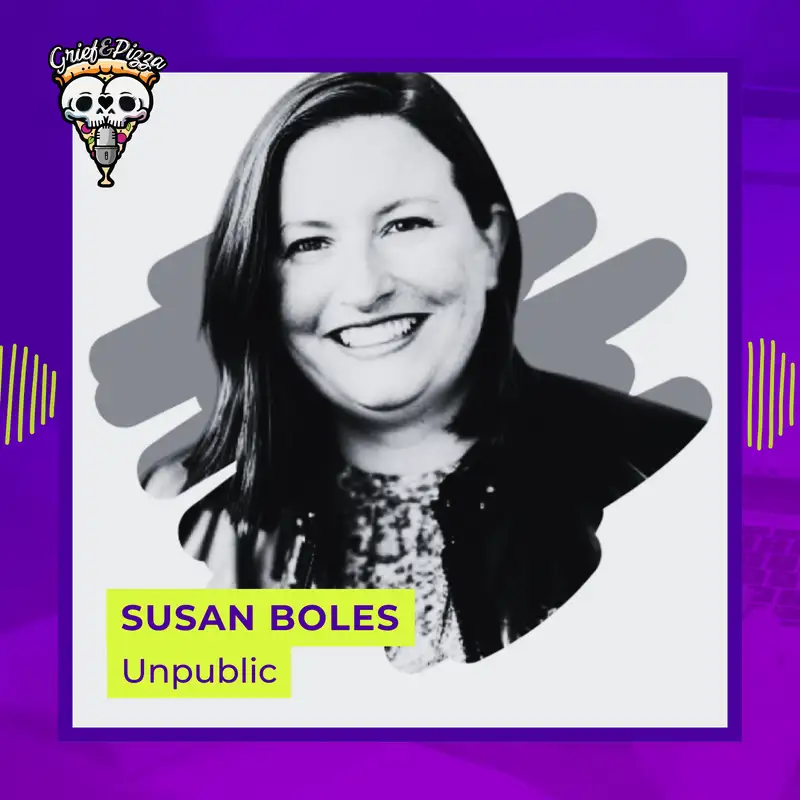
Building Calm Businesses with Susan Boles
You're listening to Grief and Pizza, a podcast exploring the highs and lows at the intersection of business and emotional well-being. In this episode, we chat with Susan Boles, an air force veteran turned CFO, COO, operations strategist, and founder of both Beyond Margins and Unpublic about what it actually looks like to build a calm business. We talk about online creator safety, parasocial relationships, and the very real risks of showing up publicly on the Internet. We also talk about challenges of pivoting businesses and letting go of services. And we also get into Susan's unique six week work cycles and the neurodivergent reality of designing a business with room for both tornado days and potato days.
Marie:Hey. Hello. Hey, Susan. Hello. I'm so stoked to chat with you today.
Marie:It's been a while.
Susan:Me too. It's been a really long time.
Marie:And I think a lots maybe changed on sort of both of our fronts. And I think that's gonna be a a big topic of conversation today.
Susan:So, yeah, super excited to I'm excited.
Ben:How did you
Susan:two meet originally? What works?
Ben:Oh, Tara.
Susan:Yeah. No. Yes. Cool. Yeah.
Susan:A long time Yeah.
Marie:I've been following Tara for a long time and it's I mean, even Tara has gone through so many iterations in her business too, I think.
Susan:Yeah. Yeah. She has. So I
Marie:think, maybe maybe a lot of us have. Maybe there is kind of something quite common about that that we sort of have these iterations and these life stages, and we're like, this is the chapter that felt right at the time, and now there's new information. And we're discovering our skills and, markets are changing, and so we kinda pivot. So, yeah, I'm really excited to, chat with you about your journey, your path. And I was listening to your podcast this morning, and I was like, oh my gosh.
Marie:I'm ready to binge some of these episodes because I already had so many ideas for our business. So, anyway, let's dig in for anyone that doesn't know you. Let's talk about maybe your path to kinda what you're doing today because I know you've got these two businesses beyond margins, unpublic. Let's talk a little bit about maybe, I don't know if you want to start with your background and kind of work your way to today or talk a little bit about what your business is today. And then we can kind of talk about how we got there.
Susan:Yeah. I think we can go either direction. It was a very long and windy path to both businesses, honestly. On public, which is the newer business is actually a return to like the beginning of my career. So I started out in the air force as a security forces officer.
Susan:So all of my degrees are actually in security, criminal justice. That's actually where I started out thinking I was going to be professionally. And then I got married to somebody who was in the same career field in the air force. And we realized that we were never going to see each other if I kept down that path. He really cared about it and I really didn't was mostly what it came down to.
Susan:So when I got out of the air force, I ended up following him around and I needed to have a career that was able to move. And so I had lots of stops on that route that was like, I was a data analyst and I was in higher ed and did institutional research, which is data stuff. And as we were moving around, every time we moved, had to figure out what that was going to be. So I managed a bike store and I worked at an overseas base as an anti terrorism officer. We came back to The States.
Susan:I went back into higher ed. We bought a guest ranch. Oh my And ran a guest ranch. Opened a retail running store and then I opened what became Beyond Margins. So there were a lot of stops that required me to learn technology, accounting, how to run a business in a lot of different formats that ultimately evolved into what Beyond Margins ended up being, which started out as a software consultancy, helping people do technology implementations, and ended up being part fractional COO, part fractional CFO, because I ended up doing CFO work as kind of a technological plus data initiative.
Susan:And then along the way, got my MBA. So it ended up being this very evolutionary thing where every step along the way helped me do what I do at Beyond Margins, which is ultimately help people run calmer businesses. And sometimes that looks like thinking through how they design their work. Sometimes it looks like thinking through technology and how we're going to use that to implement doing calmer work. And so that was a really long evolution of a business that has now existed for eight years and ultimately led to on public, really, because as I was having a conversation with one of my friends who has a very niche YouTube channel about business operations, She was telling me about all of these scary things that have been happening to her as someone who is a woman who shows up on a video platform.
Susan:And you would think that talking about business operations on YouTube, business process, super niche, super boring. She gets a lot of harassment. And so she had been talking to multiple people over like two years about how she thought somebody should write a book about that experience, right? About being kind of a marginalized creator on a video platform and the harassment that creators deal with on a daily basis. And as she was describing it to me, I was like, oh my gosh, that is the thing that I should have been doing for the last decade because I didn't talk about my security background a lot.
Susan:It's not super pertinent to operations and finance. Right? So this is somebody who had known me for a decade, had no idea about that background. And I was like, you just handed me this thing that is like so important in the world, but also something that most people don't really have the weird background of experience. I've been a creator now for almost a decade, and I have a security background, and I can talk both languages.
Susan:I understand the reality that is the lives of creators online. And, so that kind of evolved into Unpublic, which is a company that helps creators stay safe when they show up online. So we do a lot of privacy education, privacy services, and helping people understand how to stay safe.
Marie:That epiphany that you had from your friend, this, I'm super fascinated. There's so many parts of this journey. That's very interesting.
Susan:I'm like, that's the shortest way I could tell that story. Think probably have to get better at that, but
Marie:no incredible background. I'm really curious when your friend was was kind of, you know, sharing what was happening and you had this epiphany. How long between the epiphany and being like, okay, this is actually a business. And how long did it kind of take you to to make that happen given you already had a business and you're thinking about calmness? What was that process like?
Marie:And was it a calm process for you? Like, I'm so curious
Susan:So how this I am not someone who sits on ideas. Like, I am good at a lot of things and I talk a lot about being calm. But to me, calm is kind of an ethos, right? I like to say I am either a potato or a tornado. I am going 150 miles an hour or I'm going zero.
Susan:There's not really an in between for me. And so what actually happened is we had this conversation. We were at a conference. It ended up being kind of late at night. And I called my partner in the morning who is also in security.
Susan:Right? And the way that I pitched it to him was I'm going to say a thing. And once I say the thing, I'm not going to be able to un say this and it's going to blow up everything that we thought was going to be true for the last decade. You're going to fall in love with this idea. We're not going to be able to not do it.
Susan:So that's how I preface to it.
Marie:And I was like,
Susan:so here's the idea. And he was like, Oh my goodness, you're right. That's the thing we should have been doing. We have to do this. And so we spent the drive home from that conference ideating on it.
Susan:And about a week later, I started the process to incorporate it. It was a little slower than our other businesses because there's a lot of technical aspects to this, right? Like us being publicly the face of this, we needed to go through our own process and be our first clients There's a lot of technical considerations for what tools are we gonna select and where are we gonna incorporate and what are the policies in our specific state? So like the actual process, I can start a company for a week. Because you know, this is business number six for us or whatever.
Marie:Oh my gosh.
Susan:So the actual process from idea to like beginning to work on it was almost immediate, but it took probably six months before I was like publicly talking about it being a thing to people I knew.
Marie:Yeah. And how long did it take you to even develop the services around it and like, think about what those formats were and the educate like, obviously there's a lot of moving parts with any business. So, yeah. How did you decide kind of what angle to take with it and what actually is are the services you're currently offering through Unpublic right now?
Susan:Yeah. So it's still relatively new. So a lot of the services are still in development. Our main product is that we do what we call a scout audit, which is basically we go and investigate you like a stalker would. See what's probably available about you, thinking through your specific risk profile as a creator.
Susan:So what kind of topics do you talk about? What's your following? What platforms are you on? A lot of different platforms have different risk profiles. So we do an actual profile and threat assessment of you as a creator and your specific unique characteristics, and also investigate what's available about you publicly.
Susan:Like if somebody wanted to find you, how easy or hard is that and what can you do to counteract that? So here in The US, what tools you have available is very heavily dependent on what state you live in. So each state has different rules about what information is public record, how easy that is to access. So that audit is basically a really personalized assessment of you and what tools you actually have available to be able to fix this. So that's our main service.
Susan:One of the ones we have kind of coming up is state specific privacy guides. Basically a DIY version for folks that is you live in this state, here's all the information about that specific state. Think like, is your voter registration public record? What protections do you have in place? Are there doxing laws?
Susan:Are there swatting laws? What kind of harassment repercussions or resources do you have available? One of the ones we just added is around AI protection. So some states have laws about protecting you from AI deepfakes or having your voice stolen by AI, those kinds of protections. So that's our DIY version that's coming relatively soon on a state by state And then we also do implementation.
Susan:So if you do a audit and we're like, Hey, here's all the things that we found out about you. We can help you fix that so you don't have to go do it because a lot of it is nitty gritty, really boring admin kind of things. And then later on this year, we're launching like a retainer monitoring support service. Woah. So there's lots of lots of different areas.
Susan:And one of the things that's really important to us is accessibility. Right? A lot of this information isn't publicly available, and a lot of the common, let like, me tell you how to do this thing does not apply to creators. Most security people will tell you, just disappear from the Internet, because it's not really possible when your job is Internet.
Marie:Yeah. That's why I'm so curious. I'm sure you probably developed some, like, best practices, things to be aware of just even that, like, common creators are I'm sure I'm, like, making a ton of those mistakes myself. You know? When you've lived on online for so long and this is how you make your living, you know, you sort of take those risks, and you're like, well, this is like the cost of of making money online, and we sort of take those risks.
Marie:But I think a lot of people maybe don't even know what risks they're signing up for when we're putting content out there. Right?
Susan:Yeah. And a lot of you know, most of the information that most creators get about how to protect themselves comes from other creators. Right? Somebody had something bad happen. They did a quit Google.
Susan:They learned that you should use a PO box, and so they did that, and they think that they are safe. But most of that information is business related. Use a registered agent or use a PO box so you're not using your home address without people realizing that, at least in The US, your home address is public record. If somebody can get your legal name and what state you live in, it's really not very difficult to find your home address unless you're taking real steps to protect that. And most of it is in publicly available information.
Susan:That's not common to your business.
Marie:How common are some of these incidents like the incident with your friend? Do you feel like once you sort of discover what was happening there, are other people coming out of the woodwork and you're like, oh yeah,
Susan:this has a crazy story, right? Like every time I've told somebody the idea for unpublic, they're like, let me tell you about the thing that happened to me. And some of them are not necessarily dangerous. So one of my friends had someone find his address and mail him a dirty running shoe, with like a tag that was something about, let me let's do a collaboration. Right?
Susan:So they took the advice of, do direct mail, do personalization, and went, I'm gonna do something really unique. And maybe it would've worked that way, except the feeling was, Wow, somebody knows where I live and they managed to mail me something. And so instead of that being what we think the person had intended, which was, this is eye catching. Right? It grabs your attention.
Susan:That was the point. Instead, it ended up being, wow, that's really creepy. Now I feel very threatened and unsafe because it crossed into the physical world. But even on platforms like LinkedIn, which in general is a slightly less risky platform, if you think about one of the risk characteristics is how the parasocial relationship between the creator and the audience member is. How intimate is that relationship?
Susan:And as creators, we are actually, our job is to build those parasocial relationships. Right? That's what the foundation of the whole build, know, like, and trust thing is actually taking people from a stranger to a true fan. That's what we're trying to do as creators. That's literally the entire job is to build that parasocial relationship.
Susan:But those parasocial relationships exist on a spectrum. On one end, you've got stranger and the job is to move that stranger into an audience member, into an engaged fan. And eventually the goal is to build the thousand true fans is really what we're trying to do, right? But at some point that there is a tipping point, there's a line that potentially gets crossed, and there is a whole negative side of that parasocial spectrum. The people who is the creepy guy in your DM, the guy that's doxxing you, the person that could escalate all the way to a stalker that's showing up in your physical space, right?
Susan:So this all exists on a spectrum and the things that impact that relationship, part of it is the medium, the channel, right? So TikTok creators, the vibe is very close-up. We're talking. It's not very produced. It's a very intimate relationship that the audience member is maybe seeing a TikTok from you like ten, fifteen times a day.
Susan:TikTok creators post a ton. So you're actually hearing from this person more than you're hearing from people in your real life, right? Like more than your friends versus something like LinkedIn where like, a lot of it is text. There's not a lot of like video content on there. It's mostly professional and all of that kind of impacts your risk profile.
Susan:But even somebody like so mostly I have shown up historically on LinkedIn. Even I get weird DMs from people that you're like, okay, creepy, not threatening yet, if they decide to take it that way, it could become that. And so almost everybody has some sort of scenario where something made them a little uncomfortable. Right? Like we all have that gut feeling where you're like, I don't know if that's something that I should worry about, but it makes me uncomfortable.
Susan:And that's kind of the beginning of that negative side of the parasocial spectrum.
Ben:The spectrum concept is really interesting because I find the work that we do, we're doing YouTube videos, has that sort of disconnection from the person. But we meet with our students, anybody who wants to show up, twice a week and so they actually have, we have very deep personal relationships within our community directly with people. So there is that beyond just knowing the person, we're actually talking to them, so we're almost developing these friendships. And I've definitely got one of those stories in my past consulting work where I had signed a contract to do some design work for this person and a couple days later I got a text message and I had never shared my phone number with this guy and he said there's a book in your mailbox that I would like you to read this week. And so I was like yeah, that's, we're not gonna be doing this relationship going forward.
Ben:That is a boundary that was you know, very uncomfortable to have crossed. Where somebody was looked up my information, showed up at my door, and then dictated that I should also read this Take some homework. Yeah. And I was like, yeah, this isn't gonna continue, relationship is not happening. So I'm curious from your perspective, how much of your work is in helping people not only understand their risk, but what type of work do you do in helping them practice having setting boundaries and sort of one thing that we've been doing lately is developing sort of templated responses that take a little bit of the sting out of responding to people.
Ben:What what kind of work are people doing in the DIY side with Unpublic in in terms of developing a sort of response, a standard response to certain types of interactions that can help sort of protect them at certain different levels of boundary stepping?
Susan:Yeah. I think there's definitely so much more there to do. Where we focus right now is trying to essentially make it so that we're never going to be able to get rid of the creepy people. That's the reality of existing in the world that is the internet. When we're talking about parasocial relationships, that's really a one way relationship, right?
Susan:So you have this relationship where you are putting information out into the world. People are receiving it and feeling like they know you, right? Like the goal is to make them feel like you are their friend. But in reality, you don't actually know any of these people. They know you, you don't know them.
Susan:When you decide to engage and build a relationship with them, right? Like we all have audience members who became friends or who became like collaborators. Right? But that was because us as the creator decided to initiate a two way conversation instead of just that one way conversation. So to me, when you build that two way relationship, you exit the parasocial spectrum.
Susan:You're kind of moving into a social relationship or like a real world relationship. The parasocial spectrum is where we're focusing is when they cross that line, can we put a force field over you on the bad end of the spectrum so that even if they are being weird and threatening, there's not a lot for them to find. We want you to be visible because that's the job, but some of that information should be unpublic. That's why we call it unpublic. Are visible where you need to be and you're invisible where it counts.
Susan:You're private where it counts. So we are currently focused on how do we protect you so there's not much to find and there's not much for those people who are trolling you or trying to dox you. There's not much for them to find. But I do think there is an extra element there of how do we help you protect yourself? Like you said, having standardized templated responses, having different platform specific protocols.
Susan:So different platforms have different social constructs, different expectations. Nobody really expects LinkedIn creators to be like super responsive necessarily, but a lot of people do expect TikTok creators or YouTube creators to be engaging in their comments and responding and initiating those conversations. And so part of building up that force field is deciding where you as a creator feel comfortable. And the part that's important to me at least is you understanding what the trade off is, right? Everybody has different levels of risk.
Susan:Everybody has different scenarios. So what a cis white dude is going to be comfortable with might be really different than somebody who shows up on TikTok, is out trans, and talks about social justice issues. There's a huge amount of risk involved in that second characteristic.
Ben:There's
Susan:maybe some risk in the first one, depends on what you talk about and other factors, but it's really personalized how you feel about that risk and what you're comfortable with. And so to me, it's really important that creators understand what the trade offs are, understand the adversary that they're protecting against. It's not all the same kind of person that you're trying to protect against. And so for me, I want them to understand that model so that they can make rules for themselves about what their boundaries are, what they feel comfortable with, what tools might support them.
Marie:I have so so many questions. Like, I'm curious about the government side of it when you have, like, governments sort of owning technology and then how that influences, you know, the rules and and how we engage with these different, hey. If I sign up for the social platform, the government can now tell this information about me or it could be used in nefarious ways. And so is that must always be changing too. Then with AI technology so, I mean, you must always kinda have to be keeping on top of that as well to kind of- Yes.
Marie:Know how to adjust adjust and be aware of just what's what's happening even, like, behind the scenes that is not so widely advertised.
Susan:Yeah. So there's the particularly, at least in this moment, American issue, which is one of the things that has popped up recently, is that the government is subpoenaing companies like Meta for the information behind social media influencers who are saying negative things about ICE, which, you know, is a completely reasonable thing to do when you have somebody kidnapping people off the streets. It's okay to be like, that's a
Marie:bad This is wrong illegal. However,
Susan:the government is currently targeting those people who are saying negative things, and they are using the platform to get that information. That is a reality in a lot of countries that have more authoritarian governments. Now, is it something to be aware of? Absolutely. Is the reality that if you are trying to hide from the US government, that's actually going to be possible?
Susan:Not really. Right? Like, if the full might of the NSA is thrown at you, there's very little you can do to protect yourself. That's not to say that you can't do anything, and it's not something that you should be aware of, but it's just, it's a lot harder to protect yourself from capital T, capital S, the state, than it is to protect yourself from some overly enthusiastic fan who wants to mail you a book. Right?
Susan:But that's what we're talking about is what is the actual adversary that you're trying to protect against? Who is the most likely person to target you based on who you are, based on what you talk about, based on what your platform is. That's really important information to know is whether the state is your most likely person to target you or whether it is a creepy guy who wants you to buy his executive assistant services and is going to mail you a book about the E Myth Revisited. Right? Those are really different things to protect against.
Susan:It's important to understand what your specific profile and adversary kind of model is as a creator because the tactics to protect yourself are different for those scenarios.
Marie:I'm curious if the business model feels a bit almost like writing your wills where it's like, oh, yeah, I'll get to that late. Like, it's not until something bad happens that you're like, oh, whoops. I should have put these things in place. And so I'm curious if the people that come to you are people that have encountered something bad first, or is it like, oh, this happened to a friend of mine. You gotta talk to Susan.
Marie:Like, how do you get people to care about this stuff before something bad happens? Like, is that an issue? I'm just curious kind of where your marketing lands and how people find out about you.
Susan:So I am someone who personally, I don't want to scare people. Right? Like, that sort of Yes. A reality our also I would much rather spend my time and energy educating people that the risk is real. It's a little bit of a pain in the butt to solve, but it's not actually any different than the rest of your business infrastructure.
Susan:Right? Like nobody wakes up in the morning going, Yay, I want to do taxes today. Right? But it is a reality of running the business. So I like to approach it a little bit more as this is just part of the infrastructure of your business that you should have if you are a creator, if you're a public person showing up online.
Susan:And so I really prefer to One of the things we say is be prepared, not scared. Would much rather spend my energy telling people this is a real risk, and it also has a solution that's not scary than try to scare people into thinking something's gonna happen. But the reality is it's the world we all live in. And so for me, most of our folks are people who are aware of the risk and they maybe had something creepy happen. Or, what's happening a lot now is people are realizing, hey, the government is targeting creators like me.
Susan:What can I do? Or something happened to a friend. That's not to say that we don't work with people where something negative has happened, but for a lot of people, when something negative happens, they got some advice from some other friend, and they believe they are protected now, even if most of that information is not super substantiated. Right? Like most of the techniques that get passed around creators doesn't actually substantially protect you, but it makes you feel like you have.
Susan:So we do a little bit in terms of crisis response. We have a service we call the un panic button, which is basically if something bad is happening to you now, we will help you respond, deal, document, deal with law enforcement. We kind of hope we don't have to use We would rather everybody be prepared and not have to do response because it's so much easier to do prevention than to fix things once your data's been exposed or you've been doxxed. Right? Like it's really hard to undox yourself without Yeah.
Susan:Moving and changing your name.
Ben:Having somebody else able to take that first iterative step or that action is really beneficial. We got audited a couple years ago and I totally had a panic attack and was freaking out. And I just had somebody sit down with me and then Marie sat down with me and was like, what's the smallest action we can take here to improve this? And so like even watching her work or watching a professional handle a little bit of that stuff really reduces that anxiety and so you can kind of focus on, okay, I see the value here. The awareness component has kind of made it obvious now that this is something that if I spend a little bit of time every quarter know buttoning up some things, it's going to overall improve my response to it so I can be less flooded when something does happen and I can respond a little more calmly.
Susan:Yeah. And that's, I mean, that's how we think about our services. So like the newsletter is there for, it's, you know, kind of generic. It's not necessarily personalized to you, but it is, here's a little thing that you can do to improve your privacy or security posture now, right? Like we try to make it bite size, but it's also kind of generic.
Susan:Then we've got the DIY version, which is you would like to solve this problem on your own. And then we've got our services. And so we kind of, we're trying to hit all the beats. Right? Because the reality is most creators don't think they're famous enough for this to be a problem yet, and it can happen to you at any time.
Susan:You don't have to be a big name to have somebody be creepy or scary.
Marie:Well, I think you've done a really, really beautiful job given that it is something that could be quite panic inducing. I feel like you really live out that calm business in the un panicked button. The language, way you've written it is well done to not sort of lean on that urgency that I think a lot of creators make you feel like, you know, there's gotta be that, like, call
Susan:to action.
Marie:Yeah. Like, like, it's so interesting
Susan:my that detriment.
Marie:No. I think there's it's kind of a refreshing alternative to a lot of really heavy in your face marketing. And it really lives out that idea that the calm business, like that being sort of like a pillar concept for you about, like, calm and equity. So did you wanna jump in, Ben, on
Ben:Oh, I was gonna say I I loved the you're not paranoid. You're just paying attention quote on one of your websites. I sometimes jokingly use this word, at a catastrophizing. So you're
Marie:it's I'll tell them stop catastrophizing. Know?
Ben:Like, This is the correct amount of of for for the given situation. Yeah. Like there's so many things that people are just completely unaware of and you know, so if you do a little bit of what if this actually happened, this is the worst possible thing that could happen and how would we actually respond if that happens. Do you do any sort of role play in that in your communities with like helping people? How would you respond to this?
Ben:Here's a scenario or you know, kind of I haven't
Susan:yet, but that's a fantastic idea.
Marie:Yeah. I like that.
Susan:I do think there's Part of it, I think, is a little bit of a lack of awareness. Right? So me as a prior law enforcement person, I know what the escalation signs are, Right? When somebody is a little bit creepy, but they haven't really escalated, like to me, I know where to gauge that. But I think that's not something that most creators have.
Susan:Right? You don't know when to start getting really concerned. Right? You don't know what that behavior, that escalation behavior looks like. So you don't know when to go, oh crap, maybe I should call the police.
Susan:This is bad. This is a stalker. They might show up. And so we're trying to create tools around that to be able to help people kind of create that internal benchmark, but still under development. Not quite there yet.
Susan:But I love the scenario idea.
Ben:Yeah. I think in terms of, you know, I don't have a law enforcement background, but I've been a firefighter for eight years and kind of
Susan:just with some some of the same stuff.
Ben:Similar stuff where, you know, I can look at a a fire and be totally chill about it. Yeah.
Susan:Yeah. It's like, no. No big deal. Because you know what the signs to look for. Yeah.
Susan:You have developed your internal mechanism, your your data.
Ben:Somebody that has never seen that before and doesn't know how you would actually, you know, mitigate the situation would probably be running around freaking out. I'm like, yep. We'll pull a line over here. We'll get some water on there. No problem.
Ben:Like, we'll take
Susan:care looks not that scary and is in actuality really serious.
Ben:That's right.
Susan:And so, yeah, I think there's a lot of overlap there.
Marie:Even with the prevention versus correcting, right, it's like so much, you know, more beneficial to focus on prevention. And once the damage has been done, it's so expensive to
Ben:read world. The very first chapter of the fire service book that you read when you when you do your first, you know, your 1,001 is all about the history of the fire service and how basically nothing has ever been done proactively in the fire service. There's always a large scale event or death, and then we create new rules for, okay, we need exit doors, we need this, we need that, we need this kind of protection, we need sprinklers, it has to be done this certain way, but nobody is really looking at the
Marie:What could happen and let's
Ben:It's it's very rare to actually do that. So there is an amount of we have to we have to experience loss in order to understand what's at stake for us sometimes in our businesses. Like that's, I've basically done absolutely nothing proactively in my business. I'll admit that it's always something like, oh man, that tax bill was not fun. Okay, I guess we should do something different next year.
Ben:Whoops, we got audited. What do we do differently next year? So that kind of awareness thing is really, really helpful. And that's why I thought the role play thing would be really interesting, because then it's like you're not actually experiencing it, but you're presenting a situation, and it's like, give me an incident action plan for this in your business if this were to happen. Would you be able to roll with the punches or is this going to collapse your business for the next three months?
Ben:You know, that kind of thing.
Susan:No. I love that. You're giving me tons of ideas of new things I have to go build.
Marie:Yeah. New Like a forum where you're like, you know, putting in your risk assessment, which of these four, you know, scenarios describes how you would react if
Susan:So I am very close to that. That's that's actually what I've been building this week is a creator risk assessment. So you put in who you are as a creator, basically your characteristics, and kicks out a who your adversary is and what is your generalized risk profile. So I'm working on that one. And then I've got a the second the tool that's like I'm trying to build next is scenarios around helping you decide if this thing is scary.
Susan:Right? So here's the scenario that's happening to me as a creator. Should I be concerned? What should I be looking for? What are the escalation signs?
Susan:Both of those are in development, hopefully. Very cool.
Marie:Hopefully soon. There's a couple sort of pins I'd like to to, like, maybe feature or highlight, and that's one is you've talked about chronic illness and neurodivergence, and then this idea of shifting what you're known for. And so I'm I'm curious. You sort of had these two businesses running. Is the hope or intention that you could kind of shift from being known as the beyond margins to now I'm known for this?
Marie:Are you happy to kind of blend these two different businesses? And maybe how does your own experience with chronic illness and neurodivergence maybe influence the way that you approach thinking about having multiple businesses or thinking about your positioning?
Susan:Yeah. When I originally decided to open on public, I had a very different plan. My plan was I'm gonna keep both things running. Right? Like a lot of beyond margin stuff, it's all client services, but a lot of those services are pretty heavily productized because that's literally what I do, right?
Susan:Like that is my area of expertise. So a lot of those services are relatively easy for me to deliver at this point. I have a lot of resources. There's a lot of IP. It's eight years old, right?
Susan:It's been through all the iterations. And I really loved my IP on that side of the house. My tagline is Calm is the new KPI. That's the name of my podcast. It's so well developed and I love it so much.
Susan:But fundamentally, I don't love the business necessarily because in operations, it is one of those things where the better you are at running somebody's operations, the more invisible it is and the less they value it. And there's also the issue of people have to feel the pain to realize it's valuable. So I don't work with anybody that hasn't had a business for five years because in order to value my services, they really need to have messed it up several times. And I'm sure you guys have that same issue on the Notion Mastery side of the house, right? They have to have tried eight different things to realize that they need to figure out their own process.
Susan:So same kind of relation, but I never figured out a scalable way to deliver services on that side. So I've made it as easy to deliver as I can, but I still fundamentally have to show up so I can control some of my schedule. But like if I have a client session scheduled and I feel like crap that day, I have to still decide, am I showing up or am I trying to reschedule? And if I show up, can I show up enough to be able to deliver the value of this service? And as Unpublic has evolved, I've realized that I just fundamentally like that business more and it feels more important to me.
Susan:Right? Like there are so many other business operations people out there that are really, really good, and there aren't people out there who could do Unpublic. And so it feels like more important work and something that I'm just kind of creatively a little bit more interested in right now.
Marie:Yeah.
Susan:And so I am leaning towards, I think, OnPublic will become the thing that I'm trying to be known for. And at some point I will probably either turn Beyond Margins into like a personal brand and like let the IP just live there because it's Sell the IP? It's so good. Or sell the IP or like the fundamental core there is so good. But I kind of always knew I wanted to run a scalable business.
Susan:I knew I wanted to have something where I could create actual, real, great jobs for people. And Beyond Margins just is never going to be that. It's always going to be dependent on me, my expertise, and trying to train someone on that side of the house is just there's just no way for me to do that because it comes from too many diverse experiences that most people just are never gonna have. Where on public is there's more there there is kind of how I describe it, right? Like there are very specific products and services and it's also all stuff that doesn't have to be me.
Susan:There's a whole career field of people who I could hire directly into that who might actually be even better at it than I am in terms of doing the individual work. My unique value there is being able to translate security and privacy and the creator ecosystem. The unique value is not necessarily in the deliverables. It's in the positioning. It's in the product design, in the service design, in the identifying here's what matters.
Susan:Where on Beyond Margins, I am the service and there's no way to make that not true. It's been a long process of me being able to let go of this thing that has been my baby and my focus for almost a decade And like being open to something new and thinking about where do I bring value in this new thing.
Marie:You must have so many other clients, I think, that come to you even based on the podcast interviews and some of them that I saw that are kinda in that same boat too where they're like, hey. I've been known for this thing. I wanna be known from this thing. And that transition is often not an overnight thing. So fun.
Marie:Before Notion Mastery, I was known for, like, digital strategy school, and that was, like, my coaching program. And then suddenly having to, like, turn the taps off of a thing and then launch a new thing, but it takes time to build up that momentum. And so I'm curious what are some of the things maybe you've seen, or are there like strategies when someone is going through this process of like, I kind of want to say goodbye to this thing, but this is my bread and butter. Are there strategies for how long of a runway do we give ourselves? You know, are we using the money from this to kind of fund the other thing?
Marie:And how do we find calmness in what could be seen as like a pretty intense process potentially?
Susan:Yeah. I think some of it depends on where you're coming to the pivot from. Right? So if you have a business that has, you know, a decent runway, you've got pretty solid reserves, maybe things are standardized, maybe you have a team. I think it's a little bit easier to pivot when all of those things are true and you can use the old thing to sort of fund the new thing versus I think some people have the flexibility to just cut it off.
Susan:Right? Like you've got enough runway. You could just be like, I'm done with that old thing. I'm not selling any services on that side. I'm only doing the new thing, and I've got six months of runway to pull it off.
Susan:Right? Like that is a legitimate position that some people have. For me, the way that I have approached it is trying to think about what could I pull from Beyond Margins that becomes part of Unpublic.
Marie:Yeah.
Susan:And for me, part of it is that ethos around engineering calm into your business and that the privacy and security infrastructure is just one more piece of that engineering calm into your business. Right? If that is business infrastructure, it's not something that you have to turn on and off. It's just sort of part of your standard operating procedure, same way that bookkeeping is. It feels like maybe less of a transition for people who already know me for a thing.
Susan:It doesn't seem like it's completely coming out of left field. It's just kind of an extension of what I've been talking about and I'm just applying it in a new area. That's relatively new. I haven't necessarily been able to fully test that, but that is my approach is knowing now that beyond margins probably isn't gonna live forever. How do I take the pieces that I want from that and apply it to the new thing?
Marie:Yeah.
Susan:In the same way that a lot of the topics that I talk about in Beyond Margins is talking about running more equitable business. Right? I talk about empathetic leadership or more autonomous stuff. And for me, Unpublic is my lab. I am taking Because normally when I work with clients, the thing that I bump up against is whatever the founder's preconceived notions are.
Susan:If they're a micromanager, there's only so much I can do that they're gonna let me do. But in Unpublic, I can take all of my wildest dreams of what I think an ideal company is and live that out in the real world unencumbered by other founders because it's just me. I get to decide all of it. And so that's been actually really cool to see what can I create when I have complete autonomy to make all of those choices? So I'm pulling a little bit here, a little bit there.
Susan:My expectation is kind of the same as when I started my podcast, which was I'm going to do this thing for six months before I even think about evaluating it. I'm just going to focus on doing the thing every day and seeing
Marie:Yeah. What
Susan:And then in a year, I'll decide if it was like, if there's an ROI, if I wanna keep doing it. But I think one of the things as business owners is we expect that once we shift something, everybody else is suddenly gonna know about it. And the reality is it takes so long. Right? Even though I have shifted pretty much all of my public persona to be talking about on public, it's probably gonna be three years, I guess, I would guess, before I stop getting referrals to business or to beyond margins.
Susan:Right? Like, it just takes a lot longer than you expect because
Marie:you're not talking
Susan:to these people every day, and nobody is paying as much attention to your content or what you're talking about as you are.
Marie:I think it's a a fantastic reminder because I think even as Ben and I think about, like, what might happen after Notion. Like, where are we pivoting our messaging and how long that might take when someone has gotten to know you or maybe, like, a bunch of traffic that came out of nowhere from the Notion universe. And then I'm like, well, wait a second. Like, that was this chapter, but what if I want this to happen next? Do you transition the people that have already found you?
Marie:Do you taking two, three years seems like a long time, but it's actually not that unrealistic when you think about how long it takes to develop IP and how long it takes for people to be consuming your content and be getting value out of it and following along on your journey. So Yeah. It's a good reminder.
Susan:I think if you've done it more, the more you do it, the faster you can do it. So beyond margins, trying to develop that IP was a ten year process. But because I now am thinking about everything in tools and frameworks and proprietary stuff, the unpublic side of the IP is coming together exponentially faster, because I've already been through the process once. So I think repetition, how many reps you've been through really makes a difference in how fast you can make the turn. That's not necessarily, I don't think gonna impact who sees you and what they know you for, but I think it gives you like foundational stuff to be able to point to so much faster.
Ben:It's also why I think the community driven development is so such a strong thing because if there's something say that we want to extract out of notion mastery, something that we've identified as something that people really get hung up on, we're able to make stuff from the community and the need there is kind of just kind of spoken to you and you don't actually have to do at a certain sense
Susan:You don't have to research because people are just telling you.
Marie:Yeah. Exactly.
Ben:Yeah. So like one of the examples that we've had that we talk about a lot is early on in the Notion journey, we had so many people and all of our course intakes and feedback was I don't have time to learn Notion. That's the hardest thing right now. And so we developed a capacity planning workshop in order to help people discover where all their time was going and that kind of smoothed over that onboarding thing where it's like, yeah, you start with the capacity planning. You don't start with learning Notion.
Ben:So it's one of those kind of, a little bit of a Trojan horse where people come for the notion and it's like, here's permaculture and systems thinking. These kind of things that we're trying to extract out and almost create an umbrella over the notion. The notion's kind of just a delivery mechanism for the systems thinking work that we're trying to accomplish. Right?
Susan:Yeah. I think that's one of the strengths of Notion Mastery is that like, yes, it is like it is a Notion course, but I am not a Notion user. No matter how many times I try to do Notion, I'm never gonna do Notion. I'm gonna start it and go, this is hard and I hate it. But going through the course gave me ideas about how to structure systems.
Susan:And then I just replicated in whatever tool I happened to be using
Ben:at the
Susan:time because it is so universal and not necessarily like tool specific. Yeah. Yes. I mean,
Marie:that's exactly what we're thinking about is, like, what are those enduring principles regardless of the technology? What is always there? What is always a challenge to people? It's gonna keep showing up in different contexts. Right?
Marie:And so much of it is the the inner work or how we think about our energy and time and all of this stuff. It's it's always there. It's always stuff I'm I'm more interested in in getting into is even like especially as a neurodivergent person that struggles with time or struggles with, you know, how much we put on our plate and wait, I don't have the energy for that. And I wasn't planning on being a potato this week, but now I'm a potato. How do we-
Susan:I'm an involuntary potato. What are we doing now?
Marie:I'm curious how you think about your time and like how structured you are even with sort of how you plan for things given that you've got, whether it's chronic illness or however things show up for you, how do you plan?
Susan:Yeah, for me, I have gone through many, many iterations of this over the years. And for me, it's mostly making sure I have so much buffer built in. Right now I am recovering from COVID that I got from my husband going to the ER. Are very, very COVID cautious, and this was involuntary and frustrating, but it means that the last two weeks I've been almost unable to work. And that the reality is like last week, I think I managed to work three hours a day, three days out of the week.
Susan:And so, but it didn't break anything because I have natural break points built in. Most of the time I'm operating at maybe 50% is like my, my version of a 100% is like everybody else's 50%. And there's lots and lots of white space built in to be able to absorb when something unexpected happens. And, you know, within that I have, I actually do a six week work cycle where one of those weeks is a rest week. One week is a buffer week because I'm somebody who will start a ton of new things right before I'm supposed to take a break.
Susan:Then I don't want to take the break because I got all these new projects happening. So like my cycle goes, I have a deep work week where I'm like not doing any calls, but it's there for me to build because right now I'm in a heavy build stage of life. I do a client week where I'm doing like all of my client projects. I do another deep work week, another client week, a buffer week, which is close out things. Don't start anything new
Marie:type all the way
Susan:and then a rest week. And so I go through that six week cycle that I always have the rest week built in, luckily this time it happened that that's the week I got sick. So I already didn't have anything scheduled for that week. And then coming back in, I had a deep work week where I didn't have any calls. I didn't have anything that I needed to reschedule.
Susan:So having kind of half of my time is essentially white space that I get to choose what I have the energy for or what I can do that week. And sometimes that week ends up happening to hit with like a, this is a tornado week and I can build six weeks of a neurotypical person's work. I can do that in But a it also means that I'm going to have an energy hangover. I'm getting nothing done that next week. And so for me it was realizing I don't do consistency.
Susan:Right? I'm on or I'm off. There's no middle ground for me.
Marie:Potato or tornado.
Susan:And realizing that I need to build to that. I need to build a hard charging week and then a rest week and a hard and being able to really pay attention to like how my energy tends to work. And then just as much buffer as I can come up with is most of my strategy.
Marie:What does a rest week actually look like for you in practice when you're not sick with COVID?
Susan:It depends. So I try my best to follow whatever the rules are. There are no rules. Like if I'm having a flare or I'm really not having a lot of energy, sometimes that rest week is me sitting on the couch doing absolutely nothing, trying to find a new TV show to watch because the goal is I need physical rest and this actually needs to be a recovery week. If I'm having a, like a good energy week, a lot of the times it ends up being hobbies, reading, other fun projects.
Susan:I am, I do a lot of gardening and baking. And so like a lot of the times it's just me doing that. The goal is really like follow my energy, follow what I feel like, and just whatever feels good at the time is what I'm doing. And sometimes if I end up coming up with a really good idea for a work thing, I'll make a note of it. But I've tried really hard to like
Marie:Not pursue it in
Susan:that moment. Which is why I have the week after I come back is a deep work week because I find that rest week is so I generate so many creative ideas because it's all white space. I'm a marinator. So I come up with stuff when my brain is occupied doing other things. Yeah.
Susan:That's when I come up with my best ideas. So I almost always come back from that rest week with 18 new creative things that I have to build and ideas. Having that deep work week after that means I can go do some of that when the creativity is kind of hitting.
Marie:Was there something that influenced this six week cycle? I know sometimes I've heard about people taking these sabbatical cycles or the twelve week year and that sort of thing. How did you arrive at that being the right pace? You must have experimented with that a little bit before you kind of landed on Yeah.
Susan:It was very, very iterative. So originally it started as actually Tara McMullen is the one who she was like, oh, every month that has five weeks, she blocks off the fifth week as a break week. So originally it started as just rest weeks. And for the first at least six months, I continually messed those up. So I blocked off the rest weeks, but then I overrode that and scheduled calls or projects.
Susan:Made exceptions. Yeah. It's just just a here, just a there. So it took me probably six months before a rest week actually was a rest week, but that's where it started. And then I realized that client work tends to be kind of exhausting for me.
Susan:And so I started doing client weeks or a call week and a not call week. And then there was an evolution where it was specific. I didn't really do weeks. I did rest weeks and then days of the week. So Monday was content and Tuesday was projects and Wednesday and Thursday were clients.
Susan:And so like, it's been a little bit of an evolution and it definitely changes depending on like what's happening in my world. So the last eighteen months, I have had a retainer COO client that dictated that I had a meeting every single week. So I wasn't able to really control my schedule, but that ended at the end of last year. So now I've gone back into, I'm doing the six week cycle. But this iteration is new for me this year, doing this full six weeks.
Susan:So I'm one and a half cycles in right now. So I'm sure it'll continue to evolve and change as I figure out, you know, what's working, what's not. Yeah. What is the stage of the business? What's the focus?
Ben:I'm curious from a Just from a perspective of Marie and I were talking about this this morning, how often our we have different chronotypes. I'm
Susan:more
Ben:of a I wake up at 07:30 no matter what. So whatever time I go to bed is I will wake up at 07:30. Marie is a late a big time night owl, And so our sequence of like bedtime and rising is often out of step and I often feel really tired because we tend to go to bed later than I would like. Mhmm. I'm curious how how does that rest period and your cycles work with your partner and other people in your life?
Ben:How do you plan around that and how does that interaction work?
Susan:So originally, my partner and I were very similar to you guys. I'm the morning person and he naturally is a little bit more of a night owl, but twenty years in the military kind of broke him. And so now we are both morning people and Yeah. He actually works extremely early now. So he starts work at 4AM our time, but he also gets off at 01:30 in the afternoon, which is freaking fantastic.
Susan:So we have a 13 year old. And so that means we're both available after school. During the summer, We both take off at 01:30 and we go There's a lake near us. We go up to the lake and go paddle boarding. We have kind of evolved I evolved my work schedule to more closely match him.
Susan:He still goes to bed about two hours before I do. He goes to bed super early and I stay up with the kid who now goes to bed way later than either one of us. Trying to get that kid in bed before midnight when he's out of school is a real But we have kind of evolved that all sort of works, right? Like when Coop is home in the summer, he sleeps till eleven. And so we only have like an hour and a half where we're both working before we can go do something.
Susan:So for us, it has evolved into, I've shifted my schedule a little bit, my partner has shifted his a little bit And we focus on the stuff that happens when we're both available. So like trying to go do summer fun things in the afternoon because we're all available, but we don't necessarily like try to do a whole lot around meals or, like it's a little bit we have a very low demand household that has been a real evolution of like, when we started parenting, it was, you have to sit down for dinner. We're all sitting down for dinner. This is very important. People have told us this is important and it used to drive us nuts.
Susan:Like all three of us are various flavors of neurodivergence, which Don't we know didn't what to do. We did not know. My partner and I did not realize we were neurodivergent until we were both almost 40. That was a huge eye opening. And then realizing that the kid is too, and that maybe all of these constructs of things that we have been told we're supposed to be doing just don't work for us.
Susan:And so we don't eat meals together. We all cook meals, but the kid eats up in his room while he's talking to his friends and gaming and Josh and I eat together downstairs while we're watching TV because it's just easier for everybody, right? Everybody's nervous system is just happier that way. So we've tried to focus on where do we have control and where are there points of connection and then kind of letting everybody else free for all as makes sense to them.
Marie:Your whole approach feels very similar to what Ben and I described as an elastic business. Right? It's like, oh, this worked for a time and then now it doesn't. And you're able to kinda shift and go in and out. And I love how much you're listening to your own needs, your family's needs, both on the business side and the household side to, like, really make sure your business and your life are working with your nervous system.
Marie:I think it's something a lot of people crave. It's easier said than done. It takes a lot of experimentation and compassion noticing.
Susan:Right. Like when I first realized that I was autistic, I did not realize that the air conditioner in my office was making me insanely angry. Did not know, had no idea how to accommodate myself. And Josh bought me noise canceling headphones and I just started wearing them and realized like, oh my gosh, I am so much better if I just wear my headphones. That's very small thing, but it took so much experimentation to realize what is impacting me?
Susan:How do I counteract that? Likewise, we do a lot of stuff to accommodate chronic illnesses. We all also have at least one of those. So there are days where hanging on to bare minimum is about all we can manage. And so our approach has just been figure out where the bare minimum is, and it needs to be way lower than you think it should be.
Marie:I love that.
Susan:So it's been an iterative process of like, here's the burrow. Okay, now lower it again. Lower it again. Still not working. Keep going.
Marie:Good reminder, Ben, as we were talking about, you know, burnout this morning and how so easy it is to self flagellate when you had big intentions for what you were gonna get done that day. And you forget that, like, you didn't sleep great last night. You're you know, had a fire call in the middle of it. Like, we forget. It's just not realistic, and we just keep.
Marie:Yeah,
Susan:Well, I think fucking it's so easy for us to put like business in one silo and life in another silo without realizing how much life can just explode all over business unintentionally. But stuff happens. Stuff is always going to happen. Chaos is always going to happen. And being able to really realize that your life really impacts your business capacity and performance and what you can get done.
Susan:And I think we so often completely forget that and they just exist in two buckets that aren't ever supposed to cross. And then we feel bad when they do. Like, it's life.
Marie:We're just trying to be human.
Susan:Not I'm be human.
Marie:I'm not just the business owner. I'm just a human being trying to live my life and do my best. Yeah.
Susan:Yeah. And I think we really forget that. And I mean, I I do. As much as I've spent the last five, six years trying to unpack all of that stuff and teaching people how to unpack all of that stuff, I am still so guilty of that, of like, oh, I got sick and I haven't done anything for two weeks and let me beat myself up because I didn't get anything done for two weeks. Yeah.
Susan:Cool. But like, you couldn't sit up, so maybe cut yourself
Marie:a Maybe. Little bit of
Susan:that's not realistic.
Marie:I think that's one of the things I love about our community too is like, are quite honest with folks and we share these kinds of things that it's like, we are engaged in a practice together. We are not a guru being like, this is how it's done, and I have figured this all out in the past. So we're quite honest with folks about like, yeah, this week I didn't follow through, I felt burnout, or I'm still struggling with this. So people are like, oh, okay. Even people that seem like they're at the top of their game are also still struggling with these very human things that we're all dealing with.
Marie:So I think it's just I think
Susan:the important to part I love the most about sharing because like you, I share a lot with my community. I've talked about my neurodivergence and our chronic illness and all of that and how that impacts how I approach business. One of the things I love the most about being transparent is that you end up attracting people who genuinely understand that, and you sort of tend to push away the people who are very hustle culture centric. And the crypto bros, I don't get a lot of those because they take one look at my stuff and they're like,
Marie:absolutely And
Susan:so you end up creating this self fulfilling community of really amazing empathetic people that then totally understand when you're like, I can't do it this week. Sorry.
Marie:Yeah. Yeah. I love it. I think that's a great place to end. I know we've reached the top of the hour, but I have so loved this conversation.
Marie:I feel like I'm absolutely gonna be doing a deep dive. Like, I I had so many ideas just after the one podcast interview I think you did with Tanya Mushi. I'm like, Ben, we gotta talk about this after. So if for anyone, you know, that that's following along and wants to kinda dig more into your work, I know you've got unpublic.co. It's probably the place that you want to be sending people to, but your Beyond Margins podcast, there's such a fantastic wealth of information there.
Susan:Is solid. Is an episode with Marie about Notion from a ways back if you want to, check that one out. That was actually, It was the top downloaded episode for many years, actually. What? I mean, it's surprising.
Susan:It is a solidly good episode, I think, personally. But yeah, so Calm is the New KPI is the name of the podcast. If you wanna go listen, we talk about engineering calmer businesses, and a lot of that is relatively geeky, like service design. It's not like it is less emotional and more tactical, practical business design y kinds of topics. And yeah, on public.co is either place.
Susan:If you like calm business, go to beyondmargins.com. If you wanna talk about privacy and security and creator world on public.co.
Marie:Fantastic. Thank you so much, Susan. This was
Ben:an awesome night with us.
Susan:Thank you. This was so much fun. I really appreciate it.
Creators and Guests